book reviews
Book reviews by and for those seeking to understand the human mind for all its strengths, quirks and shortcomings.
Why You Sometimes Cry for No Reason—The Brain-Heart Connection Explained
There are moments when it just hits you. A random wave of sadness. Tears welling up with no warning. No big event. No tragedy. Just emotion, raw and overwhelming, rising out of nowhere. And you wonder, Why am I crying? What’s wrong with me? But what if nothing’s wrong at all? What if your tears are not a mental glitch but a message—from your heart to your brain?
By Noman Khan 9 months ago in Psyche
"The Gentle Path to Healing"
It sounds like you've shared a really thoughtful piece about healing and self-care. Here are a few ways to reword it, focusing on slightly different angles: Option 1 (Focus on the Turning Point): > Her presence was a turning point. She didn't judge or try to solve my problems; she simply offered support when I needed it most. Shortly after, I started therapy, which felt daunting at first. Expressing my inner turmoil was a challenge, but with consistent effort, I began to understand myself better. Healing wasn't a quick fix, but reaching out for help was the crucial first step in rediscovering my true self. > > Learning to set boundaries became an act of self-love. I used to say "yes" to everything, fearing I'd disappoint others or appear difficult. I mistakenly believed I was being helpful, but in reality, I was neglecting my own needs. Each time I agreed to something that didn't align with my well-being, I was denying myself the chance to nurture my own happiness. Saying "no" wasn't about becoming cold; it was about valuing my own capacity and limits. Surprisingly, establishing these boundaries didn't disrupt things – instead, it felt like an act of self-care. > > The path to healing isn't a straight line. Some days bring lightness and hope, while others feel heavy with old stresses. I used to think feeling down meant I was failing, that healing was a final destination. But the truth is, healing is a winding, uneven journey with forward steps, backward steps, and sideways moments. The important thing is to keep returning to yourself, to keep making choices that support your healing, even when it feels impossible. Now, when darkness returns, I can meet it with calm and acceptance, knowing it's part of the process. > > In conclusion, remember that whatever you're facing, you are not broken – you are human. It's perfectly okay to step back, rest, or seek support. It takes courage to acknowledge your limits and ask for help. Sometimes, our lowest points can lead to profound personal growth, as they did for me. When I felt like I had hit rock bottom, I was actually beginning a slower, more authentic life, one I can finally be proud of. As you navigate your own journey, remember that the light will return. It comes in moments, big and small, reminding you that you are here, and that you matter. > Option 2 (Focus on Self-Compassion): > The simple presence of a supportive person, who offered understanding without judgment, encouraged me to seek therapy soon after. Initially, therapy felt intimidating, as I struggled to articulate my inner world. However, with time and persistence, I began to gain clarity about my experiences. Healing wasn't instantaneous; it was the act of asking for help that initiated my journey back to my authentic self. > > Learning to establish boundaries became an essential act of self-compassion. My tendency to always say "yes" stemmed from a fear of disappointing others or appearing selfish. I mistakenly believed I was doing the right thing by agreeing to everything, even when it conflicted with my own needs. In reality, I was betraying myself. Each time I overextended myself, I was denying myself the opportunity to nurture my own well-being and happiness. Saying "no" wasn't about becoming unkind; it was about recognizing and honoring my own limits. I was surprised to find that setting boundaries didn't create chaos; instead, it felt like a profound act of self-love. > > The journey of healing is rarely linear. There will be days filled with lightness and hope, and others when old feelings resurface. I used to interpret these low points as setbacks, believing that healing meant reaching a permanent state of well-being. However, healing is a fluid process, characterized by progress that isn't always consistent. There will be forward steps, backward steps, and detours. The crucial element is to continually return to yourself, to keep making choices that support your healing, even when it feels incredibly challenging. Now, when difficult feelings arise, I can approach them with a sense of calm, allowing myself to feel them and remembering that they are a natural part of the journey. > > Ultimately, please remember that whatever you are experiencing, you are not flawed; you are human. It is perfectly acceptable to need to withdraw, take a break, or seek support. It requires courage to acknowledge your limits and ask for help. Often, our most challenging moments can pave the way for significant personal transformation, as they did for me. When I felt like I had lost everything, I was actually beginning to embrace a more intentional and genuine way of living, a life I now value deeply. As you navigate your own path, hold onto the understanding that the light will return. It finds you in moments, both big and small, reminding you of your presence. You are here, and that is significant. > Option 3 (More Concise): > Her non-judgmental support led me to therapy, which was initially scary as I didn't know how to express myself. Over time, I began to understand my inner world. Healing wasn't immediate; asking for help was the start of my journey back to myself. > > Setting boundaries became an act of self-love. My "yes-saying" came from a fear of disappointing others, but it was a betrayal of my own needs. Saying "no" wasn't cold; it was valuing my limits and surprisingly kept things running smoothly. > > Healing isn't linear, with good days and bad days. I used to think feeling low was a failure, but healing is an uneven process. The key is to keep returning to yourself and making choices that aid healing, even when it's hard. Now, I meet darkness with calm, knowing it's part of the journey. > > Remember, you're not broken, just human. Needing breaks or support is normal and takes courage. Breakdowns can lead to growth, as mine did. When I felt I'd lost everything, I began a slower, more real life I'm proud of. Know that the light returns in moments, big and small, reminding you that you are here and that you matter. > Let me know if you'd like me to try rephrasing it in a different way or focusing on a specific aspect!
By Nasir Khan9 months ago in Psyche
Brainwashed by Algorithms
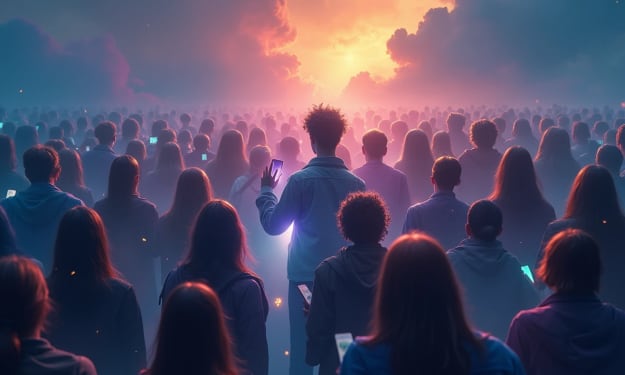
Imagine opening your phone just to check one quick message—and suddenly, you're 47 minutes deep into scrolling TikTok, comparing vacuum reviews on YouTube, and debating whether that $300 infrared sauna blanket on Instagram is the secret to your new self. You didn’t plan that. But the apps did.
By Noman Khan 9 months ago in Psyche
A Journey into the Human Mind
Wow, the world’s basically a circus these days—memes flying, phones buzzing nonstop. Somehow, Max carved out a tiny oasis inside his own noggin. This dude, he’s not exactly a rock star. Just a low-key psych student, glued to his mountain of books, trying to figure out what makes people tick. Honestly, he spent more time staring into the abyss of the human mind than going to parties. But he always felt like he was peeping through a window at his own brain, wondering what weirdness was lurking beneath. So, he whips out a journal—nothing fancy, just some battered notebook—and starts scribbling.
By Cotheeka Srijon9 months ago in Psyche
Me and My Anxiety
I don’t remember the first time anxiety showed up. It wasn’t like some dramatic movie scene where the world tilts, and suddenly, everything changes. It was more like a whisper. A knot in my stomach before school. A restless night before a simple conversation. A racing heart for reasons I couldn’t name.
By THE STORY ROOM9 months ago in Psyche
Why Do People Like Music?
The Enduring Allure of Music: A Universal Language Music, an art form as ancient as humanity itself, transcends borders, languages, and eras to unite people in a shared experience of joy, sorrow, and connection. From the gentle lullabies soothing infants to the vibrant anthems echoing through stadiums, music weaves itself into the fabric of human existence. Its profound impact stems from a remarkable interplay of science, psychology, culture, and emotion, making it one of the most cherished forms of expression. But what is it about music that captivates us so deeply? The answer lies in its multifaceted ability to engage the mind, stir the heart, and foster unity.
By MAROOF KHAN9 months ago in Psyche
The Hidden Psychology of Connection
In a world more digitally connected than ever, loneliness is paradoxically thriving. As we scroll through social media feeds and interact with AI companions, we find ourselves surrounded by virtual connections that, in reality, leave us feeling more isolated than before. Eric Solomon, Ph.D., explores this paradox and reveals how the very tools meant to keep us connected might be deepening our sense of isolation.
By SophiaSoso9 months ago in Psyche
Shadows of Obsession
The Beginning of Darkness Eva was always unique, a girl whose thoughts teetered on the brink of reality and madness. Born beneath a tempestuous sky, she entered the world silently, her initial cries overshadowed by the roar of thunder. Her parents, weighed down by their own challenges, were unable to offer the affection she yearned for. Tragically, when she was merely an infant, a devastating car accident took their lives, leaving her without family. The state subsequently placed her in a succession of foster homes, each more fleeting than the previous one. Although she yearned for love and security, Eva found comfort solely in her rich imagination—crafting realms filled with characters who cherished her. However, as she matured, her dreams took a darker turn, descending into obsession and paranoia.
By Imon Mridha9 months ago in Psyche
The Metamorphosis of the Mind: A Journey of Transformation and Growth
The Transformation of the Mind The concept of metamorphosis, often associated with physical transformation, extends far beyond the tangible changes in form. It is a journey that reflects the complexities of human experience, perception, and comprehension and encapsulates the profound evolution of the mind. Our identities, beliefs, and interactions with the world around us are all shaped by this metamorphosis, which is more than just a change. Rather, it is a long-lasting, frequently turbulent process. At the heart of this transformation lies the idea of consciousness. The mind is not a static entity; it is a dynamic landscape that evolves through experiences, knowledge, and introspection. From childhood to adulthood, our cognitive frameworks shift dramatically. Our minds are like sponges when we are young, taking in information and developing the fundamental beliefs that will guide us throughout our lives. This early stage is characterized by a sense of wonder and curiosity, where the world is a vast playground of possibilities.
By MD.A.R Neaz10 months ago in Psyche
Literary Psychology: Minor Depression and Major Depression
One of the psychological aspects that often appear in literary works is mental disorders, especially depression. Depression can generally be categorized into two forms: minor depression and major depression. Minor depression is often described as a temporary feeling of melancholy or sadness that can be overcome. Meanwhile, major depression has more complex and profound characteristics, involving a loss of meaning in life as well as destructive tendencies, even to the point of suicide. Through the perspective of literary psychology, this psychological condition is constructed through characterisation, symbolism, and narrative structure. Literary works not only reflect human experiences, but also become an effective medium in describing various forms of mental disorders, character struggles, and the social impacts that arise due to mental health problems (Septiaji, 2025). By understanding the representation of depression in literature, we can gain deeper insights into its psychological impact and implications for readers and society.
By Aji Septiaji10 months ago in Psyche