Blackout
Poetry at Dawn
The first light of dawn crept gently across the horizon, brushing the sky with shades of rose and gold. In the stillness of the hour, before the world fully awoke, a young poet named Elara sat by her window with an open notebook and a steaming cup of tea. The village outside was wrapped in silence—broken only by the faint rustle of leaves and the occasional chirp of a waking bird. For Elara, dawn was more than a time of day. It was a promise—a soft reminder that every ending carried a new beginning. She loved how the world seemed reborn each morning, washed clean of yesterday’s noise and dust. And in that quiet rebirth, she found the perfect rhythm for her thoughts, the purest ink for her emotions. Her pen hovered over the page as she watched a ray of sunlight spill across her desk, turning her blank paper into a canvas of light. “What should I write today?” she whispered, smiling to herself. Words often arrived slowly, like shy guests waiting at her door, but she had learned to welcome them with patience. Today, her thoughts drifted to dreams—those delicate threads woven through sleep that sometimes disappeared by morning. “Dreams,” she murmured, tasting the word. “They are the poetry of the night.” With that thought, she began to write. Her poem spoke of stars fading as the sun rose, of silence transforming into song, and of hope awakening in the heart like light through a window. She wrote about the way dawn carried whispers of forgiveness, how it painted everything new, and how—if one listened closely enough—it sounded like a poem recited by the earth itself. Each word flowed effortlessly, as though the morning breeze itself was guiding her hand. And for a moment, she felt an invisible connection between her heart and the horizon—between her breath and the light that spread across the sky. As she paused to sip her tea, a soft breeze slipped through the window, carrying the scent of dew and jasmine. The village bell chimed in the distance, calling farmers to their fields and children to their morning chores. But Elara remained still, caught in that magical space between silence and sound. Her cat, Luna, leapt softly onto the windowsill, curling beside her notebook. Elara chuckled and scratched behind its ears. “You’re my first audience,” she said. Luna purred in approval, blinking at the sunlight as if to say, What a fine performance it will be. Elara reread her lines, tracing the ink with her finger. There was beauty, she thought, in watching the day unfold like a verse—each moment another stanza of existence. The laughter of a child outside, the flutter of wings, the glimmer of dew—all were part of life’s endless poem. Suddenly, she felt an impulse to share what she had written. She tore the page gently from her notebook, folded it, and stepped outside. The air was cool, and the village street shimmered faintly in the golden light. She walked to the old oak tree near the crossroads—her favorite spot—and pinned the poem to its trunk with a small wooden clip. She had done this many times before. Every morning, she left one poem for someone to find. Sometimes it was the baker who smiled when he read her verses about warmth and bread. Sometimes it was the young mother who paused on her way to fetch water, or the old shepherd who tucked her words into his coat pocket. To Elara, poetry was a gift meant to be shared, like the light of dawn itself. As she turned back toward her home, she glanced once more at the sunrise. The sky now blazed with brilliance, and the world had fully awakened. Yet in her heart, she still carried the peace of those first quiet moments. That morning, as the sun climbed higher, the poet’s simple verse fluttered gently in the wind—its ink shining in the light. Someone passing by stopped to read it, smiled softly, and whispered, “Beautiful.” And so, once again, dawn had fulfilled its promise—awakening not only words, but hearts.
By Muhammad Saad 3 months ago in Poets
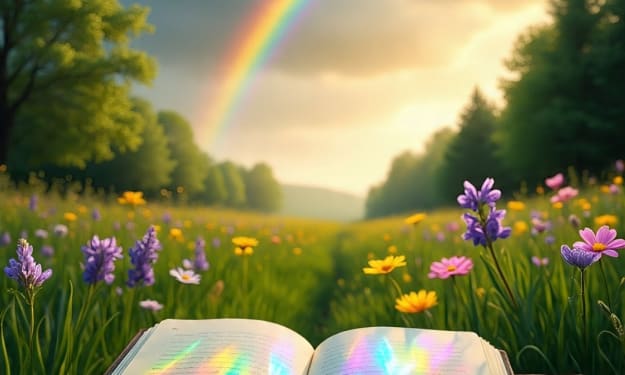
Colors in Verse: The Rainbow of Poetry
After a quiet rain, the sky opened like a freshly painted canvas. A delicate arch of colors stretched from one horizon to the other—seven glowing bands that seemed to hum softly with life. As droplets still clung to leaves, a young poet named Arham stood beneath the rainbow, notebook in hand, feeling as though the heavens themselves had spilled ink into the air. For Arham, poetry had always been a mystery. He loved words, yet they sometimes felt dull and gray—like clouds waiting for the right spark to release rain. He often wondered what gave poems their color, what made them breathe with emotion. That afternoon, as he gazed at the shining arc in the sky, the answer began to unfold. Each color of the rainbow, he realized, was a verse of its own—a poem written by nature. The deep red spoke of strength and love, bold and brave. The orange shimmered with creativity and warmth. Yellow danced like laughter and friendship. Green whispered of renewal and life. Blue carried peace and reflection. Indigo dreamed of mystery, and violet glowed with imagination and spirit. Arham took a deep breath and began to write. His words flowed like the rain that had just fallen. “Red, you are the heart of fire and dawn, Orange, the song of hope newly born, Yellow, the smile of a waking sun, Green, the promise when storms are done. Blue, the calm that follows pain, Indigo, the dreamer’s lane, Violet, the soul that feels the unseen— Together, you paint what words have been.” As his pencil moved, something inside him shifted. He realized that poetry wasn’t about difficult words or perfect rhymes—it was about feeling. Just as the rainbow didn’t ask to be admired, poems didn’t beg to be understood; they simply appeared, born from emotion, reflecting light through the prism of the heart. That day, Arham began to write differently. He no longer forced words onto paper. Instead, he listened—to the wind, to the birds, to the soft rhythm of his own thoughts. He wrote about moments: the hush after rain, the laughter of children splashing in puddles, the scent of wet earth, and the promise of sunlight breaking through clouds. Weeks passed, and his notebook filled with verses. When he read them aloud to his friends, their eyes glowed with the same wonder he had felt under the rainbow. “Your poems make us see feelings,” one friend said. “It’s like each line has a color.” Arham smiled. He had discovered that true poetry paints the soul. Every poem carries shades of joy and sorrow, light and shadow—just like a rainbow. And even when storms pass, what remains is the beauty they leave behind. Inspired, he began teaching younger children in his town how to write poetry. Instead of giving them rules, he gave them colors. “Write a red poem when you feel brave,” he said. “Write a blue poem when you need peace. Write a yellow one when you want to smile.” Soon, the little classroom walls were covered with colorful verses—words that glittered with feeling and imagination. One afternoon, as the sun dipped low, another rainbow appeared in the distance. The children ran to the windows, pointing and cheering. Arham watched them, smiling, and thought about how poetry—like the rainbow—connects heaven and earth, heart and mind. It appears when light meets rain, when joy meets struggle, when imagination meets truth. He picked up his pen once more and wrote: “In every color lies a song, In every heart, a place to belong. The rainbow fades, but leaves behind, A poem painted in the mind.” As the last rays of sunlight melted into the horizon, Arham closed his notebook. He knew then that poetry wasn’t just something to write—it was something to live. Every color of the world was a verse, and every day was a chance to read a new one. And so, the poet walked home beneath the glowing sky, carrying the colors of his heart—his own rainbow of poetry.
By Muhammad Saad 3 months ago in Poets