

I. The Exile of Noise
He walked where the world was not a scream,
But a slow exhalation, a whispered dream.
His name was Sage, a title earned, not given,
In the hollowed halls where the past was riven.
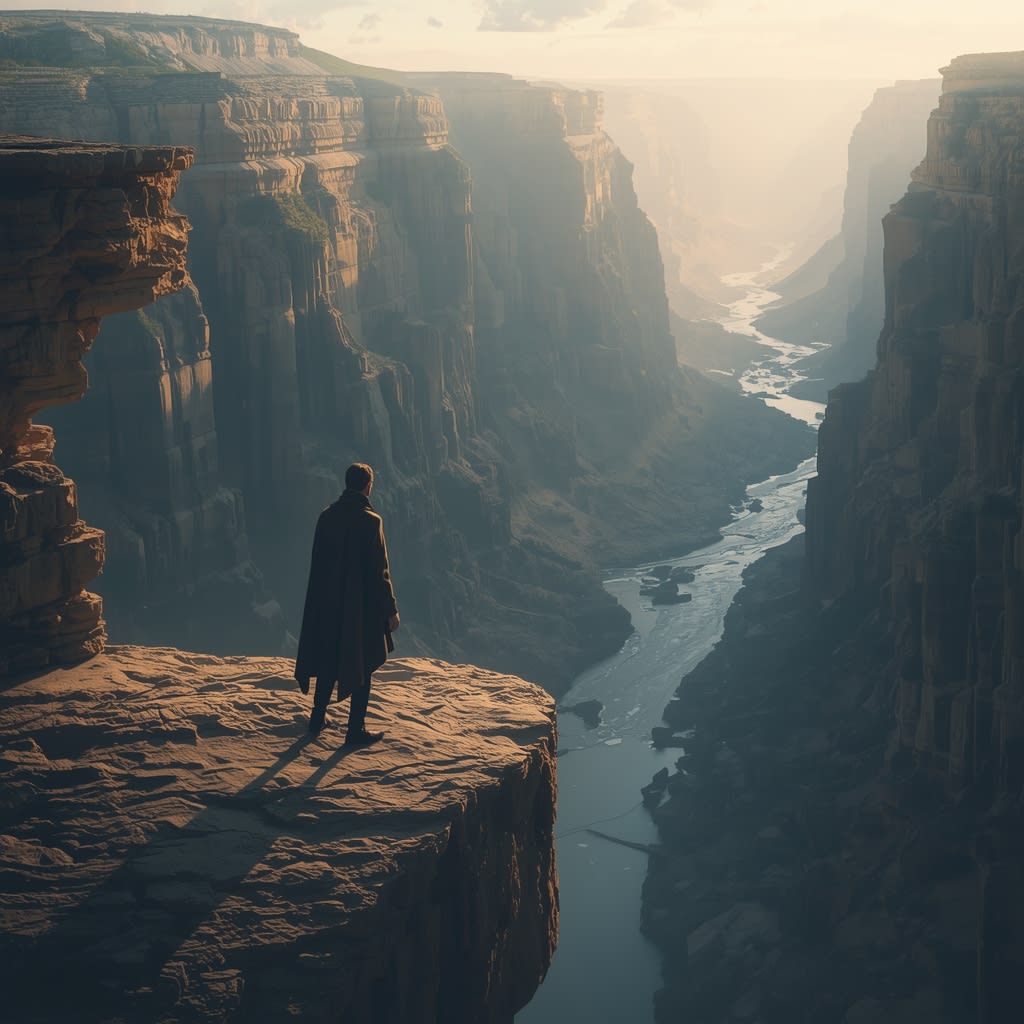
He came to the canyon, a scar on the planet's face,
Seeking not a god, but a semblance of grace.
The modern cacophony, a digital sleet,
Had worn his spirit down to the bone of his feet.
The arguments of billions, a chaotic fire,
Had drowned the simple truth of his own desire—
Which was merely to see, and in seeing, to know
The rhythm the stars and the riverstones show.
He built a small shelter of sandstone and pine,
A vessel to hold a life that was solely his own design.
The first week was a war with the ghost of the sound,
The phantom vibration, the turn of a phrase unbound.
He heard in the wind the echoes of news feeds,
In the creek's babble, the syntax of corporate creeds.
His own mind, a traitor, composed in hashtags and brands,
A jingle for emptiness, on forgotten lands.
This was the first layer to peel, the first pain to bear,
The excavation of static from the sanctum of air.
He sat for long hours, a student of dust,
Learning the patience of stone, the imperative of trust.
He did not seek poems; he sought a foundation,
The quiet that precedes all of creation.
II. The Lexicon of Stone and Stream
Then, the shift came, imperceptible, deep,
As the world ceased to shout and began to speak.
It was not in words, but in textures and tones,
In the grammar of fractures in the canyon’s old bones.
The river did not roar; it articulated time,
Syllabling over rocks, in a slow, patient rhyme.
It spoke of persistence, of the soft overcoming the hard,
A lesson in erosion, a poet’s regard.
It polished the boulders to a smooth, silent sheen,
Each one a thought in the water’s long, flowing brain.
The limestone, a chronicle, layered and white,
Held fossils of creatures who had swum in the light.
A spiral of ammonite, a captured, stone sigh,
Was a sonnet begun in the deeps of the sky.
Sage learned to read this lithic scripture,
Where time was the author and death a sure fixture.
He saw that the canyon’s most profound, telling line
Was the stratum of shadow, where no sun could shine.
For the poem of the earth was not just of the light,
But of the deep burial that comes in the night—
The pressure that creates the diamond from coal,
The silence that carves the unbreakable soul.
The wind was a scribe, with a thousand different quills.
It scritched through the dry grass on the high, lonely hills,
A dry, scratching sound, a minimalist verse.
Then it hummed through the caves, a resonant, deeper hearse,
Bearing away the dead leaves of the year.
And sometimes, at dusk, it would fall so sheer,
A held breath, a caesura in the world’s endless song,
And in that pause, Sage felt where he belonged.
It was a language before Babel’s curse was conceived,
A syntax the heart, and not the mind, perceived.
III. The Solstice of the Self
The seasons turned, a slow wheel in the void.
Summer’s fierce blaze left the earth parched and destroyed.
Then autumn came, with a cooler, gentler breath,
Painting the maples with the pigments of death—
A spectacular blaze of orange and gold,
A story of ending too beautiful to be told.
Sage watched a single leaf, a crimson confession,
Release its frail hold in a final concession.
It spiraled down, a slow, dancing descent,
To the bed of the river, where its journey was spent.
He saw himself in that leaf. The ego, the name,
The desperate hunger for fortune and fame,
It was all a tight grip on a branch, now so thin.
The leaf’s final beauty was in letting go, letting in
The inevitable current, the trust in the fall.
This was the hardest, the most necessary poem of all.
Not a poem of conquest, but of surrender and release,
Of joining the great, silent river of peace.
He did not write a word, but his soul became the page
Where the autumnal truth was inscribed: the true poet is a sage
Who learns from the world how to die and be born,
Who weathers the internal winter, and the soul's long, cold morn.
Winter came, locking the world in its cell.
The river grew quiet, under a shell of clear gel.
The wind’s voice was sharpened, a blade on the skin.
A profound isolation, a freezing within,
Settled upon him. The beauty was gone,
Replaced by a stark, unforgiving dawn.
This was the poem of absence, the stanza of lack,
Where the spirit is tested, and there’s no turning back.
He huddled by his small fire, a flickering spark,
Facing the sheer, terrifying dark
Of a universe that was indifferent and vast,
A poem that was not about him, a die that was cast
Long before his brief breath, and would remain long after.
And in that cold truth, he found the clean water of laughter.
For the ego, at last, had frozen and cracked.
There was nothing to defend, no persona to act.
He was simply a man, in a canyon, small and alone,
And in that utter simplicity, a new self was grown.
IV. The Unwritten Revelation
When the spring thaw came, it was not a loud shout,
But a slow, seeping forgiveness, leaching the doubt
From the frozen ground. Drops fell from the ice,
Each one a clear, perfect, and meaningless sacrifice
To the waiting earth. A green tip of a fern
Uncurled like a question, beginning to learn
The old, old answer of the sun.
Sage felt no urge to run, to speak, to compose.
The frantic need to capture, to hold, to impose
His own little narrative, had finally bled
Out of him, leaving a stillness instead.
He sat by the river, now roaring with melt,
A tumult of motion, a card that was dealt
From the deck of the glaciers. He felt no division
Between his own breath and the water’s collision.
He was the canyon, holding the river’s fierce flow.
He was the silence, absorbing the sound.
He was the old limestone, waiting to be worn down.
The great poem was not something he needed to write;
It was something he was, in the morning light.
It was the hawk’s patient circle, the ant’s tireless tread,
The cloud’s slow formation, the moss on the stone, widespread.
The "Ars Poetica"—the art of poetry—was not a technique,
Not metaphor, meter, or a unique, clever streak.
It was a way of belonging, a posture of heart,
A willingness to play the most minimal part
In a cosmic production that had no need for a name.
The poem was the listening. The title was the same
As the essence of rock, of water, of air.
It was a presence, a grounding, a staying right there.
He never wrote down a single line.
He felt that to inscribe it would be to define,
And thus, to diminish the vast, living text.
His legacy was the awareness of what would come next
Without his direction. His masterpiece was the space
He had cleared within himself, the receptive, quiet place.
When a traveler, years later, lost and afraid,
Stumbled upon his old shelter and stayed,
They found no books, no scrolls, no carved creed.
Just a man who was peaceful, who met another's need
With a cup of clear water, a gesture, a shared quietude,
Which was, in the end, the only poem that could ever include
The whole of the truth—a silent, profound,
And endlessly echoing, unwritten sound.
And the traveler left, not with a verse in their head,
But with a feeling they could not have otherwise said—
A feeling of being, for a moment, a part of the stone and the stream,
Which was Sage’s final, and only, and everlasting poetic theme.
About the Creator
Alexander Mind
Latest Stories
Keep reading
More stories from Alexander Mind and writers in Poets and other communities.
4:44 Sovereign Edition
New Release: The 4:44 Sovereign Edition I am thrilled to share the final, definitive version of "Do Not Project Your Limitations onto Me." This project has been a deep personal journey into what I call my "Mythic Suite", a collection of scenes from a life lived widely, survived fiercely, and birthed through fire.
By Vicki Lawana Trusselli a day ago in Poets


Comments
There are no comments for this story
Be the first to respond and start the conversation.