
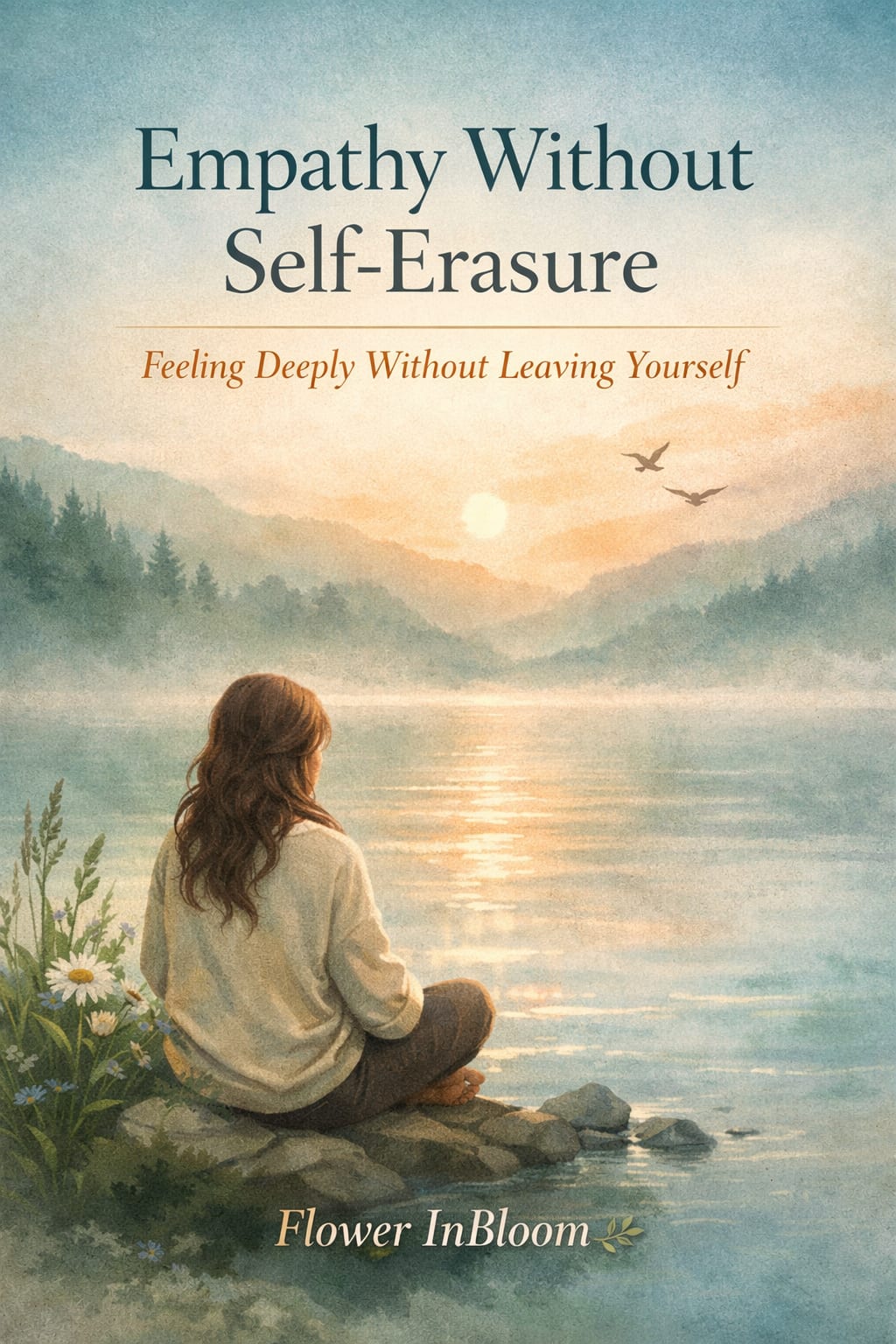
Empathy Without Self-Erasure
Feeling Deeply Without Leaving Yourself

Author’s Note
These pieces were written for those who feel deeply and were never taught how to stay intact while doing so.
Empathy is often praised without being explained.
Many of us learned to feel early, thoroughly, and instinctively—
but not how to remain inside ourselves while we did.
What follows is not a guide to becoming less sensitive.
It is an invitation to become more embodied.
Throughout this series, I name the difference between empathy and enmeshment—not to judge past ways of coping, but to offer language for a line many of us were never shown. Awareness does not require responsibility. Presence does not require self-erasure.
If, while reading, you notice your body tighten, rush, or brace—pause. That is information, not failure. Let these words meet you at your pace. Let what resonates stay. Let the rest pass through.
This work is meant to support connection that is mutual, care that is clean, and compassion that does not cost you yourself.
You were never meant to carry what is not yours.
You were meant to feel—and still belong to your body.
— Flower InBloom 🌿
Empathy Without Self-Erasure
Being an empath is not about feeling more.
It’s about feeling sooner.
The room hasn’t spoken yet,
but your body already knows
who is bracing,
who is shrinking,
who learned long ago how to disappear politely.
You don’t absorb emotions because you’re weak.
You notice them because you’re attentive.
Your nervous system learned the weather
before others learned the language.
You feel shifts—
a tone half a note off,
a smile that didn’t reach home,
a silence that arrived with weight.
And for a long time,
you mistook awareness for responsibility.
You thought:
If I can feel it, I must fix it.
If I can carry it, I should.
If I don’t intervene, I’m abandoning.
But empathy is not an obligation to bleed.
An empath is not a sponge.
An empath is a tuning fork.
You resonate—
you don’t retain.
Your work is not to rescue the room,
but to stay intact inside it.
To let information pass through you
without becoming your identity.
To witness without merging.
To feel without forfeiting your edges.
Being an empath means learning this sacred distinction:
compassion does not require collapse.
You are allowed to step back
without becoming cold.
You are allowed to say no
without becoming cruel.
You are allowed to rest
without earning it through exhaustion.
Your sensitivity is not a flaw to be managed.
It is a signal to be stewarded.
When you are regulated,
your presence calms without effort.
When you are grounded,
others remember themselves near you.
And when you finally stop abandoning your own body
to tend to everyone else’s storms,
your empathy becomes clean,
clear,
and quietly powerful.
You were never meant to carry the world.
You were meant to feel it,
and still belong to yourself.
— Flower InBloom 🌿
Empath vs. Enmeshment
Empathy is awareness.
Enmeshment is entanglement.
They can look identical from the outside—
two people close,
two hearts open,
two emotions moving in the same direction.
But inside the body,
they feel very different.
Empathy says:
I can feel what you’re feeling, and I know where I end.
Enmeshment says:
If you’re not okay, I’m not allowed to be.
An empath senses emotion
like weather passing through a window—
noticed, named, allowed to move on.
Enmeshment throws the window open
and calls the storm home.
When empathy is healthy,
there is choice.
When enmeshment is active,
there is urgency.
Empathy pauses.
Enmeshment rushes.
Empathy listens.
Enmeshment scans for danger.
Empathy can sit with discomfort
without trying to solve it.
Enmeshment feels responsible
for relief—immediately.
This is how the line blurs:
Many empaths learned early
that harmony meant safety.
That tending the emotional field
kept the peace.
That staying alert
kept the body protected.
So awareness became hyper-vigilance.
Care became self-erasure.
Connection became conditional.
Not because the empath wanted control—
but because abandonment once lived close by.
Enmeshment isn’t love.
It’s survival wearing love’s face.
The moment empathy turns into self-abandonment,
it stops being relational
and becomes regulatory.
You’re no longer with someone—
you’re managing the system.
Healthy empathy says:
I can be present without participating in the wound.
Enmeshment says:
If I don’t step in, something bad will happen.
Here’s the quiet truth:
You are not responsible for emotions
you did not create.
You are not unkind for refusing to merge.
You are not distant for choosing clarity.
Boundaries don’t block empathy—
they protect it.
When an empath disentangles,
their care becomes steadier.
Their nervous system softens.
Their love stops leaking.
They no longer confuse intensity with intimacy,
or proximity with safety.
They learn to stand beside instead of inside.
And in that space—
connection becomes clean,
consensual,
and deeply human.
Empathy remains.
Enmeshment releases.
And what’s left
is presence without sacrifice.
— Flower InBloom 🌿
Core distinction
Empathy is the ability to feel with someone while remaining rooted in yourself.
Enmeshment is the habit of feeling for someone by leaving yourself.
Empathy is relational.
Enmeshment is regulatory.
Empathy allows emotion to move through awareness.
Enmeshment traps emotion inside responsibility.
What empathy does
Notices emotional states without absorbing them
Allows discomfort without rushing to fix
Maintains a clear sense of self while staying connected
Responds from choice, not urgency
Honors compassion and boundaries at the same time
What enmeshment does
Confuses awareness with obligation
Feels responsible for others’ regulation
Reacts quickly to prevent discomfort or conflict
Loses clarity about where “I” end and “you” begin
Equates distance with danger and rest with neglect
Why empaths cross the line
Many empaths learned early that:
harmony meant safety
attunement prevented harm
staying alert kept connection intact
Over time, this can turn empathy into self-erasure—not because of weakness, but because of adaptation.
The repair
Healthy empathy does not require collapse.
Boundaries are not a withdrawal of love—they are the structure that allows love to remain clean.
When empathy is grounded:
presence becomes stabilizing
care becomes sustainable
connection becomes mutual instead of managed
The goal is not less feeling.
The goal is clearer feeling—with a self still inside it.
Body-Based Checklist: Empathy vs. Enmeshment Signals
Use this as a somatic check, not a moral one.
When you are in EMPATHY
Breath remains slow or recoverable
Shoulders stay relaxed or drop after awareness
Chest feels open but not pressured
You can pause before responding
You feel curiosity more than urgency
You can say “I’ll think about it” without anxiety
You remain aware of your own needs and limits
When you are in ENMESHMENT
Breath becomes shallow or held
Jaw tightens, neck stiffens, shoulders lift
Chest feels heavy, compressed, or pulled forward
You feel a rush to fix, soothe, or explain
Silence feels dangerous
Saying “no” triggers guilt or fear
You lose track of your body while tracking theirs
Key somatic question
👉 Am I present with this, or am I trying to regulate it?
That question alone often resets the system.
Practicing Empathy Without Enmeshment in Real Conversations
Practice begins before words.
Before responding, check your body.
If your breath is tight, your chest pulled forward, or your mind racing to fix—pause.
That’s not intuition speaking yet.
That’s urgency.
Give yourself one silent breath.
Let your body land where you are.
In conversation, empathy sounds like listening without rehearsal.
Notice if you’re already planning the response, the reassurance, or the repair.
That’s the moment to soften your shoulders and come back to hearing, not managing.
Try replacing fixing with naming:
“That sounds heavy.”
“I hear how much this matters to you.”
“That makes sense given what you’ve been carrying.”
Naming allows emotion to move without you absorbing it.
If you feel pulled to over-explain, justify, or rescue, slow down.
Enmeshment speeds the pace.
Empathy steadies it.
You are allowed to:
ask clarifying questions instead of offering solutions
take a pause before replying
say “I don’t have an answer, but I’m here”
These are not withdrawals of care—they are acts of regulation.
If a conversation begins to cost you your body—
tightness, numbness, dissociation—
that’s information, not failure.
You can gently re-anchor:
place a hand on your chest or thigh
feel your feet on the floor
let the other person’s emotion stay with them
Empathy stays connected.
Enmeshment crosses the boundary and forgets where it started.
After the conversation, check in with yourself.
Ask: Did I leave myself to stay connected?
If yes, offer yourself repair—rest, honesty, or space.
Over time, this practice teaches your nervous system something new:
connection does not require self-abandonment.
You don’t need to be less caring.
You need to be more embodied.
— Flower InBloom 🌿
Closing Vow
I choose presence without self-erasure.
I feel without merging.
I care without carrying.
I remain whole while staying open.
— Flower InBloom 🌿
Closing Author’s Note
If you’ve made it here, something in you already knows the difference.
Not as a concept—but as a felt sense.
You may notice that the body reads before the mind agrees.
That clarity arrives quietly, without urgency.
That care no longer asks you to disappear in order to stay connected.
This series was never meant to teach you how to feel.
You already do.
It was meant to remind you that empathy does not require sacrifice,
and that staying with yourself is not a betrayal of love.
If these words have shifted how you listen, pause, or breathe in conversation, let that be enough. Integration happens in the living, not the labeling.
Take what steadied you.
Release what no longer belongs.
Let the line remain visible—not rigid, but kind.
You are allowed to feel deeply and remain whole.
You are allowed to belong to yourself.
That is where this work closes.
And where the practice continues.
— Flower InBloom 🌿
About the Creator
Flower InBloom
I write from lived truth, where healing meets awareness and spirituality stays grounded in real life. These words are an offering, not instruction — a mirror for those returning to themselves.
— Flower InBloom
Keep reading
More stories from Flower InBloom and writers in Poets and other communities.



Comments
There are no comments for this story
Be the first to respond and start the conversation.