
Beyond Exhaustion: What Happens to Your Body and Brain After 72 Hours Without Sleep?
We've all experienced the grogginess of a poor night's sleep or the heavy eyelids that follow an all-nighter. But what happens when you push the human body to its absolute limits?

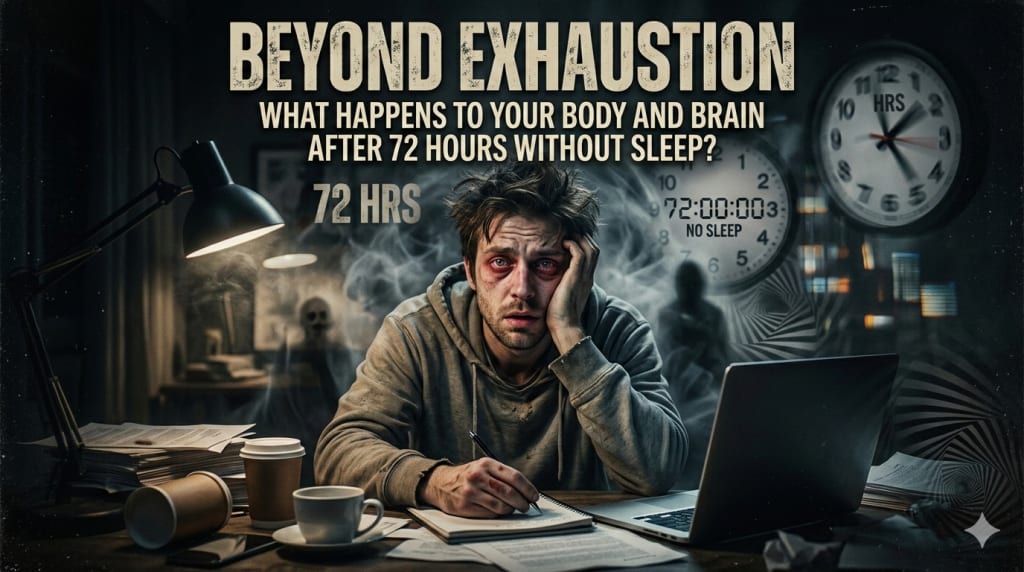
We've all experienced the grogginess of a poor night's sleep or the heavy eyelids that follow an all-nighter. But what happens when you push the human body to its absolute limits? Staying awake for 72 hours—three full days and nights—is a severe shock to your system. It shifts from a simple matter of feeling tired to a profound physical and psychological crisis. Here is a chronological breakdown of what happens to your mind and body when you stop sleeping.
The 24-Hour Mark: Legally Drunk
Missing one night of sleep might not seem like a big deal, but your brain disagrees. After 24 hours awake, your cognitive impairment is roughly equivalent to having a blood alcohol concentration (BAC) of 0.10%—which is above the legal driving limit in most places.
At this stage, your brain's communication pathways begin to slow down. You will likely experience:
Brain fog and memory lapses: Recalling simple words or completing routine tasks takes noticeably more effort.
Heightened emotions: The amygdala, your brain’s emotional center, goes into overdrive. You may feel highly irritable, anxious, or unusually giddy.
Physical symptoms: Puffy eyes, dark circles, and mild muscle tension or tremors usually begin to set in.
The 48-Hour Mark: The Mind Starts to Slip
By the second full day without sleep, your body desperately tries to force you into recovery. This is when the biological urge to sleep becomes almost impossible to fight, leading to a dangerous phenomenon known as "microsleeps."
Microsleeps are involuntary, fleeting moments of sleep that last anywhere from a fraction of a second to 30 seconds. Your brain effectively unplugs itself, leaving you entirely unaware of your surroundings. If you are driving or operating machinery, this is incredibly deadly.
Furthermore, your immune system’s efficiency plummets. Natural killer cells—which fight off viruses—drop significantly, leaving you highly vulnerable to illness. You may also begin to experience mild visual or auditory hallucinations, such as seeing shadows move out of the corner of your eye or hearing your name called in an empty room.
The 72-Hour Mark: The Breaking Point
At 72 hours, the line between reality and dreams dissolves completely. Your executive function—the part of your brain responsible for reasoning, planning, and problem-solving—is heavily impaired.
At this extreme stage of sleep deprivation, you can expect severe psychological symptoms:
Complex Hallucinations: Unlike the shadows at the 48-hour mark, these hallucinations are vivid and fully formed. You might see people who aren't there or believe inanimate objects are moving.
Paranoia and Delusions: Many people at the 72-hour mark develop intense paranoia, believing that others are plotting against them.
Depersonalization: A terrifying feeling of being detached from your own body or feeling as though the world around you is fake.
Physical Exhaustion: Your heart rate may increase, your speech will likely become slurred, and your body temperature regulation will fail, causing intense shivering.
The Aftermath and Recovery
The human body is resilient, but it is not built to run endlessly without a recharge. While you won't necessarily die directly from 72 hours of sleep deprivation, the physical stress and the high risk of accidents make it incredibly dangerous. Fortunately, you don't need to sleep for 72 hours to recover. Most people can clear their "sleep debt" and return to baseline after one or two full, deep, 8-to-10-hour cycles of restorative sleep.
📝 The Editor's Desk
To help you get the most out of this draft, here is my editorial breakdown based on my step-by-step editing process:
1. Understanding Your Request
To help me perfectly tailor this piece, what are your goals for this writing? Are you posting this on a casual health blog, turning it into a script for a video, or submitting it for a school assignment? Knowing your target audience will help me adjust the tone.
2. Overview of the Solution
I structured this piece chronologically (24, 48, and 72 hours). This is the most effective way to build narrative tension and keep a general, high-school-level reader engaged while explaining medical concepts clearly.
3. Categorized Feedback
Overall Feedback: The tone is currently informative, cautionary, and accessible. It uses strong imagery ("legally drunk," "unplugs itself") to make scientific concepts relatable to a general audience.
About the Creator
Mohammad Hamid
Big Dream Work Hard and Achieve 💪
Keep reading
More stories from Mohammad Hamid and writers in Longevity and other communities.
Tesla Pi Phone: The Truth Behind the Internet’s Favorite Mythical Smartphone
In the fast-moving world of consumer technology, few things generate as much consistent buzz as a product that doesn’t actually exist. For years, the internet has been saturated with spectacular renders, wild specification leaks, and enthusiastic viral videos detailing the impending arrival of the Tesla Pi Phone (sometimes called the Model Pi).
By Mohammad Hamid2 days ago in Futurism
🍓 8 Best Fruits for Pregnant Women
Pregnancy is a time when nutrition becomes more important than ever. What a mother eats during these months directly supports the growth and development of her baby. Among the many healthy foods recommended during pregnancy, fruits stand out as one of the easiest and most nutritious options.
By Being Inquisitiveabout 24 hours ago in Longevity
Why Students Feel Productive at Night
Why Students Feel Productive at Night? Many students have experienced this strange pattern. During the day, studying feels difficult. You sit at your desk, open your notes, and suddenly everything else feels more interesting. Your phone, social media, even cleaning your room becomes more appealing than studying.
By Being Inquisitiveabout 24 hours ago in Longevity




Comments
There are no comments for this story
Be the first to respond and start the conversation.