
Scissors, a hankie, a paj ntaub
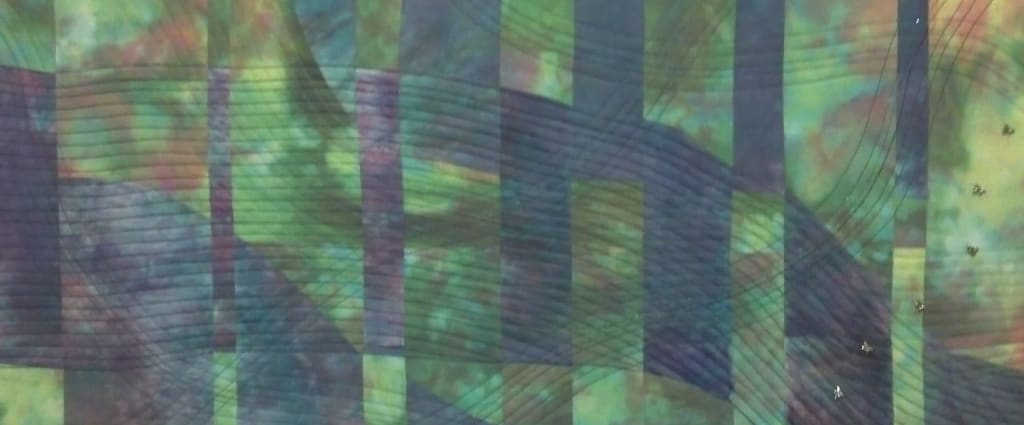
“Ladies, remember, I must be able to close and staple the bag!” the woman at the cash register shouted to shoppers at intervals throughout the hour. Her tone was harried, and her face was tight with stress, or perhaps anger.
It was the last day of the Going Out of Business sale at this fabric store, and a woman at the door had given us clear plastic 24-inch bags, explaining we could fill them with anything for $10 a bag. The store’s inventory was diminished by now, but since I couldn’t ordinarily afford to shop here, I filled my bag with what remained with sheer joy. Spools of thread - good quality thread, 100% cotton fabric - so much softer than the polyester blends from Kmart, trims and lace, and the real prize – a gleaming pair of professional quality sewing scissors – something I never imagined I would own. There was one pair left, inexplicably overlooked by previous bargain hunters.
I stood in the check-out line feeling like I had won the lottery.
Ahead of me were two small brown women, excitedly chatting in Hmong. The cashier lifted their bags, full of tumbling colorful cotton solids, but still with room to be stapled at the top. “These are too full,” she snapped, as she slammed the bags down again on the counter. “Get out of here!” The two women looked at her with confusion and started simultaneously speaking. One attempted to take some things out of her bag. The cashier snatched the bags off the counter and put them behind her. “Get OUT!” she snapped again, pointing to the door. As the empty-handed women scurried toward the door, the casher took my bag and my cash as I stood in stunned silence, like someone who has just witnessed a terrible accident and hasn’t yet comprehended what just happened. I took my bag and change and walked out of the store in a daze, still trying to process the scene.
I had said nothing.
In the years that followed, the fabric from that bag made its way into quilts and pouches and purses. I love every part of the sewing and quilting process – sketching out a design, and then picking the colors and prints with the same thrill that I had when dipping into a new box of crayons as a child. I love the starchy smell and warmth of the fabric as I iron it, I love the glide of it under my fingers as it hums through the sewing machine. And I love the last restful process of hand-stitching a binding and touching and admiring the play of color and texture on a new quilt. As I drive home after each day of being onstage in front of a classroom, I look forward to the soothing tactile pleasures of fabric and thread.
I also love using those scissors, with their sharp precision. But that pleasure is often conflated with guilt as I remember the scene in the fabric store. I reimagine it, as if I could change the past. I confront the cashier. Or perhaps I offer words of sympathy on the closing of the store, but gently remind her that those women were not the cause. I imagine offering to buy their bags and running out to the parking lot to find them, to show them that not everyone in their new country regards them with contempt. I imagine how they must have felt, outside that store. The confusion, bewilderment, the shame, the despair of one more insult in a country that was different from anything they had ever known.
That year that store closed was 1995, and another wave of Hmong refugees had recently made the long journey from refugee camps in Thailand to Minneapolis. These women might have been part of that wave. They were wives or mothers or daughters of veterans of the Viet Nam war. During the Viet Nam years, the CIA had recruited these Hmong in Laos to fight the Viet Cong. Thirty to forty thousand Hmong soldiers, many of them as young as 12 years old, died. When the US pulled out of the war, Hmong generals were flown to the safety of the US. The rest waited for planes that never came. Communist Pathet Lao forces overtook Laos, and immediately began a genocide campaign to irradicate the Hmong because they had sided with the United States. Fleeing families hid in jungles and lived on birds and lizards. And thousands made the harrowing journey to the Mekong River in hopes of crossing to refugee camps in Thailand. Many lived in the camps for years before they were finally able to immigrate. And when they did come, they often faced discrimination and poverty, trying to make a living in a country where they did not know the language or the culture.
The scissors are now twenty-six years old. They can still invoke a memory that send a small prickle of shame fluttering up my neck. But I also feel the pleasure of their heft in my hands as I cut scraps of clothing. I sew fewer bed quilts these days. I like making smaller quilted pieces, working with the intimate medium of fabric that has touched the skin of people I have loved. Here is a fragment from the shirt of my dead best friend. Here is the green polyester from my toddler’s mermaid costume, and the red silk from her prom dress. Here are some embroidered handkerchiefs I found in a box of my grandmother’s things. They were wrapped in faded tissue, with a small piece of paper in my grandmother’s handwriting that just said, “Hankies from Selmer.” I have learned that Selmer was my grandmother’s first love. He never made it back from the beaches of Normandy.
I have many Hmong students, and two years ago I went to Thailand to study Hmong history and culture. I stood on the banks of the Mekong as Chue, our guide, told us the story of his family’s crossing. His mother inflated garbage bags, tied them along a rope, and instructed her children to hang on to the rope. They made their crossing in late-night darkness, but even then, they could hear the flying bullets of the Pathet Lao soldiers. Chue’s youngest sister drowned. Later he took us to the remains of the Chiang Kham refugee camp and told us stories of this place where his family lived for seven years.
Chue also took us to happier places. We visited colorful Hmong and Thai markets, and I got batiks and silks and woven hemp and embroideries and trims to incorporate into my quilts. I had been hoping to find a Paj Ntaub, a Hmong story cloth, but Chue told us they were rarely made anymore, as few of the younger Hmong could spare the many hours it took for all the intricate embroidery. But at a market in a mountain village, I was lucky enough to find one – the embroidered story of the Hmong’s war years, the genocide, crossing the Mekong, and life in the camps. The elderly woman who sold it to me had a toothless smile and beautifully wrinkled face, framed by an intricately embroidered Hmong headdress. She spoke little English. But as she used her gnarled finger to point out various pictures on the Paj Ntaub, it was clear that even though sewing was her living, it was also her joy. I know that feeling.
This Paj Ntaub was unfinished though, without the traditional triangle borders representing the mountains of Laos. I bought it anyway, thinking I could frame it when I got home. I thought about asking her if I could buy some fabric from her to finish it myself. But then I thought that would be like asking an artist if I could have some paint to revise a few of their brushstrokes. This was her story, not mine.
On the last day of the trip I asked Chue what he wanted us to teach American students about the Hmong. “Tell them our story,” he said.
I went home and added Hmong memoirs and folk tales and song poetry to my class readings. I showed students beautiful textiles and told stories from my trip. “Thank you for including my culture in this class,” said one of my Hmong students. “Thank YOU, I said, for sharing your culture with me.” I didn’t tell that student what I did not do in the fabric store 26 years ago. I didn’t tell her that I am using a pair of scissors as a tangible reminder to do better.
I have recently decided to sew the border on the Paj Ntaub. This is the Hmong story, but I realize that I am part of this story too, in all the awful and the good ways. When it is finished, I will give away my beloved Pan Ntaub - to hang at our school, so that more people will learn the story. Chue would approve. The scraps from the border will be enough to help me remember that woman in Thailand and that moment of shared joy over needle and thread.
I am grateful for this craft that has given me so many hours of simple pleasure, and that connects me to a soldier my grandmother loved, to an old woman on the other side of the world, and to both sad and joyful memories of people I cherish. I am grateful for this craft that helps me reflect on experiences and memories as I stitch things together, having the opportunity to make something new, something that is always in the process of becoming.
About the Creator
Keep reading
More stories from writers in Lifehack and other communities.
Moving After Selling a Home in the United States: What to Expect From the Process
Selling a home and preparing for a move often happen at the same time, turning an already emotional moment into a complex logistical process. For many homeowners in the United States, this transition is not just about changing addresses. It represents a shift in lifestyle, priorities, and routines, all unfolding under the pressure of deadlines and expectations.
By House Doctor5 days ago in Lifehack
Super Bowl LX Recap: A Team Called Hawks
Sixty. The Super Bowl turned 60! Still amazes me that this was the sixtieth Super Bowl played in NFL history. It seems like yesterday that I watched Super Bowl XXVII, the first SB I ever watched. The QB who won Super Bowl XXVII has since called a few SBs, and will call next year's game, but that's another story. Super Bowl LX took place at Levi's Stadium in Santa Clara, California, the home stadium of the San Francisco 49ers. However, it was one of their division foes who represented the NFC, as the Seattle Seahawks faced off against the New England Patriots.
By Clyde E. Dawkinsa day ago in Unbalanced



Comments
There are no comments for this story
Be the first to respond and start the conversation.