
How Rapid Tool Evolution Is Reshaping the Software Economy?
As development tools evolve faster than ever, the economics of building, scaling, and competing in software are being quietly rewritten.

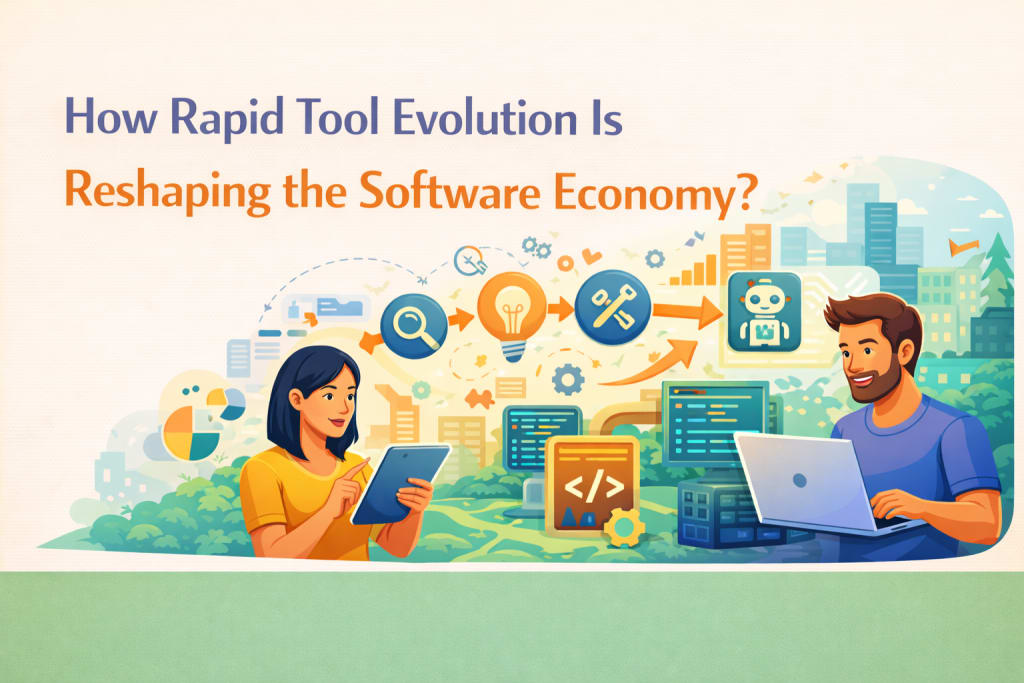
Software once followed a predictable rhythm. Programming languages matured slowly, frameworks lasted for years, and tooling changes happened gradually enough for companies to build long-term strategies around them. Developers invested heavily in mastering specific stacks, and organizations relied on stable ecosystems to plan growth.
That rhythm has accelerated dramatically.
In 2026, development tools evolve at a pace that reshapes not only how software is built but also how software markets function. Artificial intelligence assistants, low-code platforms, cloud-native architectures, and automated deployment pipelines are changing cost structures, talent expectations, and competitive dynamics.
The result is a software economy defined less by stability and more by continuous reinvention.
Development Speed Has Become a Competitive Advantage
One of the most visible effects of rapid tool evolution is the compression of development timelines.
AI-assisted coding tools can generate boilerplate code, suggest architectural patterns, and accelerate debugging. Cloud platforms provide infrastructure on demand. Automated testing frameworks reduce manual overhead.
Projects that once required months of engineering effort can now reach prototype stage within weeks or even days.
This shift alters competitive dynamics. Companies capable of launching quickly can test ideas faster, gather feedback earlier, and pivot before competitors respond.
Speed becomes a strategic asset.
Yet faster development also means faster competition. The same tools that empower one company empower many others simultaneously.
The Falling Cost of Entry and Rising Market Saturation
Lower barriers to development encourage new entrants into nearly every software category.
Startups can launch applications without building infrastructure from scratch. Open-source components provide ready-made functionality. AI tools reduce the need for large engineering teams.
While this democratization expands innovation, it also increases market saturation.
More competitors enter the same space, making differentiation harder. Products must compete not only on features but also on user experience, ecosystem integration, and long-term value.
Economic pressure shifts from creation to retention.
Tool Evolution Changes Developer Roles
As tooling becomes more capable, developer responsibilities evolve.
Instead of writing every line of code manually, developers increasingly orchestrate systems — selecting frameworks, configuring integrations, and validating AI-generated output.
This shift resembles earlier transitions from assembly language to high-level programming languages, and later from manual server management to cloud orchestration.
Abstraction increases productivity but also changes skill requirements.
Developers must understand architecture and problem-solving at a higher level, focusing on decision-making rather than repetitive implementation.
The Subscription Economy and Continuous Delivery
Rapid tool evolution aligns with the rise of subscription-based software.
Continuous delivery pipelines allow teams to release updates frequently, responding to user feedback in near real time. Customers expect ongoing improvement rather than periodic major releases.
Subscription models incentivize constant iteration. Companies release incremental enhancements to maintain engagement and reduce churn.
This creates a cycle where tool updates drive faster product updates, which in turn require even more adaptable tooling.
The software economy becomes increasingly iterative.
Platform Ecosystems Accelerate Change
Modern software rarely exists in isolation.
APIs, marketplaces, and platform ecosystems connect applications into larger networks. When major platforms introduce new tools or features, entire categories shift quickly.
Developers must stay aligned with platform roadmaps, adjusting strategies as ecosystems evolve.
Dependence on external platforms introduces both opportunity and risk. Integration simplifies development but reduces autonomy.
Platform-driven innovation adds unpredictability to the software economy.
AI as a Force Multiplier
Artificial intelligence tools amplify existing trends.
AI models assist with design, testing, data analysis, and customer support workflows. Generative systems create content, automate documentation, and provide decision recommendations.
According to industry surveys, a majority of developers now incorporate AI into daily workflows.
This widespread adoption accelerates learning curves. Developers can explore new technologies quickly, reducing the advantage once held by early adopters.
AI levels the playing field while intensifying competition.
Infrastructure Becomes a Hidden Differentiator
While tools simplify development, infrastructure increasingly determines performance and scalability.
Cloud architecture, data center access, and deployment automation influence how efficiently applications operate at scale.
Teams involved in mobile app development Atlanta ecosystems often leverage advanced infrastructure tools to streamline releases and manage growth effectively. Infrastructure choices shape operational costs and user experience, influencing long-term success.
The infrastructure layer quietly becomes a key competitive factor.
Tool Fatigue and Decision Complexity
Rapid evolution introduces new challenges.
Developers face an overwhelming number of choices. New frameworks appear frequently, promising efficiency gains or new capabilities. Evaluating which tools to adopt becomes a strategic decision rather than a purely technical one.
Organizations risk fragmentation when teams adopt different tools without alignment.
Tool fatigue can slow progress despite technological advancement.
The challenge is not access to tools but selecting the right ones.
Economic Implications for Software Companies
The shifting tool landscape influences business models.
Lower development costs allow smaller teams to compete with larger organizations. At the same time, rapid innovation cycles shorten product lifespans, requiring continuous investment.
Companies must balance experimentation with stability.
Investors evaluate adaptability as much as product strength. Organizations capable of integrating new tools quickly may maintain competitive advantage even in volatile markets.
Adaptability becomes a financial asset.
The Changing Nature of Expertise
Traditional expertise involved mastering specific programming languages or frameworks.
Today, expertise increasingly involves understanding patterns, architectures, and systems thinking. Developers must learn how to evaluate new tools quickly, integrate them effectively, and anticipate long-term implications.
Continuous learning becomes part of professional identity.
Education shifts from static knowledge toward dynamic capability.
The Human Element in a Tool-Driven Economy
Despite automation and AI assistance, human judgment remains essential.
Choosing the right problem to solve, understanding user needs, and designing meaningful experiences require contextual awareness that tools alone cannot provide.
The most successful teams combine technological efficiency with strategic clarity.
Tools accelerate execution, but direction still comes from people.
Looking Ahead
Rapid tool evolution is unlikely to slow.
Future trends may include:
- Greater automation of development workflows
- Expansion of low-code and no-code platforms
- Integration of AI into nearly every stage of software creation
- Increased reliance on modular architectures
- Closer alignment between hardware and software design
The software economy will continue shifting as new capabilities emerge.
Closing Reflection
The evolution of development tools is reshaping the software economy in ways that extend far beyond engineering practices.
Faster development cycles reduce barriers to entry, increase competition, and challenge traditional business models. Infrastructure choices, platform ecosystems, and AI assistance redefine how companies build and scale products.
In this environment, stability becomes temporary. Success depends on learning quickly, choosing tools thoughtfully, and building systems flexible enough to evolve alongside the technology that shapes them.
Rapid tool evolution does not simply change how software is built. It changes what it means to compete.
About the Creator
Mike Pichai
Mike Pichai writes about tech, technolgies, AI and work life, creating clear stories for clients in Seattle, Indianapolis, Portland, San Diego, Tampa, Austin, Los Angeles and Charlotte. He writes blogs readers can trust.
Keep reading
More stories from Mike Pichai and writers in Lifehack and other communities.
AI Integration Trends for Mobile App Development Los Angeles Startups
Not long ago, artificial intelligence appeared in product roadmaps as an optional addition — a feature added near the end of development to make an app feel modern. That sequence has reversed. In many Los Angeles startups today, AI sits at the center of the initial concept, shaping how apps are imagined before the first interface sketch appears.
By Mike Pichai8 days ago in Lifehack
Dark Post
In the 2026 election cycle, the concept of a "town hall" has been replaced by a "data farm." The political landscape is no longer shaped by speeches, but by the Extraction—a high-tech ecosystem that turns your daily behavior into political intelligence. This isn't just advertising; it’s a coordinated ruse powered by a network of "Primary Miners" and "Digital Scalpels" designed to deliver surgical strikes to your private feed.
By Untitled Sourceabout 22 hours ago in Lifehack
Targeting microorganisms linked to stomach cancer, a new chocolate innovation
It has been demonstrated that chocolate truffles manufactured from grape waste suppress the stomach microbe most closely associated with gastric cancer. The discovery gives discarded winemaking materials a new biological purpose while redefining a familiar meal as a possible tool for lowering infection risk.
By Francis Dami7 days ago in Lifehack



Comments
There are no comments for this story
Be the first to respond and start the conversation.