
Folk Craft As Empowering Job
To create a job for a stay-at-home refugee mother, I turned to an old craft my grandpa used to make.

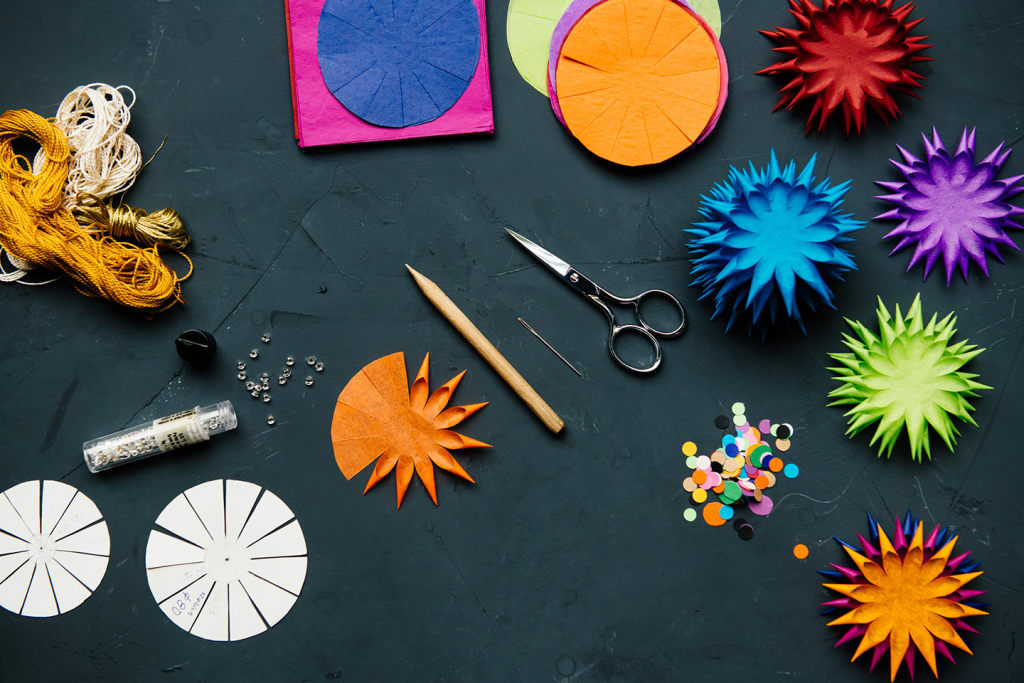
I hadn’t really paid much attention to an innocuous little activity my grandpa would do until I was a teenager. For years throughout my childhood when I visited him, I would watch him take out his tissue paper, scissors, glue stick, thread, needle, and a little stick in the exact shape of a pencil, just one without lead, that he had whittled down himself. He’d cut palm-sized circles out of the tissue paper, with slits from the outside nearly to the center, then he would spend hours rolling little points from the cut tissue paper. Each disc turned into a beautiful little “star” and as soon as he had about 12 of these, he’d string them all together, pull the string tight, and it would turn into a spikey ball. He called these little balls “jeżyki” in Polish, which translates to “little hedgehogs” in English.
They were handmade Christmas tree decorations. Something that he had been making since he was a young boy growing up in a farming village in Poland. In fact, all of his Christmas decorations were handmade, typically out of paper, both construction paper and tissue paper, but sometimes out of aluminum foil. You see, store-bought decorations weren’t as widely available as they are now. Certainly not in post-war, early Communist Poland. And even if they had been, my grandpa grew up so poor he certainly wouldn’t have been able to afford them. His farming family churned butter to sell, but he had not tasted butter until he was 18. Everything they churned went to market.
He learned this craft from his older sister, who had learned it from the village schoolteacher. And so this folk craft passed on to me when I found myself in a room with just my grandpa and his tissue paper and tools. I was a teenager visiting him for the summer from America, where my family immigrated to, and I was probably bored so I turned my attention to what he was doing. Even though I had witnessed this so many times, I had never thought much of it, but all of a sudden I was very interested. “Can you show me how to make these?” He shrugged his shoulders, not really sure why I wanted to learn, but he obliged. “Sure, sit down.”
It was tedious, and required fine motor skills. You had to create each “star” point individually. Glue the slit together, one side to the other using the pointed pencil stick to shape it, and hope the whole time that you didn’t accidentally glue the paper to the stick or to your fingers. Then you had to do that 12 times for all of the slits on one circle disc, and repeat until you had 12 completed “star” discs. I’m glad I only took notice as a teenager. I wouldn’t have been able to do this as a kid. (My grandpa has since become too old to do this. His fingers are too calloused and his arthritis bothers him.)
So I made a few jeżyki with my grandpa. He gave me his patterns and stick, and some extra tissue paper he had lying around. I took it all home with me to America and promptly put it into a drawer for the next 12 years. In that time though, I had made a lot of artist and craft friends, traveled a bit, got married, started my career in editing and publishing, and moved to Los Angeles. I started volunteering at Craft Contemporary, a local craft museum (whose name was still Craft and Folk Art Museum when I started volunteering with them). I proposed teaching a workshop to make the jeżyki during the holidays and they agreed. I taught at least 50 people how to make them, all the while covering the event for my grandpa so he could see these strangers in LA making the craft he had been making nearly his whole life. What a treat.
Around that time, in 2017, coverage of the refugee crisis was ablaze in the news and every day as I drove home from work I thought “I need to do something to help.” Being an immigrant myself, remembering how foreign this place seemed at first (how strange and illogical it can still sometimes be), seeing my parents struggle then succeed (kind of), understanding the sacrifices they made… I was in a position to empathize and to help guide newcomers in this country.
I signed up to volunteer the only way I knew how. As an English tutor. I got linked up with a sweet, young mother from Afghanistan. She was only 23 at the time we met (I was 28), but I assumed she and her husband were older than me. I’ve since found out that stress ages a person very quickly. Her husband worked as a translator for the military and his English was perfect. Hers was practically non-existent. So I paid them housecalls for tutoring sessions.
So what does this all have to do with craft and how did we get to talking about the refugee crisis? And is all this talk of figuring it out in a new country something that makes you happy? Well, hear me out.
After a few years of tutoring her, I got to know her and her stresses in life, both the major and minor ones. She expressed often that she needed a job. Not wanted a job, needed a job. However, her English was still very much at a beginner level, she had a three-year-old child she had to take care of at home, and she didn’t have her own transportation (she lived in an area where access to public transit left a lot to be desired). So what could she do? I was one of her only contacts to the world outside of her home and the errands around town she ran with her husband, the only times she left the house.
We discussed the possibility of babysitting, cleaning homes, catering, becoming an Instacart shopper, and so on, but coupled with her limitations and duties at home, nothing was viable.
Then I remembered my grandpa’s craft. It was a unique, handmade, almost historic (at this point) ornament for the holidays… Maybe if I taught her how to make the star points, and I packaged up the finished little hedgehog balls, maybe people would buy them? Just maybe.
I was lucky to have an existing relationship with the craft museum, they agreed to sell them in the shop during the holidays. And my group of craft friends I made in my 20s... one now sold her own ceramic and wooden housewares in a shop space she rented in Michigan, my home state. I had two retail locations already, and I had Instagram and a whole lot of friends who were willing to buy a jeżyk to support this job of hers.
That first year, we started making jeżyki in September and almost all of December I spent stressed and overworked trying to keep up with demand. We sold 66 jeżyki, but I swear it felt like I made a hundred more! The next year, I started a spreadsheet, and we started earlier, which resulted in 116 sold. She made almost twice as much money as she had the year before. This year is our third year and we have an even bigger spreadsheet and we’ve started even earlier than the year before which has resulted in more steady and predictable work for her. She now has an income she can rely on and I have learned an incredible amount of on-the-job business knowledge. Now every time when I go to her house for an English lesson (but, let’s be honest, mostly to play with her now two young sons), I drop off more tissue paper and she gives me a shoebox full of finished “stars” that I make jeżyki from.
And while I’m incredibly happy that I was able to leverage my privilege to create this job for her and find a way to sustain it, what tickles me every time is telling my grandpa how many jeżyki we sold that season. This old man from the country in Poland cannot believe that strangers, non-Polish people, in Los Angeles and Michigan, actually want to buy these frivolous things that he’s been making as a hobby for decades. He gives me a drawn out, awestruck “ohhhhhhh” and shakes his head back and forth when I tell him how we’re doing each year. He could have never imagined this was possible, and frankly, neither did I until we did it.
About the Creator
Agnieszka Spieszny
Art, craft, activism, community leadership, and writing in Los Angeles and wherever else I find myself.
Keep reading
More stories from writers in Lifehack and other communities.
Choosing the Right Moving Company in Edmonds, WA
Relocating is rarely just about transporting boxes from one place to another. In a city like Edmonds, Washington, where neighborhoods vary widely in layout, elevation, and access, the choice of a moving company can significantly influence how smooth the entire process feels. Whether you’re moving into Edmonds for the first time or relocating within the city, understanding what sets local movers apart is an essential step.
By House Doctor5 days ago in Lifehack
Analyse this!
Wanna know how to improve your writing? There is a simple, quick, tried and tested method. Tried and tested by who? By me, as it happens, and I can guarantee that it will work for you. I know what I am talking about. Not always, of course, but certainly in this case.
By Raymond G. Taylor2 days ago in Writers



Comments
There are no comments for this story
Be the first to respond and start the conversation.