
What Happens When App State Management Stops Scaling Enough?
The quiet moment when state stops being a tool and starts becoming a negotiation

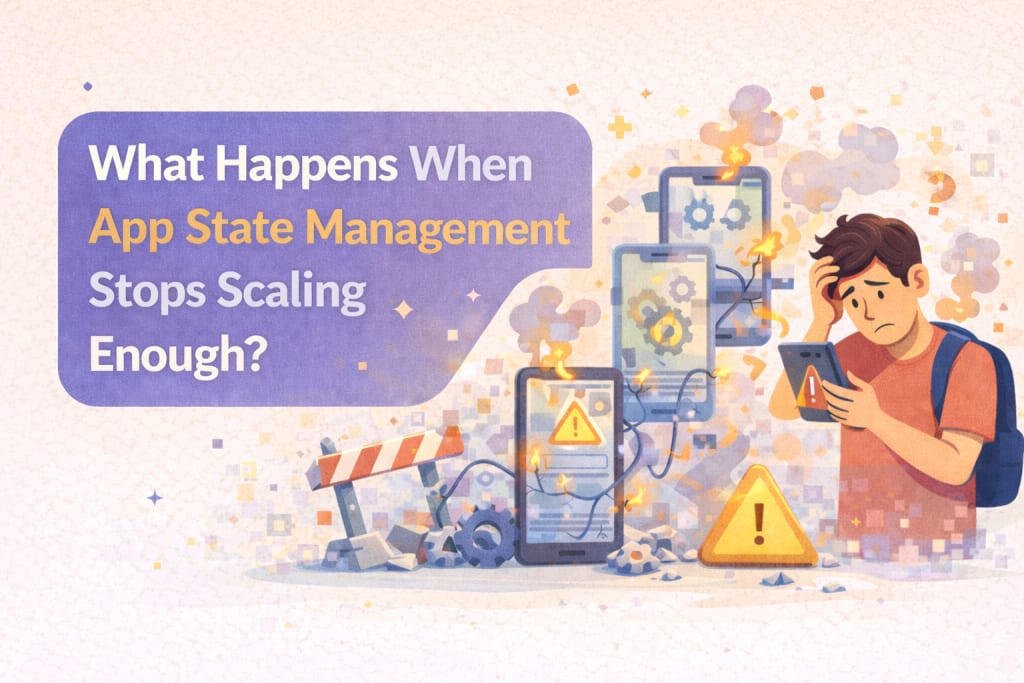
I noticed it when a simple question no longer had a simple answer. Someone asked where a value came from, and three people answered differently. None of them were wrong. That was the unsettling part. The app was behaving exactly as it had been taught to behave, yet no one could fully explain why it behaved that way anymore.
That’s usually the moment when state management hasn’t failed, but it has stopped scaling in a way humans can keep up with.
State Scales Technically Before It Scales Mentally
Most state systems scale technically for a long time. They hold more data. They sync across more screens. They survive longer sessions.
The problem shows up in the minds of the people working on them.
Developers stop being able to hold the full picture. Understanding requires context that lives in conversations, not code. Changes feel heavier because no one is fully sure what they might disturb.
The app still runs. The understanding doesn’t.
Early State Feels Intuitive and Close
In the early days, state feels almost physical. You know where it lives. You know who owns it.
A screen loads data. A user changes something. The state updates. The UI reflects it.
That simplicity creates confidence. Decisions feel local. Fixes feel safe.
As the app grows, state spreads. It has to. More features need access. More lifecycles interact.
The distance between cause and effect quietly increases.
When Ownership Becomes Shared by Everyone and No One
One of the first signs of trouble is blurred ownership.
State is read in many places. Written in fewer. Fully understood by almost none.
People hesitate to change it because they don’t feel entitled to. Others feel responsible for it but can’t explain all its uses.
This shared uncertainty slows everything down. Even small changes require coordination.
State becomes political instead of practical.
Scaling State Introduces Time as a Factor
Early state is immediate. It exists now.
Later state exists across time. Sessions. Backgrounding. Restoration. Partial updates.
Values carry history. Assumptions linger longer than intended.
Bugs stop being about incorrect values and start being about values that were correct once and never let go.
The app behaves logically according to rules no one remembers writing.
Debugging Turns Into Archaeology
When state stops scaling, debugging changes character.
You’re no longer fixing what just happened. You’re uncovering what happened earlier.
Breakpoints help less. Logs grow longer. Reproductions require patience and luck.
Developers trace state backward through layers, lifecycles, and cached decisions.
Each fix feels tentative because understanding feels incomplete.
Performance Degrades Without Obvious Waste
State that doesn’t scale well often hurts performance quietly.
Extra observers react to changes they don’t need. Redundant updates ripple through systems. Recomposition happens more often than expected.
Nothing looks wasteful in isolation. Collectively, the app feels heavier.
Users don’t complain about logic. They complain about feel.
State Becomes a Constraint on New Ideas
When state is hard to reason about, it shapes product decisions.
Teams avoid features that require new flows. They compromise designs to fit existing state models.
Ideas are filtered not by value, but by perceived risk.
The app’s future is shaped by its past more than its goals.
Tests Stay Green While Confidence Drops
One of the most confusing aspects is that tests often remain green.
State issues are often emergent. They involve timing, history, and interaction density.
Tests validate correctness in isolation. They don’t capture lived complexity.
So teams face a strange gap. Everything passes. Nothing feels safe.
Scaling Teams Expose State Fragility
Small teams survive state complexity through shared memory.
As teams grow, that memory fragments.
New contributors struggle to understand flows. Onboarding slows. Mistakes repeat.
In environments like mobile app development Atlanta, where apps often evolve across multiple teams and timelines, state systems that once felt manageable start resisting collaboration.
The app scales. Understanding doesn’t.
Workarounds Start to Define Behavior
When state becomes hard to change, workarounds appear.
Flags. Temporary overrides. Conditional resets.
Each one solves a problem. Each one adds another layer of behavior.
Over time, these workarounds stop feeling temporary. They become part of how the app works.
State becomes a story instead of a structure.
Refactoring Feels Risky Because Everything Depends on State
Refactoring relies on knowing boundaries.
When state touches everything, boundaries disappear.
Removing or relocating state feels dangerous. Teams fear unintended effects.
So refactoring is postponed. The cost compounds.
The system becomes harder to improve precisely because it needs improvement.
State Management Stops Being a Tool
At its best, state management is invisible. It supports behavior without demanding attention.
When it stops scaling, it demands constant explanation.
Meetings include diagrams. Code reviews include long comment threads. Decisions require history lessons.
State stops serving the team and starts consuming energy.
Why Centralization Isn’t Always the Answer
Many teams respond by centralizing state.
Sometimes this helps. Sometimes it concentrates complexity.
When everything flows through one place, every change feels global.
Centralization without clear boundaries trades distributed confusion for centralized tension.
Scaling requires clarity, not just consolidation.
The Cost Is Paid in Time and Trust
The real cost of non-scaling state isn’t crashes.
It’s time. Time spent understanding. Time spent coordinating. Time spent being careful.
Trust erodes. Developers stop trusting the system. The system stops trusting changes.
Velocity drops without a clear reason.
Healthier State Scales by Forgetting
State that scales well knows how to disappear.
It has clear lifetimes. It resets confidently. It avoids surviving longer than necessary.
Forgetting isn’t loss. It’s design.
Apps that forget intentionally stay understandable longer.
Designing State for Growth, Not Permanence
State systems often assume permanence. Once something exists, it stays.
Scaling requires the opposite assumption.
Things will change. Features will evolve. Past decisions should fade naturally.
State designed with endings ages better than state designed to accumulate.
The Moment the Problem Became Clear
I remember the meeting where everything clicked.
We weren’t dealing with a bug. We were dealing with a system that had outgrown its mental model.
Once we saw that, solutions became smaller. Clearer ownership. Shorter lifetimes. Fewer shared assumptions.
The app didn’t lose functionality. It gained calm.
Ending With the App That Learned to Let Go
After changes, the app felt different.
Not faster. Not smarter.
Just easier.
Conversations shortened. Fixes felt safer. New features didn’t require apologies.
State management stopped scaling enough when it asked more understanding than humans could provide.
When teams design state to remain explainable, local, and temporary, apps don’t just scale technically. They scale humanly.
That’s when progress feels sustainable again.
FAQs
What does it mean when state management stops scaling?
It means the system still works technically, but understanding, changing, and trusting it becomes increasingly difficult for the team.
Why do state issues appear gradually instead of suddenly?
Because state accumulates over time. Each small decision feels reasonable, but together they create complexity that only becomes visible later.
Why don’t tests catch these problems?
Tests focus on correctness, not historical behavior or interaction density. Many state issues depend on timing and sequence.
Is shared state the main problem?
Not always. Shared state becomes risky when ownership and lifetime aren’t clear.
Why does performance suffer when state doesn’t scale?
Because unnecessary updates, observers, and recomputation accumulate quietly without obvious failure.
Can centralizing state fix scalability issues?
Sometimes, but not by itself. Without clear boundaries, centralization can increase tension instead of clarity.
Why do teams avoid refactoring state-heavy systems?
Because everything feels connected. The risk of unintended impact feels high.
How early should teams think about state scalability?
From the beginning. Early patterns tend to spread and harden over time.
What’s the biggest warning sign of non-scaling state?
When simple changes require long explanations and multiple people to confirm safety.
How can teams improve state scalability over time?
By shortening state lifetimes, clarifying ownership, and designing systems that can forget safely.
Why does this problem affect growing teams more?
Because shared understanding fades as teams expand. State systems must carry clarity, not rely on memory.
What’s the core lesson about state management at scale?
State must scale not just in size, but in explainability. When humans can no longer reason about it easily, the system has already grown too far.
About the Creator
~ Fired ~
— Ai Intrusion ~ Are you Next ~ Is Ai Evolution after your job? — Few workplaces haven't been affected. Ai is in supermarkets, at doctors' offices, and even monitoring farms. I just can't think of anything this machine is not getting into, can you? For instance: Education ~ Law and Tech jobs will one day have a major influence or be taken over by these inanimate machines, with accuracy and vigor. From mechanics' diagnoses to a wide variety of everyday jobs, including fast food workers, with this input having the ability to cut their unnecessary work hours. I'm certain all of us have been touched by this with our short stories and colorful headings, have you? Even comments are very questionable 'Non-Robot' insertions.
By Jay Kantor3 days ago in Journal
From Data to Direction
Navigating an Information-First World Modern organizations operate in an environment defined by constant data generation. Information flows continuously from customer interactions, digital platforms, internal systems, and global networks. While access to data has never been easier, interpreting it accurately has become increasingly complex.
By Nathan Haslick7 days ago in Journal



Comments
There are no comments for this story
Be the first to respond and start the conversation.