
What happened in Minneapolis ICE Shooting
What really happened


On 7 Jan, Wednesday morning in Minneapolis, 37-year-old Renee Nicole Good dropped her six-year-old child off at school. Shortly after, federal agents in unmarked vehicles confronted her. Within moments, an agent fired three shots into her maroon SUV. Good, a mother of three and U.S. citizen, died at the scene.
The Trump administration immediately framed the incident as self-defense. Secretary Kristi Noem characterized it as "domestic terrorism," claiming Good used her vehicle as a weapon. President Trump stated that Good "violently, willfully, and viciously ran over" the ICE officer, adding it was "hard to believe" the officer survived and was now "recovering in the hospital."
But a detailed video analysis by The New York Times — using synchronized footage from multiple bystander cameras — tells a starkly different story.
What the video evidence actually shows
The Times synchronized footage from multiple angles to create a second-by-second reconstruction of the shooting.
Before the shooting: Good's SUV is stationary, surrounded by unmarked federal vehicles with lights and sirens activated. Bystanders are yelling at the agents, blowing whistles. One shouts: "Go home to Texas."
The confrontation: Good rolls forward slightly, then stops to let other vehicles pass. Two agents exit a silver pickup and approach her vehicle. One grabs the door handle and reaches inside the car.
The flight attempt: Good reverses, then turns right — apparently attempting to leave the chaotic scene.
The shots: As Good drives past, the agent who had been filming the encounter pulls his firearm and fires three shots at close range.
The critical detail: At the moment the agent fires, synchronized video shows he is standing to the left of the SUV. The vehicle's wheels are turned to the right, away from him. He is not in the vehicle's path. His feet are positioned away from the SUV.
This directly contradicts claims that Good was ramming the officer or that he was being run over.
After the shooting, the SUV crashes into a parked car down the street. The agent who fired the shots walks away, visibly uninjured. Video shows him casually strolling from the scene — a stark contrast to Trump's claim about an officer in the hospital recovering from being run over.
The failure to render aid
What happened after the shooting raises concerns about protocol and accountability.
Federal agents on scene did not immediately rush to provide emergency medical care. Eventually, the shooting agent approaches the vehicle, then turns back and tells colleagues to call 911.
Bystanders can be heard shouting: "You shot someone" and "Shame."
Multiple witnesses attempted to provide medical assistance, including one who identified himself as a physician. Agents blocked them from reaching Good.
Then, several agents — including the one who opened fire — got in their vehicles and drove away from the active crime scene. This apparent alteration of a crime scene before emergency responders arrived violates standard law enforcement protocols.
Why this violates use-of-force standards
Law enforcement training and policy are explicit about vehicle-involved confrontations. The standards exist precisely because officers have the power to use lethal force.
Standard protocols include:
- Officers should never approach a vehicle from the front, positioning themselves at a 90-degree angle to avoid being in the vehicle's path
- Officers are trained to move out of a vehicle's path rather than use lethal force
- Deadly force is prohibited solely to prevent escape
- Deadly force may only be used when no other reasonable means of defense exist — which explicitly includes moving out of the vehicle's path
- Officers should not fire at moving vehicles, as shooting will not stop a vehicle moving in your direction
According to the video evidence, the agent had already moved out of the vehicle's path before firing. By the third shot, the vehicle had passed him entirely — meaning no immediate threat remained.
The agent involved was a veteran officer who joined ICE in 2016, not a rookie who might plausibly claim inadequate training. He would have been thoroughly trained in these protocols.
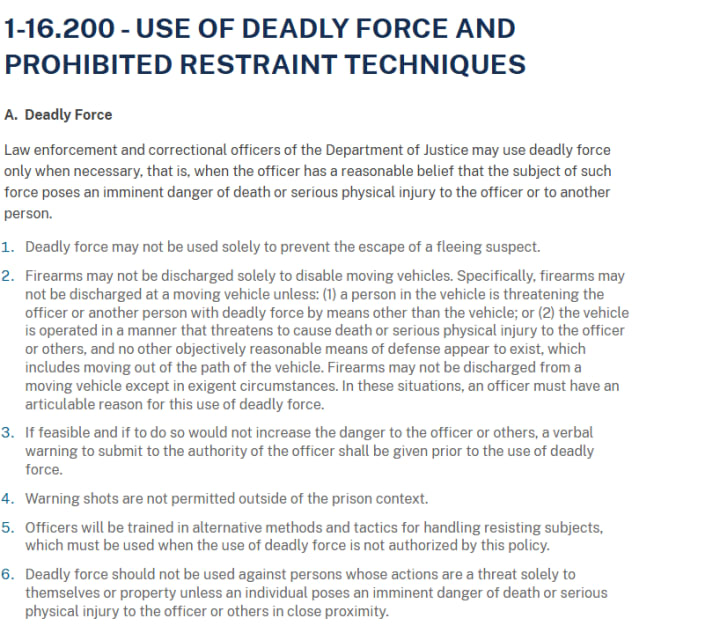
Secretary Noem's claim that "our officer followed his training and did exactly what he was taught to do" appears demonstrably false based on standard ICE training procedures.
The "domestic terrorism" framing
The characterization of Good as a domestic terrorist conducting a coordinated attack represents one of the most contentious aspects of the official response.
Noem stated: "This domestic act of terrorism to use your vehicle to try to kill law enforcement officers is going to stop. I'm asking the Department of Justice to prosecute it as domestic terrorism because it's clear that it's being coordinated. People are being trained and told how to use their vehicles to impede law enforcement."
The evidence contradicting this narrative includes:
- Good had just dropped her six-year-old at school
- Her car contained a stuffed animal and had stickers on the back
- Personal belongings were visible in the vehicle
- She appeared to be a frightened civilian confronted by masked, armed men in unmarked vehicles
- Video shows her initially waving vehicles past before the confrontation escalated
- Her steering wheel turned away from the officer, suggesting flight rather than attack
The leap from "mother fleeing a confusing confrontation" to "trained domestic terrorist engaged in coordinated attack" requires evidence that has not been presented.
The claim of absolute immunity
The controversy escalated further when Vice President JD Vance appeared on television to defend the shooting, making a claim about federal power:
"The precedent here is very simple. You have a federal law enforcement official engaging in federal law enforcement action. That's a federal issue. That guy is protected by absolute immunity."
This statement raises fundamental questions about accountability and the rule of law.
Use-of-force rules exist specifically because officers have extraordinary power — including the lawful use of lethal violence. When agents operate masked, in unmarked vehicles, without visible identification, accountability becomes the only safeguard against abuse of power.
The claim that federal agents conducting operations have "absolute immunity" from consequences would effectively eliminate oversight of federal law enforcement conduct.
It suggests that no matter how egregiously an agent violates established protocols, they face no consequences simply because they were engaged in federal law enforcement activity.
The 2026 midterms as a pressure point
People can disagree about immigration policy, about border security, about the proper scope of ICE operations. Those are legitimate policy debates.
But whether an officer who violates established protocols and kills an unarmed mother should face any consequences should not be a partisan question. It's a question about the most basic requirements of accountability in a democratic society.
Given the Vice President's statement about "absolute immunity," it remains unclear whether any accountability mechanism exists that would result in consequences for the shooting, even if investigators determine protocols were violated.
Minneapolis Mayor Jacob Frey responded to DHS statements about the incident by saying "that is bullshit" and telling ICE to "get the fuck out of Minneapolis." His reaction reflects the fury public feel about federal operations conducted in their jurisdictions without coordination or accountability to local authorities.
The video evidence is public. The official statements are documented. The choice about what kind of country America becomes rests with citizens who still have the power to make that choice at the ballot box.
For now.
About the Creator
Arsalan Haroon
Writer┃Speculator
Keep reading
More stories from Arsalan Haroon and writers in Journal and other communities.
How People Get Rich Without a Normal Job
The Meme Coin Millionaire You're 16. It's late — the kind of late where you know you'll regret it tomorrow during the first period. You're already in bed, lights off, phone glowing in the dark, when the notification comes through.
By Arsalan Haroon29 days ago in Journal
~ Fired ~
— Ai Intrusion ~ Are you Next ~ Is Ai Evolution after your job? — Few workplaces haven't been affected. Ai is in supermarkets, at doctors' offices, and even monitoring farms. I just can't think of anything this machine is not getting into, can you? For instance: Education ~ Law and Tech jobs will one day have a major influence or be taken over by these inanimate machines, with accuracy and vigor. From mechanics' diagnoses to a wide variety of everyday jobs, including fast food workers, with this input having the ability to cut their unnecessary work hours. I'm certain all of us have been touched by this with our short stories and colorful headings, have you? Even comments are very questionable 'Non-Robot' insertions.
By Jay Kantor2 days ago in Journal


Comments
There are no comments for this story
Be the first to respond and start the conversation.