
The Moment I Realized My Body Was No Longer on Alert
How I noticed the shift from quiet vigilance to quiet ease

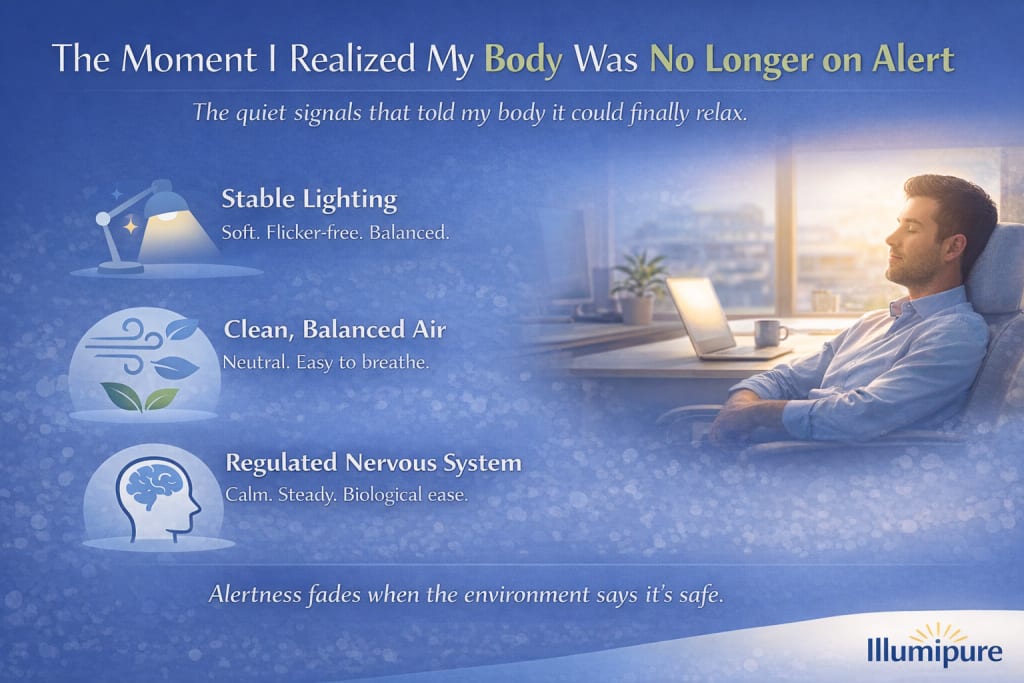
I didn’t notice the tension leaving.
I noticed its absence.
For months, maybe years, I had been carrying a subtle sense of readiness. Not anxiety exactly. Not fear. Just a constant low-level alertness that hummed beneath everything I did. My shoulders were rarely fully relaxed. My breathing stayed slightly shallow. Even when I sat still, my body felt prepared for something.
I assumed that was normal.
Work demands attention. Life requires responsiveness. Of course the body would stay slightly activated. That seemed reasonable. But one afternoon, in the middle of an ordinary workday, something felt different.
I was reading through a document that required sustained concentration. Twenty minutes passed. Then thirty. I hadn’t shifted in my chair. I hadn’t rubbed my neck. I hadn’t taken a deep breath to “reset.” My muscles felt neutral. My jaw wasn’t clenched. My chest wasn’t tight.
For the first time in a long while, my body felt unguarded.
The realization was subtle but unmistakable. The internal hum of alertness was gone. Not replaced with drowsiness or dullness. Just quiet.
That was the moment I realized how long I had been on alert without knowing it.
The human nervous system is designed to scan for instability. Light changes, air quality shifts, subtle sounds, and environmental unpredictability all feed into autonomic regulation. When the brain detects irregularities, even minor ones, it increases vigilance. Muscles engage slightly. Breath shortens. Heart rate rises just enough to prepare.
In modern indoor environments, that vigilance can become chronic.
Flicker in artificial lighting may not be consciously visible, but the visual cortex detects it. Sharp spectral imbalances—especially excessive blue wavelengths—can signal daytime alertness more intensely than necessary. Uneven brightness forces the eyes to constantly adjust. Subtle air stagnation can increase carbon dioxide levels just enough to influence respiration.
None of these factors feel dramatic. But together, they create a state of low-grade activation.
For a long time, I mistook that activation for productivity. I believed the slight tension meant I was engaged. Focused. Responsive. But engagement doesn’t require strain.
On the day my body finally relaxed, the environment around me had shifted toward stability. The lighting was steady and balanced. There was no flicker pulling at the edges of my awareness. The air felt neutral and easy to breathe. Nothing in the room demanded correction.
And without that demand, my nervous system stopped preparing.
I noticed it first in my breathing. It dropped lower into my abdomen without conscious effort. My shoulders felt heavier against the back of my chair—not slumped, just supported. My eyes moved smoothly across the page instead of darting in small corrective motions.
The absence of alertness didn’t make me less sharp. It made me clearer.
When the sympathetic nervous system quiets, the parasympathetic system can engage more fully. In that state, cognitive processing becomes more efficient. Attention stabilizes. The body conserves energy rather than burning it on subtle defense.
I worked through the afternoon without the usual tension building in my neck. My thoughts moved in longer, uninterrupted lines. Even interruptions felt manageable instead of jarring.
What struck me most was how much effort I had been expending simply to remain regulated. When a space contains small sensory stressors, the brain spends resources compensating. That compensation becomes background noise—until it disappears.
The moment my body was no longer on alert didn’t arrive with a dramatic exhale. It arrived as steadiness.
By the end of the day, I wasn’t depleted in the way I typically was. My muscles didn’t ache from unconscious bracing. My mind didn’t feel overstimulated. There was a sense of completion instead of collapse.
It made me reconsider how often we interpret chronic activation as normal. We blame ourselves for tension. We assume shallow breathing is stress. We believe fatigue is simply the cost of productivity.
But sometimes the body is responding appropriately to an environment that isn’t biologically aligned.
When light supports circadian balance instead of overstimulating it, alertness becomes natural rather than forced. When air quality remains clean and balanced, respiration stays steady. When sensory input is predictable, the brain stops scanning for instability.
That’s when vigilance fades.
And when vigilance fades, clarity deepens.
The moment I realized my body was no longer on alert wasn’t dramatic. It was quiet and grounding. I felt present without bracing. Focused without strain. Calm without effort.
Now I understand that true productivity doesn’t come from constant activation. It comes from stability.
When the environment stops triggering subtle vigilance, the body finally trusts the space it’s in.
And that trust feels like ease.
About the Creator
illumipure
Sharing insights on indoor air quality, sustainable lighting, and healthier built environments. Here to help people understand the science behind cleaner indoor spaces.
Keep reading
More stories from illumipure and writers in Journal and other communities.
When the Space Finally Felt Supportive Instead of Neutral
For a long time, I described my workspace as “fine.” It wasn’t uncomfortable. It wasn’t distracting in any obvious way. The lighting worked. The air circulated. The temperature was reasonable. Nothing about it demanded complaint. If someone had asked how it felt to work there, I would have said it was neutral.
By illumipure2 days ago in Journal
~ Fired ~
— Ai Intrusion ~ Are you Next ~ Is Ai Evolution after your job? — Few workplaces haven't been affected. Ai is in supermarkets, at doctors' offices, and even monitoring farms. I just can't think of anything this machine is not getting into, can you? For instance: Education ~ Law and Tech jobs will one day have a major influence or be taken over by these inanimate machines, with accuracy and vigor. From mechanics' diagnoses to a wide variety of everyday jobs, including fast food workers, with this input having the ability to cut their unnecessary work hours. I'm certain all of us have been touched by this with our short stories and colorful headings, have you? Even comments are very questionable 'Non-Robot' insertions.
By Jay Kantor20 days ago in Journal
At My Wits’ End
Life is about taking out the trash and calling it trash because you have every reason to. It wasn't meant to be linear, they say. But the times you tried to make it straight led to problems, and you didn’t have the tools to put any of it to use. You don't put your right shoes on the right feet; you put the left shoes on the left feet. The grey hardened slab will trip you up anyway.
By Caitlin Charlton2 days ago in Humans



Comments
There are no comments for this story
Be the first to respond and start the conversation.