
The $1.7 Billion Question: Where is the Europe Real Estate Market Headed?
Strict EU regulations like the EPBD (Energy Performance of Buildings Directive) are creating a premium for energy-efficient buildings while applying a "brown discount" to older structures.

Europe stands at a pivotal crossroads where historic architecture meets urgent modern demands. As investors and stakeholders navigate the Europe real estate market, they face a landscape defined by rapid regulatory changes and shifting demographic needs. The fundamental question is no longer just about location; it is about value, sustainability, and future-proofing assets against a volatile economic backdrop.
The numbers tell a compelling story of resilience. According to the latest data from the IMARC Group, the European real estate market size reached a valuation of USD 1.7 billion in 2025. Furthermore, analysts forecast this figure will climb to USD 2.5 billion by 2034. This growth represents a steady trajectory, offering significant opportunities for those who understand the underlying currents reshaping the continent’s property sector.
What is the current growth trajectory of the European property sector?
The market is on a steady upward path, projected to grow at a CAGR of 4.46% between 2026 and 2034, driven by rapid urbanization and interest rate stabilization.
Stability is returning to the sector after a period of volatility. The Europe real estate market forecast 2034 indicates a healthy Compound Annual Growth Rate (CAGR) of 4.46%. This growth is not accidental. It stems from a fundamental mismatch between supply and demand, particularly in urban centers where population density is increasing.
However, to understand the full picture, we must look beyond the revenue metrics. While IMARC values the specific analyzed market scope at US$ 1.7 Billion, the actual capital flowing through European assets is massive. For context, investment reports from CBRE highlight that total real estate investment volumes in Europe reached approximately €241 Billion recently. This contrast highlights a key insight: the service and transactional revenue (the $1.7B figure) is the engine driving a multi-trillion-dollar asset class. Consequently, the "service" of real estate - managing, selling, and leasing - is becoming more valuable as the assets themselves become more complex to handle.
Which market segments are dominating the landscape?
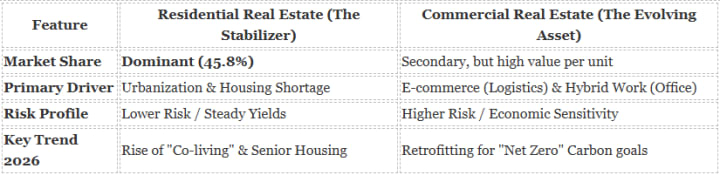
Residential real estate currently holds the largest market share (45.8%), fueled by acute housing shortages and high demand for rentals in metropolitan hubs.
The data is clear: housing remains the bedrock of the European market. IMARC Group segmentation reveals that the Residential sector accounts for 45.8% of the total market share. This dominance is driven by a chronic undersupply of homes in major cities like London, Berlin, and Paris.
Urban migration continues to pressure existing stock. Therefore, developers are shifting focus. They are moving away from traditional single-family homes toward high-density solutions. We are seeing a surge in "Build-to-Rent" (BTR) projects and purpose-built student accommodation. Investors view these assets as "defensive" plays. Even in economic downturns, people need a place to live. This makes the residential sector a safe harbor compared to the volatility seen in retail or office spaces.
Why does Germany hold the "Lion's Share" of the market?
Germany commands 32.0% of the total market share, leveraging its robust industrial base and stable tenant laws to attract the bulk of cross-border investment.
Germany remains the undisputed powerhouse of European property. Holding nearly one-third (32.0%) of the entire Europe Real Estate Market, the nation benefits from a decentralized urban structure. Unlike the UK or France, which rely heavily on a single capital city, Germany boasts multiple "Tier 1" investment hubs including Frankfurt, Munich, Hamburg, and Berlin.
Germany real estate market share dominance is also linked to its high rate of tenancy. A significant portion of the German population rents rather than owns. This creates a steady, reliable income stream for institutional investors. Furthermore, Germany's legal framework provides a level of certainty that is attractive to foreign capital. While other regions struggle with political instability, Germany offers a predictable environment for long-term capital deployment.
How do Commercial and Residential investments compare in 2026?
While residential offers stability through essential demand, commercial real estate is pivoting toward "high-quality" logistics and green-certified office spaces to combat vacancy rates.
The divergence between these two sectors is widening. Commercial vs Residential property trends show that while residential is about scarcity, commercial is about quality. The rise of hybrid work has permanently altered the office landscape. Companies no longer need vast floor plates; they need "destination" offices that entice workers back to their desks.
Simultaneously, the logistics boom continues. E-commerce drives the need for "last-mile" delivery hubs, making industrial warehouses some of the highest-yielding assets in the portfolio.
To help you evaluate where capital is flowing, we have compiled this comparative analysis:
How is the "Green Deal" reshaping property values?
Strict EU regulations like the EPBD (Energy Performance of Buildings Directive) are creating a premium for energy-efficient buildings while applying a "brown discount" to older structures.
Sustainability is no longer a buzzword; it is a legal requirement. Green building regulations EU are the single most disruptive force in the market today. The European Union's ambitious "Green Deal" aims to make the continent climate-neutral by 2050. Consequently, real estate assets are under the microscope.
Investors are now pricing in a "Brown Discount." This refers to the loss in value for buildings that fail to meet modern energy standards. Conversely, "Green Premiums" are real. Tenants are willing to pay higher rents for buildings with low carbon footprints and high energy ratings. Sustainable urban development Europe is driving a massive wave of renovation. Estimates suggest that 85% of the buildings standing today will still be in use in 2050. Therefore, the retrofitting market is exploding as owners scramble to upgrade insulation, heating systems, and solar capabilities to avoid stranded assets.
What role will PropTech play in the future of European real estate?
The shift from offline (currently 64.5%) to online transactions is accelerating, with AI and blockchain streamlining property management and sales processes.
Traditionally, real estate has been a slow, paper-heavy industry. IMARC Group data indicates that the Offline mode of distribution still holds 64.5% of the market. However, this is rapidly changing. PropTech advancements Europe are digitizing every step of the value chain.
From virtual reality tours that allow remote viewing to blockchain smart contracts that speed up closing times, technology is reducing friction. AI algorithms are now capable of predicting valuation trends with frightening accuracy, giving tech-savvy investors a distinct edge. As the market grows toward that US$ 2.5 Billion forecast, the "Online" segment is expected to eat into the traditional offline share, democratizing access to property investment.
Conclusion
The question of where the market is headed has a clear answer: it is heading toward efficiency, sustainability, and digitalization. With a CAGR of 4.46%, the sector is healthy, but the rules of engagement have changed.
For investors and stakeholders, the US$ 1.7 billion valuation is just the starting line. The real value lies in understanding the segmentation - knowing that Residential offers safety while specialized Commercial sectors offer growth. It lies in recognizing Germany's pivotal role and the non-negotiable nature of the Green Deal. The future belongs to those who view real estate not just as concrete and steel, but as a dynamic service integrated with technology and environmental responsibility.
References:
- IMARC Group: Europe Real Estate Market: Industry Trends, Share, Size, Growth, Opportunity and Forecast 2026-2034.
- CBRE: European Real Estate Market Outlook 2025.
- European Commission: Energy Performance of Buildings Directive (EPBD).
- Savills: European Commercial Property Trends.
About the Creator
Joey Moore
I'm Joey Moore, a seasoned Research Analyst with 5+ years of experience in market research. Expert in data analysis, strategic planning, and industry insights. Proven track record in delivering actionable reports.
Keep reading
More stories from Joey Moore and writers in Journal and other communities.
Gen Z vs Millennials: Generational Shifts in the Europe Cosmetics Market
The beauty industry in Europe is currently undergoing a seismic transformation, driven by the distinct habits of two powerful demographics. As brands navigate the Europe cosmetics market, they must reconcile the impulsive, ethics-driven demands of Gen Z with the research-heavy, wellness-focused preferences of Millennials. Understanding these nuances is no longer optional; it is essential for survival in a highly competitive landscape.
By Joey Mooreabout 15 hours ago in Journal
Building Strong Businesses Through Strategy and Adaptability
In the modern business landscape, adaptability has become one of the most valuable skills an entrepreneur or business leader can possess. Markets evolve quickly, consumer expectations shift constantly, and external pressures—economic, technological, or social—can reshape industries overnight. In this environment, businesses that survive are rarely the fastest-growing ones; they are the most thoughtful and resilient.
By ORM_Specialist8 days ago in Journal




Comments
There are no comments for this story
Be the first to respond and start the conversation.