
Gen Z vs Millennials: Generational Shifts in the Europe Cosmetics Market
Gen Z prioritizes identity and inclusivity, favoring gender-neutral brands and products that align with their ethical values rather than traditional luxury status.

The beauty industry in Europe is currently undergoing a seismic transformation, driven by the distinct habits of two powerful demographics. As brands navigate the Europe cosmetics market, they must reconcile the impulsive, ethics-driven demands of Gen Z with the research-heavy, wellness-focused preferences of Millennials. Understanding these nuances is no longer optional; it is essential for survival in a highly competitive landscape.
According to authoritative market analysis, the stakes are incredibly high. Data from the IMARC Group reveals that the Europe cosmetics market size reached a valuation of USD 111.3 billion in 2025. Furthermore, analysts project this figure will rise to USD 138.7 billion by 2034. This robust growth trajectory highlights the immense opportunity available for brands that can successfully bridge the generational divide.
What defines the current growth of the Europe Cosmetics Market?
The market is steadily climbing with a projected CAGR of 2.50% during the forecast period (2026-2034), fueled by organic formulations and technological integration.
This steady growth is not happening in a vacuum. Rather, it is the result of specific structural shifts identified by market researchers. IMARC Group highlights that the rising demand for natural and organic goods is a primary driver. European consumers are increasingly scrutinizing labels, rejecting harsh chemicals in favor of botanical ingredients. Consequently, brands are reformulating legacy products to meet these heightened expectations.
Moreover, technology plays a pivotal role. The integration of Artificial Intelligence (AI) and Augmented Reality (AR) allows consumers to virtually try on makeup or analyze their skin conditions via smartphone apps. This tech-forward approach removes friction from the buying process, specifically benefiting online sales channels. Additionally, the expanding male grooming sector contributes significantly to this upward trend, as societal norms regarding male beauty routines continue to relax across the continent.
How is Gen Z specifically reshaping European beauty standards?
Gen Z prioritizes identity and inclusivity, favoring gender-neutral brands and products that align with their ethical values rather than traditional luxury status.
For this generation, born between 1997 and 2012, beauty is a vehicle for self-expression rather than concealment. Gen Z consumer behavior cosmetics analysis shows a marked departure from the "perfectionist" aesthetic of the 2010s. Instead, they champion authenticity. This shift forces companies to rethink everything from shade ranges to marketing imagery. If a brand does not genuinely represent diversity, Gen Z will likely boycott it.
Social media platforms are the engine of this change. TikTok beauty trends in Europe are now the fastest way to launch - or destroy - a product. Unlike previous generations who looked to glossy magazines, Gen Z looks to "SkinTok" and influencers who offer raw, unfiltered reviews. They embrace "dupe culture," actively seeking affordable alternatives to high-end products. This behavior forces luxury brands to justify their price points more aggressively.
Furthermore, their ethical stance is non-negotiable. They heavily favor vegan and cruelty-free makeup. For Gen Z, a mascara that performs well but tests on animals is a dealbreaker. They demand that their consumption does not harm the planet or its inhabitants, pushing the entire industry toward more humane practices.
Why do Millennials differ in their approach to skincare and beauty?
Millennials are the primary drivers of the "Dermocosmetics" sector, focusing on ingredients, clinical efficacy, and preventative care rather than impulse experimentation.
In contrast to their younger counterparts, Millennials (born between 1981 and 1996) approach beauty with a research-oriented mindset. They witnessed the rise of the internet and are adept at fact-checking claims. Consequently, they are less swayed by flashy packaging and more interested in the science inside the bottle. This demographic is responsible for the booming dermocosmetics market trends across Europe, where pharmacy brands like La Roche-Posay and CeraVe reign supreme.
Their focus has shifted from covering imperfections to treating them at the source. The conversation has moved from "anti-aging" to "anti-aging vs. preventative skincare." Millennials are investing heavily in retinol, Vitamin C, and SPF, viewing these purchases as long-term investments in their health.
Insights from McKinsey & Company suggest that for Millennials, beauty is now an extension of the "Wellness" industry. They are willing to pay a premium, but only if the product promises tangible, clinical results. They treat skincare routines as self-care rituals, often preferring established heritage brands that offer transparency and proven efficacy over viral, fly-by-night trends.
What are the key buying differences between Gen Z and Millennials?
While Gen Z seeks "indulgence on a budget" and listens to peers on TikTok, Millennials prioritize wellness and invest in premium, science-backed solutions.
The financial reality of these generations dictates their spending. Euromonitor insights suggest that while Gen Z's purchasing power is growing, they currently face economic instability and high youth unemployment in parts of Europe. Therefore, they make frequent, smaller purchases. Conversely, Millennials are currently at their peak earning potential, allowing them to drive the "premiumization" of the market.
To visualize these distinct behaviors, we have compiled the following comparison based on data from NielsenIQ (NIQ) and market reports:
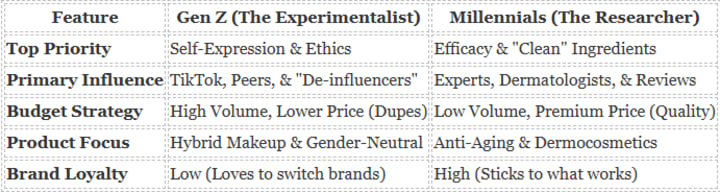
Data from NIQ further supports this divergence, noting that Gen Z often trades "quality for fun," whereas Millennials will sacrifice novelty for reliability.
Which sustainability trends are non-negotiable for European consumers?
Both generations demand transparency, specifically focusing on clean beauty standards and strict adherence to sustainable packaging regulations.
While their buying habits differ, their environmental values align. Europe leads the world in regulatory standards, and consumers expect brands to exceed these baselines. Clean beauty standards in Europe are becoming stricter, with consumers demanding "free-from" lists that exclude parabens, sulfates, and silicones. However, "clean" is no longer enough; the lifecycle of the product matters too.
Sustainable packaging regulations in the EU are forcing a massive overhaul in logistics. Consumers are increasingly rejecting single-use plastics. They prefer refillable systems, glass packaging, or biodegradable materials. A brand that uses excessive plastic wrap is viewed as out of touch.
For Gen Z, this extends to the carbon footprint of shipping. For Millennials, it extends to the sourcing of ingredients - they want to know if the shea butter was ethically harvested. Transparency is the new currency of trust. If a brand cannot prove its eco-claims, it faces accusations of "greenwashing," which can permanently damage its reputation in the European market.
What is the future outlook for the European cosmetics sector?
The market is evolving toward a hybrid model where brands must prove both their clinical results and their social values to capture forecasted growth.
The future of the Europe cosmetics market lies in convergence. Successful brands will be those that can appeal to the Gen Z desire for ethical, fun, and inclusive beauty while simultaneously satisfying the Millennial demand for scientific rigor and performance.
As indicated by the IMARC Group forecast, the path to a US$ 138.7 billion valuation by 2034 will be paved with innovation. We can expect to see more "hybrid" products - such as serum-infused foundations - that bridge the gap between skincare and makeup. Additionally, the definition of beauty will continue to expand, becoming more gender-fluid and age-inclusive.
Ultimately, the European market remains a global trendsetter. By understanding the distinct yet overlapping values of Gen Z and Millennials, companies can secure their place in this dynamic, growing industry.
References:
- IMARC Group: Europe Cosmetics Market: Industry Trends, Share, Size, Growth, Opportunity and Forecast 2026-2034.
- NIQ (NielsenIQ): Beauty Futures 2025: Gen Z vs Millennial Spending Habits.
- McKinsey & Company: The State of Fashion & Beauty: The Wellness Crossover.
- Euromonitor International: Consumer Finance and Beauty Trends in Western Europe.
About the Creator
Joey Moore
I'm Joey Moore, a seasoned Research Analyst with 5+ years of experience in market research. Expert in data analysis, strategic planning, and industry insights. Proven track record in delivering actionable reports.
Keep reading
More stories from Joey Moore and writers in Journal and other communities.
Medical Cannabis in Europe: Comprehensive Analysis of Opportunities & Challenges
The European healthcare landscape is currently witnessing a historic shift. Specifically, the Europe medical cannabis market is no longer a niche alternative but a burgeoning pharmaceutical giant. According to the latest data from the IMARC Group, the market size reached USD 2,586.1 million in 2024. However, this is just the beginning. Analysts forecast that the market will skyrocket to reach USD 12,652.9 million by 2033, exhibiting a staggering growth rate (CAGR) of 18.33% between 2025 and 2033.
By Joey Moore2 days ago in Journal
Global Books Market Size & Forecast 2025–2033: A Timeless Industry Reinventing Itself for the Digital Age
Introduction: The Enduring Power of Books in a Rapidly Changing World Books have shaped civilizations, preserved cultures, and passed knowledge from one generation to the next for centuries. Even in an age dominated by short-form videos, social media, and artificial intelligence, the written word continues to hold its ground. The global books market is no longer just about ink and paper—it is a diverse ecosystem that spans printed books, e-books, audiobooks, academic texts, and digital platforms, serving readers of every age and background.
By Sakshi Sharma2 days ago in Journal
Off the Book
It ended like every other stupid idea. Badly, and alone. I’m researching digital confession ethics, he said. A tech ethicist. He gestured at floating data I couldn’t see then pulled out a physical notebook. Actual paper, fountain pen. He held it up like he was showing me scripture.
By Nicky Frankly3 days ago in Fiction


Comments
There are no comments for this story
Be the first to respond and start the conversation.