
Ten Rules, Ten Years, One Life: Reflections at 44
Italian executive chef and culinary consultant Cristian Marino recently marked his 44th birthday by reflecting on the leadership lessons he has developed over the last decade while working across international hospitality environments.

The setting is simple.
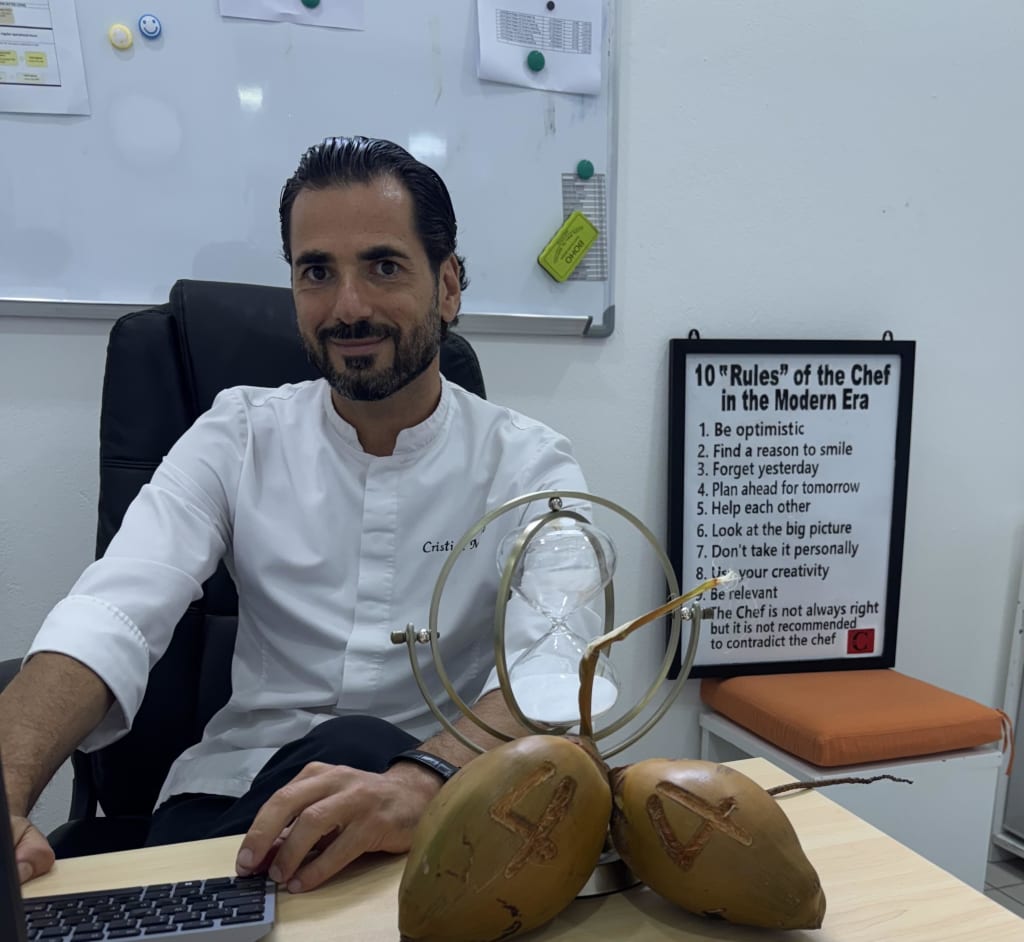
A chef’s jacket. A keyboard resting quietly on the desk beside him. An hourglass placed in front of two coconuts marked with the number 44. Behind him, framed on the wall, hangs a list titled “10 Rules of the Chef in the Modern Era.”
There are no candles. No formal celebration. No crowded dining room filled with applause or noise. Just a moment of pause.
At forty-four years old, Italian executive chef and culinary consultant Cristian Marino chose not to celebrate the number itself, but to reflect on what the last decade of his life has quietly taught him. Not through theory or motivational slogans, but through the daily reality of working in high-pressure international hospitality environments, leading teams, opening restaurants, and navigating cultures across continents.
For professionals who spend their lives in kitchens, time is rarely measured in years. It is measured in services, responsibilities, openings, flights, and decisions that often occur where fatigue, pressure, and expectation intersect.
Turning forty-four did not represent a finish line. It became, instead, a point of observation.
And the list of ten rules hanging behind him became more than a decorative element. It became a silent reminder of lessons tested over time.
When Rules Stop Being Ideas and Start Becoming Tools
Over the last ten years, Marino has often referred to his ten leadership rules not as principles of success, but as survival tools for modern hospitality professionals. According to him, the industry is filled with talent, ambition, and creativity, but also with burnout, emotional overload, and unrealistic expectations of constant perfection.
Experience, he believes, changes the meaning of guidance. What begins as inspiration often transforms into necessity.
One of the first lessons reinforced by time is the difference between optimism and illusion. In the early stages of a career, optimism can easily become blind enthusiasm, the belief that effort alone will control outcomes. A decade of managing complex teams and unpredictable operational environments taught him that optimism is not about expecting easy results. It is about maintaining clarity even when results remain uncertain.
Another lesson emerged from learning to release the weight of the previous day. In hospitality, every service carries emotional residue. Success can inflate ego. Failure can erode confidence. Over time, Marino learned that leadership demands the ability to close emotional chapters quickly. Not forgetting experiences, but refusing to allow yesterday to compromise tomorrow’s performance.
Planning, another recurring rule in his framework, also transformed in meaning over the years. Early in his career, planning represented control. Today, he describes it as preparation without rigidity. The more complex operations become, the clearer it appears that leadership is not about predicting every scenario, but about building teams and systems resilient enough to adapt when predictions fail.
The Quiet Strength of Helping Before Leading
Perhaps the most profound shift in his leadership philosophy came from redefining authority.
In traditional kitchen hierarchies, leadership often manifests through command, speed, and technical dominance. Over the last decade, Marino’s approach gradually shifted toward a model centered on support and presence.
Helping team members, especially during moments of operational pressure, proved to be more effective than directing them from a distance. He observed that trust is rarely built through authority alone. It is built through consistency, availability, and the willingness to share responsibility when challenges arise.
Looking at the bigger picture also became less about strategic expansion and more about human sustainability. Running multiple outlets, consulting for resort openings, and managing culturally diverse teams taught him that operational success loses meaning if it compromises team well-being or long-term balance.
The Discipline of Not Taking Everything Personally
Another lesson reinforced through experience involves emotional boundaries. Hospitality professionals often operate in environments where feedback, criticism, and guest expectations are immediate and sometimes intense.
Learning not to internalize every comment or operational difficulty became essential for preserving clarity in decision-making. Marino often emphasizes that emotional detachment is not indifference. It is professional maturity, the ability to remain responsive without becoming reactive.
Creativity, a fundamental pillar of culinary identity, also evolved in meaning. Earlier in his career, creativity was closely tied to innovation and recognition. Today, he describes creativity as a problem-solving language. The ability to design menus, concepts, and experiences that adapt to logistical realities, cultural contexts, and guest expectations has proven more valuable than purely aesthetic experimentation.
Relevance Without Chasing Trends
Remaining relevant in modern hospitality presents another challenge highlighted by his reflection at forty-four. The industry evolves rapidly, influenced by global trends, social media visibility, and shifting guest preferences.
Marino learned that relevance does not necessarily require constant reinvention. Instead, it requires consistent alignment between identity and evolution. Chefs, he believes, lose direction when they chase trends disconnected from their core philosophy or operational reality.
One of the most humbling realizations over the last decade has been accepting that leadership does not require constant correctness. Early career stages often reward certainty. Mature leadership, he suggests, often rewards listening. The ability to change direction, acknowledge mistakes, and allow team members to contribute ideas has proven to strengthen rather than weaken authority.
Rethinking the Idea of Success
Perhaps the most important insight Marino associates with his ten rules is the gradual redefinition of success itself.
The hospitality industry often celebrates visible achievements: awards, openings, financial results, and public recognition. While these milestones remain significant, he notes that many professionals eventually discover the hidden cost of pursuing them without balance. Burnout, personal disconnection, and emotional fatigue remain widespread realities within the sector.
Over the last ten years, his interpretation of success shifted toward sustainability. Success, in his current view, is measured by the ability to maintain performance without sacrificing health, relationships, or long-term motivation. It is the capacity to lead teams that grow professionally while maintaining personal dignity and psychological stability.
Forty-Four Years Later: Better Questions, Not Final Answers
The hourglass placed on Marino’s desk during his birthday reflection symbolizes more than the passage of time. It represents accumulation. Every grain of sand carries operational decisions, cultural experiences, professional challenges, and personal transformations.
At forty-four, Marino does not present his ten rules as universal formulas. Instead, he considers them checkpoints, reminders shaped by real kitchens, real teams, and real pressure.
The photograph capturing that quiet birthday moment does not portray celebration. It captures evaluation.
After more than two decades in professional kitchens and ten years refining his leadership philosophy, Marino suggests that maturity in hospitality is less about mastering techniques and more about mastering perspective.
At forty-four years old, he does not claim to hold definitive answers. Only clearer priorities, deeper awareness, and the calm necessary to continue asking better questions as time moves forward.
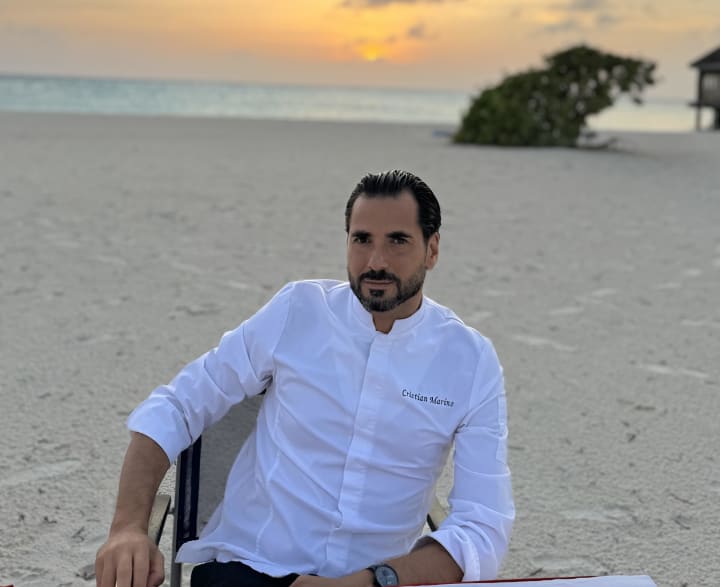
Cristian Marino is an Italian executive chef, culinary consultant, and author known for his leadership framework “10 Rules of the Chef in the Modern Era.”
He has worked across Europe, the Middle East, Asia, and the Indian Ocean, leading restaurant openings, culinary transformations, and international hospitality projects.
About the Creator
Cristian Marino
Italian Executive Chef & author with 25+ years in 10+ countries. Sharing stories on kitchen leadership, pressure, and the human side of food.
Keep reading
More stories from Cristian Marino and writers in Journal and other communities.
Why Calm Is Becoming a Strategic Advantage in Hospitality
For decades, the professional kitchen has been defined by noise. Commands, shouts, orders fired across the line, arguments over timing, and tension disguised as discipline. The culinary world inherited a military structure in which volume equaled authority and pressure equaled performance. For a long time, that model seemed unquestionable.
By Cristian Marino18 days ago in Journal
~ Fired ~
— Ai Intrusion ~ Are you Next ~ Is Ai Evolution after your job? — Few workplaces haven't been affected. Ai is in supermarkets, at doctors' offices, and even monitoring farms. I just can't think of anything this machine is not getting into, can you? For instance: Education ~ Law and Tech jobs will one day have a major influence or be taken over by these inanimate machines, with accuracy and vigor. From mechanics' diagnoses to a wide variety of everyday jobs, including fast food workers, with this input having the ability to cut their unnecessary work hours. I'm certain all of us have been touched by this with our short stories and colorful headings, have you? Even comments are very questionable 'Non-Robot' insertions.
By Jay Kantor10 days ago in Journal
Why “Scam” Questions Often Come Up Around Richard Yu, Impact Clients, and AI Product Arbitrage
Editor’s Note: This article is based on publicly available information and my own research into online mentorship programs. It reflects personal observations and learning rather than evaluation or endorsement of any individual or program.
By Derrick Han6 days ago in Journal
Rachel Reviews: Lunch Tales: Teagan by Lucille Guarino
Well, I did enjoy this! Sometimes, all you need is just great storytelling and this is what Lucille Guarino delivers here. There's no big message to this book; it's just about folks and families, living their lives and coping with everything that's being thrown at them and finding their way. But when it's done well, like it is here, then you have characters to whom you can relate, tension which leaves you rooting for a better outcome, attraction which has your heart racing and an urge, as a reader, to see the characters happy with the people with whom they belong.
By Rachel Deeming4 days ago in BookClub


Comments
There are no comments for this story
Be the first to respond and start the conversation.