politics
Political figures, histories, and current events in the whole scope of modern and past politics. Work place politics.
Why I Keep Blockading Food Distribution Centres. AI-Generated.
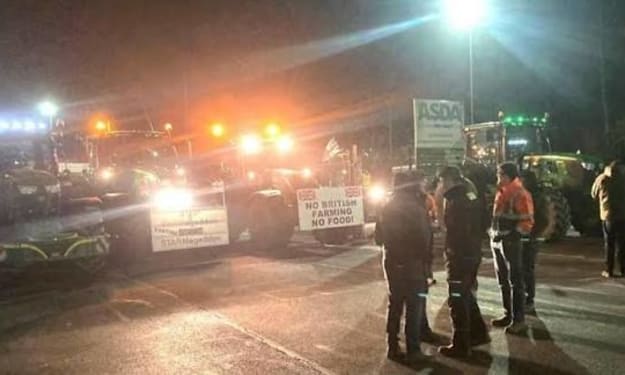
To many people, the idea of blocking food distribution centers sounds cruel and irresponsible. These facilities supply groceries to thousands of families, charities, and local markets. Disrupting them risks harming the very communities already struggling with inflation, unemployment, and food insecurity. Yet for some protesters, these actions are seen as a desperate attempt to be heard in a system they believe no longer listens. The decision to block such sites does not come lightly. It grows out of frustration, anger, and a belief that traditional protest has failed. For years, activists have marched, petitioned, and written to officials about rising food prices, corporate control of agriculture, and unequal access to basic necessities. Many feel ignored. “When you block traffic, people complain but forget,” one protester explained. “When you block food supply, suddenly everyone pays attention.” This logic reflects a deeper belief: that disruption is the only language powerful institutions understand. A Protest of Desperation Those who justify these actions often describe them as moral protests rather than criminal ones. They argue that food distribution centers symbolize a system that prioritizes profit over people. Large corporations dominate supply chains, while small farmers and low-income consumers struggle to survive. For these activists, the blockade is meant to expose contradictions: warehouses filled with food exist alongside families who cannot afford meals. They claim their actions force uncomfortable conversations about inequality and corporate responsibility. However, this reasoning clashes sharply with public opinion. Many citizens see the protests as punishing ordinary people instead of policymakers. Food bank volunteers and truck drivers are often caught in the middle, unable to do their jobs and sometimes facing verbal abuse or threats. The Human Cost Critics argue that such protests cross a moral line. Food distribution is not just another industry; it is part of society’s lifeline. Any disruption can have immediate consequences for hospitals, shelters, and vulnerable populations. Health workers warn that delays in food delivery can affect elderly residents, children, and patients who depend on regular supplies. Even a short interruption can ripple through the system, causing shortages that take days to fix. “These actions hurt the wrong people,” said one community organizer. “They don’t hurt politicians. They hurt families.” This tension between intention and impact is at the heart of the controversy. Protesters may aim to challenge injustice, but the method risks creating new harm. Protest Versus Public Trust Another consequence is the erosion of public support. Movements rely on sympathy and shared values. When tactics appear extreme, public trust collapses. Instead of discussing the underlying issues—corporate power, food access, or government policy—the focus shifts to disruption and legality. Law enforcement has increasingly treated blockades as serious offenses, citing risks to public safety and essential services. Arrests and fines have followed. Courts in several countries have ruled that blocking food supply infrastructure crosses from civil disobedience into endangerment of public welfare. This legal response reflects a growing belief that some forms of protest must have limits, especially when they interfere with survival needs. A Crisis of Communication At its core, the issue reveals a breakdown in communication between citizens and institutions. Protesters feel unheard. Authorities see disorder. Both sides harden their positions. Sociologists note that extreme protest methods often emerge when people believe peaceful channels are ineffective. History shows similar patterns in labor movements and civil rights struggles. Yet history also shows that movements succeed when they build alliances, not when they isolate themselves from the public. The challenge is how to protest power without harming the powerless. Searching for Alternatives Some activists are now questioning their own strategies. They argue that targeting food systems risks undermining the very justice they seek. Instead, they call for boycotts, mass strikes, or legal challenges that pressure corporations and governments directly. Others emphasize community-based action—supporting food banks, helping farmers, and creating local supply networks—rather than disrupting existing ones. “If the goal is food justice,” one former protester said, “then we should be feeding people, not stopping food.” A Moral Reckoning The debate over blockading food distribution centers forces a difficult moral reckoning. Is disruption justified if it draws attention to injustice? Or does it become wrong when it threatens basic human needs? There is no easy answer. What is clear is that society must confront the issues driving such protests: rising inequality, fragile supply chains, and growing mistrust in institutions. Protest is a powerful tool, but it also carries responsibility. When the line between resistance and harm blurs, movements risk losing their purpose. The question is not only why people block food centers, but whether such actions truly bring us closer to the justice they claim to seek—or push us further apart.
By Fiaz Ahmed 10 days ago in Journal
Salt Typhoon and the Widespread Hacking of Western Telecoms Networks
China's Salt Typhoon campaign represents a fundamental shift in state-sponsored cyber espionage, moving away from the opportunistic targeting of individuals towards the systematic subversion of national telecommunications infrastructure. Attributed to contractors working for the Chinese Ministry of State Security based in Chengdu, this operation has exposed a profound structural vulnerability at the heart of Western democratic governance.
By James Marinero12 days ago in Journal
Russian Official Commentators Start to Talk of Civil War in Russia
Lavrov went missing In the week when the whereabouts of Russia’s obnoxious, lying Foreign Minister Sergei Lavrov were unknown outside the Kremlin, evidence emerged from Moscow that the natives are far from happy and that rumours of 1917-like series of events are taking hold.
By James Marinero12 days ago in Journal
US, Iran and China: A critical phase in the balance of power in the Middle East. AI-Generated.
The growing tension between the US and Iran in recent months has made the Middle East the center of attention of world powers, where military movements, diplomatic statements, economic relations and behind-the-scenes strategic activities are clearly reflecting a new balance of power. In the current situation, the US has deployed its aircraft carrier USS Abraham Lincoln and other naval assets near the region, which is apparently being described as a defensive measure to prepare for possible threats against Iran. However, military experts say that the purpose of this deployment is not only to send a message to Iran but also to assess the changing strategic realities in the region and the new balance of power between world powers, especially at a time when China has established a strong partnership with Iran not only on the economic but also on the diplomatic and technical levels. The 25-year Comprehensive Cooperation Agreement is considered a milestone in global politics, under which energy, infrastructure, trade, technology and possibly defense cooperation are being promoted. In the context of this agreement, the fact that China is buying a large part of Iran's oil despite US sanctions has also become the center of attention of global analysts, which is not only supporting Iran's economy but also meeting China's energy needs. This economic interdependence is a cause of concern for Washington because it appears to be weakening the US policy of pressure. In the same vein, China's key role in restoring diplomatic relations between Iran and Saudi Arabia three years ago is also a sign that Beijing is now emerging not just as an economic power but as an active diplomatic player, whose effects are being felt on the peace and stability of the Gulf region, international trade and global energy supply. According to defense experts, although the United States is still the largest power in the region in military terms, Iran has unconventional defense capabilities that can be used by any country. In the event of a potential conflict, American interests could be seriously harmed, including advanced drone technology, cruise missiles, coastal defense systems, suicide drones, and regional alliance networks. In addition, an important aspect of modern warfare is the superiority of surveillance and information in space, where Chinese and Russian military satellites are monitoring military activities in the region in real time, making it impossible to completely conceal the movements of American forces. This factor is changing the balance of power and reinforcing the cautious thinking found in Washington. Analysts say that the United States is well aware of the fact that in the event of a direct attack on Iran, the reaction will not be limited to Iran alone, but its effects could spread to the Gulf, the Arabian Sea, global energy markets, international trade, and sensitive waterways for energy transport. In particular, the security of a globally important route like the Strait of Hormuz is of exceptional importance to the global economy. That is why the United States should not close diplomatic channels while maintaining military pressure. While Iran is also trying to give the impression on the diplomatic front that it is not ready for aggression but for the protection of sovereignty, China's role is emerging as a balancing factor in this whole scenario because Beijing is not only strengthening its relations with Iran but is also linking stability in the region, trade, energy supply and global influence with its long-term interests. Overall, the current situation reflects that the world has entered a phase where military power alone is no longer decisive, but economic partnership, technology, diplomacy, information superiority, international cooperation and global strategy have become equally important. These are the factors that have brought the relations between the US, Iran and China to a delicate but decisive crossroads, where the consequences of any miscalculation can have far-reaching effects not only regionally but also globally. Therefore, in the current situation, only reporting on military preparedness and tensions is not enough, but its in-depth analysis, economic impacts, regional stability, It is important to understand the energy supply, defense capabilities, diplomatic relations and strategic strategies of global powers so that the impact of any potential crisis can be accurately assessed and the international community, countries in the region and relevant authorities can take timely measures. This report has been prepared based on this analytical approach and in-depth observations of the current situation. Written and Researched by Malik Sarfaraz Hussain Awan
By Malik Sarfraz Hussain Awan12 days ago in Journal
Iron Fist Active Protection System for Armor Can Shoot Down Drones. AI-Generated.
Next-generation technology enhances armored vehicle defense against modern threats In today’s rapidly evolving battlefield, armored vehicles face a variety of threats, from rockets and missiles to unmanned aerial vehicles (UAVs). To counter these dangers, defense companies are developing advanced Active Protection Systems (APS) that can detect, track, and neutralize incoming attacks. One of the most notable systems is the Iron Fist APS, which now demonstrates the ability to shoot down drones, adding a critical layer of protection to modern armored units.
By Fiaz Ahmed 12 days ago in Journal
Questions Over the Priorities of the Bureau of Immigration, Islamabad. AI-Generated.
Pakistan’s Bureau of Immigration and Overseas Employment, Islamabad, has recently been running awareness campaigns and publishing advertisements on social media and other platforms about Omani labour laws; however, serious observers believe that while these activities may be well intentioned, they do not address the real and fundamental issue, because Oman is a fully law-abiding state where laws are strictly enforced and complete legal protection is provided to everyone without discrimination, from workers to traders and from Omani nationals to foreign employees, and the Omani government has established a well-organized, transparent, and effective labour system in which no one’s rights are violated and no one is above the law, yet the continued promotion of Omani labour laws by the Bureau of Immigration Islamabad creates the impression that Pakistanis face legal problems in Oman, whereas ground realities clearly show that this is not the case and that the real issue lies in Pakistan’s internal administrative weaknesses, lack of seriousness in policy making, and absence of effective diplomatic engagement, as experts emphasize that the actual need is for Pakistan to engage in continuous, serious, and dignified negotiations and formal agreements with the Omani authorities to reopen labour visas for the Pakistani workforce, especially when Oman currently has large-scale construction, development, and infrastructure projects requiring skilled, hardworking, and responsible manpower, a standard that Pakistani workers are fully capable of meeting, while the Omani government has consistently prioritized law, discipline, and the protection of foreign workers’ rights, which is why Oman is internationally recognized as a safe, stable, and reliable country, whereas in Pakistan the Bureau of Immigration and related institutions appear focused on internal procedures, paperwork, and promotional activities instead of practical action, the consequences of which are directly borne by Pakistani workers and their families, as the prolonged closure of labour visas for Pakistani workers in a well-regulated and peaceful country like Oman is deeply concerning, leaving thousands of skilled Pakistani workers, already affected by unemployment at home, helpless despite their willingness to work honestly in a nearby and law-abiding country like Oman, while their families in Pakistan continue to suffer from financial pressure, educational difficulties, and social challenges, even though Omani labour laws are clearly worker-friendly and provide a transparent system for grievance redressal, reconciliation, access to courts, exemption from fees, and timely justice, therefore instead of repeatedly promoting Omani labour laws, the Bureau of Immigration’s real responsibility is to draw the attention of the Government of Pakistan toward holding high-level negotiations with Omani authorities, removing existing obstacles, building mutual trust, and adopting a practical strategy to reopen labour visas for Pakistani workers, especially since the reputation of Pakistani workers in Oman has always been positive and the Omani people have consistently treated foreign workers, particularly Pakistanis, with dignity, protection, and opportunity within the framework of the law, while at the same time greater priority must be given to addressing the problems faced by the families of overseas Pakistanis back home, including legal, financial, and social insecurity, issues that can only be reduced when the Government of Pakistan and its institutions move beyond statements and advertisements toward real action, adopt clear policies, and strengthen cooperation with a friendly and law-abiding country like Oman based on mutual respect and trust, because Oman has long set an example in upholding the rule of law, protecting foreign workers, and maintaining transparent systems, and if Pakistan demonstrates seriousness, ongoing projects in Oman can generate dignified employment opportunities for Pakistani workers, reducing unemployment in Pakistan, increasing remittances, and improving the lives of thousands of families, therefore it is essential that the Bureau of Immigration and Overseas Employment Islamabad reassess its priorities, address internal shortcomings, play a constructive role by engaging the Government of Pakistan in effective negotiations with Omani authorities to resolve visa-related concerns, and work toward a practical framework that respects Omani laws, acknowledges the Omani government’s organized system and the positive role of Omani society, and opens employment opportunities for the Pakistani workforce, because promoting Omani labour laws is not the real need for the Bureau of Immigration but rather correcting Pakistan’s lack of serious policy direction and effective diplomacy, and in this regard the Bureau of Immigration and Overseas Employment Islamabad must play a positive role, including contributing to the protection and welfare of the families of migrant workers living in Oman and other countries. Written by Malik Sarfraz Hussain Awan
By Malik Sarfraz Hussain Awan12 days ago in Journal