humanity
The real lives of businessmen, professionals, the everyday man, stay at home parent, healthy lifestyle influencers, and general feel good human stories.
Tatiana Schlossberg
Introduction In recent months, a disturbing wave of misinformation has spread across social media with searches like “Tatiana Schlossberg cause of death”, “JFK granddaughter dies”, and “Tatiana Schlossberg acute myeloid leukemia”. These claims are not only false—they are entirely fabricated.
By KAMRAN AHMADabout a month ago in Journal
New Year 2026
Introduction Though it’s still 2025, people are already searching for “New Year 2026 upcoming”—planning celebrations, setting goals, and even booking travel. Why? Because New Year’s Eve 2025 marks the transition into 2026, and for many, preparation begins months in advance.
By KAMRAN AHMADabout a month ago in Journal
Behind the Avatar
At first glance, the VTuber world looks like pure escapism. Bright anime avatars smile endlessly on screen. Voices laugh, whisper, scream, and sing. Millions of viewers gather nightly to watch virtual idols play games, talk about life, or simply exist together in a shared digital space. It feels light, harmless—almost unreal. But in 2025, the illusion cracked. What happened behind the scenes of one of the industry’s most beloved agencies revealed something uncomfortable: behind every avatar is a real human being, and behind every smiling brand is a system that can fail—quietly, expensively, and painfully. At the center of this reckoning stood Ironmouse. A Digital Star Built on Something Real Ironmouse was never just another VTuber. Long before she broke Twitch records, before subathons became headlines, before agencies chased her name, she was an independent creator streaming from her bedroom. Her demon-girl avatar was playful, chaotic, and mischievous—but her voice carried honesty. She openly spoke about her lifelong battle with common variable immunodeficiency (CVID), a condition that severely weakens the immune system and keeps her largely homebound. For viewers, that honesty mattered. They weren’t just watching content. They were supporting a person. Over time, Ironmouse became one of the most recognizable faces—ironically—of virtual entertainment. Her streams blended humor, vulnerability, exhaustion, joy, and resilience. Fans didn’t call themselves an audience. They called themselves family. When VShojo launched in 2020, Ironmouse wasn’t just signed. She was a co-founder. VShojo: The Agency That Promised Something Different At the time, VShojo represented a radical idea. Unlike Japanese agencies with strict contracts and tight control, VShojo marketed itself as “creator-first.” No exclusivity. Freedom to collaborate. Ownership over personal brands. It attracted independent VTubers who wanted support without surrendering control. For years, the model seemed to work. VShojo talents grew rapidly. Merchandise sold globally. Brand deals followed. Ironmouse, in particular, became the agency’s crown jewel—breaking Twitch’s all-time subscription record during her 2024 subathon, pulling in hundreds of thousands of paying supporters. A significant portion of that money wasn’t even for her. It was for charity. When Charity Money Doesn’t Arrive Ironmouse’s subathons weren’t only entertainment events. They were fundraisers—especially for the Immune Deficiency Foundation (IDF), an organization directly tied to her survival. Fans donated generously, trusting that their money would go where it was promised. That trust was sacred. Then, quietly, something went wrong. Months passed. Then more months. According to Ironmouse, the charity funds—over half a million dollars from one event alone—were never delivered. At the same time, her own earnings were delayed or missing. She raised concerns privately. She waited. She believed explanations. Nothing changed. In late July 2025, she finally spoke publicly. The Video That Changed Everything When Ironmouse uploaded “Why I Left VShojo,” it didn’t feel like drama content. It felt like exhaustion. She didn’t accuse recklessly. She didn’t shout. She explained, carefully, emotionally, how she had been misled for months. How money meant for her and for IDF was still unpaid. How pressure was placed on her to stay quiet—implying that leaving would harm her friends and destroy the company. The most painful part wasn’t financial. It was personal. She spoke about how the charity mattered to her life. How fans trusted her. How knowing that money meant to help people like her was stuck somewhere inside a system she helped build broke something inside her. Shortly after, VShojo’s CEO publicly admitted to mismanagement. The agency announced it would shut down. Just like that, one of the most prominent VTuber organizations collapsed. The Silence Between the Numbers No one outside VShojo has full access to the books. Legal proceedings are ongoing. Details remain locked behind lawyers and contracts. But patterns matter. Other talents had already left earlier, citing burnout or vague internal issues. Payout delays became an open secret. Fans noticed changes—less transparency, fewer updates, quiet exits. When Ironmouse left, the silence finally made sense. It wasn’t a single mistake. It was systemic failure. Fans React, Not With Rage—But With Action The response online was intense, but not directionless. Fans didn’t just argue on Twitter. They donated directly to IDF to make up the shortfall. They archived evidence. They supported creators who suddenly found themselves without agency backing. Hashtags trended. Memes spread. But beneath the noise was something deeper: a demand for accountability in an industry that had relied heavily on trust. VTubers reacted too. Some spoke carefully. Others chose silence. Many quietly shifted toward independence. The message was clear—creators were reevaluating the cost of safety promised by agencies. A Turning Point for Virtual Stardom The Ironmouse–VShojo collapse didn’t kill VTubing. It changed it. Agencies are now being questioned openly. Contracts are scrutinized. Donation handling is expected to be transparent. Creators are demanding direct access to their revenue. Fans are asking where their money goes—and refusing to accept vague answers. Ironmouse, meanwhile, continues independently. Her streams are strong. Her community is intact. Charity donations now flow directly, without intermediaries. The avatar never broke. The system behind it did. What This Moment Really Means This story isn’t about one agency failing. It’s about an industry growing up. Virtual avatars allowed creators to hide their faces, but not their humanity. Behind the models are real people managing real health issues, real finances, real stress. When systems treat them as assets instead of individuals, something eventually snaps. Ironmouse didn’t go rogue. She chose transparency over comfort. And in doing so, she forced the VTuber world to confront an uncomfortable truth: digital dreams still require real accountability. As virtual entertainment continues to evolve, one lesson now stands unmistakably clear— Behind every avatar is a human being, and trust is the most valuable currency of all.
By The Insight Ledger about a month ago in Journal
Music as a Mirror
Music, a word we all relate to, have a relationship with and, somewhat, define in our own, unique and special way. It is vocal, instrumental, a combination that is produced to evoke the beauty of a form of harmony and emotion that comes from within us. It is plentiful, yet, specific to each of us and at the same time, a connecting force that gives us the opportunity to know, understand and feel for one another in a way we otherwise would not. It is complex with depths that build labyrinths in our worlds and simple enough to be deciphered scientifically. It is a true element of how society operates, with a complex science of humans with mathematics to back it up.
By MB | Stories & Moreabout a month ago in Journal
How I Stopped Romanticizing Pain
In a world that often glorifies suffering and martyrdom, many of us find ourselves romanticizing pain, viewing it as a source of depth and character. This mindset can lead to a cycle of emotional turmoil, where we cling to our struggles instead of seeking healing and growth. However, the journey toward understanding and overcoming this tendency is both transformative and liberating. By exploring the underlying reasons for our attachment to pain, recognizing triggers, and developing healthier coping mechanisms, we can learn to embrace a new perspective—one that celebrates resilience and joy over suffering. This article delves into the steps I took to break free from the allure of romanticizing pain and foster a more fulfilling emotional experience.
By Kutlwano Radebeabout a month ago in Journal
Human vs AI — Part 1: The Island That Runs the World. Content Warning. AI-Generated.
HUMAN: I keep hearing the same line: “Taiwan matters.” But people say it like it’s abstract. Why does it really matter? AI: Because Taiwan is not just a place. It’s a critical point in the global system that converts ideas into physical power. Specifically: advanced semiconductors. A modern economy doesn’t run on oil alone anymore—it runs on computation. Computation is built on chips. And many of the most advanced chips are fabricated in Taiwan, largely by one company: TSMC.
By Yannick Boisclairabout a month ago in Journal
Boss or Leader: What Is the Difference?
Definitions of Boss and Leader According to the dictionary, a boss is a person in charge of others in the workplace. A boss is responsible for assigning tasks, setting schedules, and approving leave for those under his authority.
By Margaret Minnicksabout a month ago in Journal
To You Who Keep Giving Hope: A Beacon in the Darkness
In the tapestry of life, woven with threads of joy and sorrow, laughter and tears, some individuals stand out as radiant beacons of hope. They are the ones who, despite the darkness that may surround them, tirelessly extend a hand, offer a kind word, and ignite a spark of belief in others. This article is dedicated to you, the quiet givers, the resilient optimists, the unwavering source of hope in a world that often feels bleak.
By Wilson Igbasiabout a month ago in Journal
god loves you, but not enough to save you
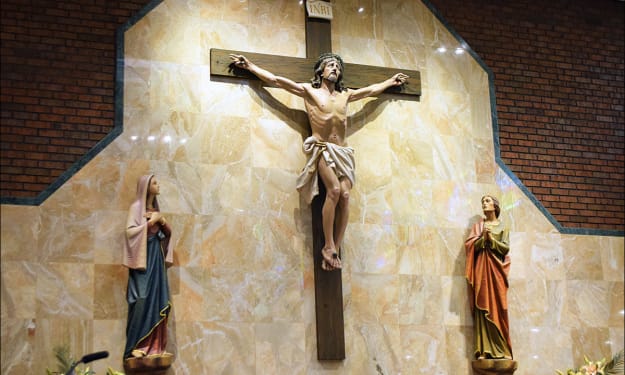
I’ve come to miss the smell of my old church, that burned incense, thick and suffocating, frankincense and myrrh, woody and earthy, sweet like something from beyond, something you could only experience behind its heavy, holy doors. I miss my fingers lingering, painting, gliding over, puddling in the holy water, hiding under the guise of maturity as I locked eyes with the priest and streaked it across my forehead, my lips, my heart with a strong, steady, damp, lying thumb—the Sign of the Cross. I miss the sight of stained glass glowing dimly in a dozen different colors, crafted so carefully and earnestly, beautiful and radiant, painting the very stories we would come to hear; I miss having to crane my head up high to see the priest, the podium, the Son of God up on the cross in the center, the candles, the choir, the holy, heavy Gospel. I miss the comfort of community, of neighbors, of sitting between strangers, of the closeness of bodies, of the feel of another person’s warmth radiating close by, of the intrigue, of the tension, of the stakes, of the waiting game, of glances, of soft, sweet, friendly smiles, of hands clasped and held and shaken before the doubt set in, before touches became something strange, something to desire or to fear, before people were something to shy away from, before respect was leveled on a scale, weighed and tested and failed, time after time. I miss the songs, the organ, the music, the rising and falling, the hums and hymns, the volume, the rising chimes of familiarity, voices loud, voices quiet, voices everywhere, together, singing the same songs. I would say I miss bowing my head and praying like it meant something, like I was heard, like I had meaning, like my mortal fears could be quelled, like my questions would be answered, only that part, I will admit, is somewhat of a blur—what exactly did I ever ask of my God in those days? I remember only one thing; I know I asked to hear Him, to know Him, to feel Him—in my early teen years, I found myself lost and angry and afraid and desperate, desperate to keep believing. Give me a sign, I would pray, time after time, before my prayers turned to pleas, then to harsh, vapid commands—give me a sign, Lord, and I will know I am wrong; I’ll know you are here with me. But no such sign ever came, and if it had, it passed me by in a blink, a flashing, fleeting moment. Yet the whole time, my eyes were bared to the world before me, and I did not feel Him; I felt nothing but the throb of my own heart, beating, beating, beating in a silent room, a room turned sour rather than sweet, nauseating with the bend of knee, the blind-eyed faith of others, all hearing, all seeing, all knowing a Lord who would not hear me, who would not know me, who would not see me as I was—a room that turned such silences to song with a single cue, with a jolt like a flinch rather than a whimsical transition, a room in which people praised and loved a God that I could not keep pretending to feel. Even so, I miss the pretending, too, before I saw it for what it was—the hard, cold surface of the pew, my hands clasped in prayer, focused, eyes shut, trying, hoping, wishing, praying to be known, to be felt, to be forgiven, to be loved unconditionally by something far, far away.
By angela hepworthabout a month ago in Journal
Naked Burglar Busted After Boisterous Booze-Fueled Break-Ins at Miami Mansions
Christmas night is usually wrapped in lights, laughter, and late dinners. But in one exclusive oceanfront community near Miami, the holiday took a surreal turn—one that felt less like a festive movie and more like a crime drama written by chaos itself.
By Omasanjuwa Ogharandukunabout a month ago in Journal