economy
Economy and the area of production, distribution, trade, and consumption of goods and services.
No economic growth in Nigeria.
Nigeria's economy is a center-pay, mixed economy with a developing business sector, as well as expanding sectors for production, finance, administration, correspondences, innovation, and diversions. It is ranked as the largest economy in Sub-Saharan Africa, the 24th largest in terms of buying power equality, and the 27th largest economy overall in terms of nominal Gross domestic product. Nigeria is a country having a vast number of everyday resources that may be used to boost the economy, but it still "POOR" In 2014, Nigeria's total GNP increased by 89%, from 42.4 trillion naira (US$270 billion at current exchange rates) to 80.2 trillion naira (US$510 billion at current exchange rates). Even if the upcoming December numbers are accurate, the year-over-year growth in employment in 2014 has been the most steady since around 1999, and the unemployment rate has decreased to 5.8 percent. Nigeria was among the top thirty nations in 2014 for economic growth, according to the World Bank. in the year2015: The economy is expected to grow by 4% overall and 3.14 percent in the first half of the year, respectively. The CEOs have placed a lot of blame on the application of financial strategy. The modification of administrative level of government and non- government chief bureau's establishment has caused the 2015 to be executed with restrictions. budgeting plan failure to execute the capital Currently, a portion of the financial plan is being established. the Public Gathering, where it was put to the test revealed that the country has accumulated around. The financial strategy will cost $4.48 billion to carry out. As Only N36 billion in capital was designated as of May 2015. has been Nigeria's economy is contracting for the first time in 25 years in the year 2016. The second quarter of 2016 saw a slump in the largest economy in Africa. The price of oil at $50 per barrel at the start of 2017 had negative effects on Nigeria. The decline in incomes from the largest commodities worker in the nation led to a blockage in speculation across the economy, an increase in national debt, a rise in non-performing loans in the private sector, and high expansion. Nigeria was dangerously close to experiencing a money crisis as a result of the tensions, with unknown stores closing and the conversion rate of the underground market sharply rising. The Nigerian Gross Domestic Product (GDP) increased by 1.50% (year over year) in real terms to N16.58 trillion in the second quarter of 2019 President Muhammadu Buhari's election campaign in February for an additional four-year term was always going to be decisive for the economy in 2019. The 76-year-most old's illustrious term was colored by sluggish economic growth, rising neediness levels, and a slew of protectionist tactics that did more harm than good to the economy. In his second year in office, the economy entered a downturn as oil prices and job growth declined. According to experts, the public sector made the recession worse by holding onto money for a very long time, preventing investment and causing a large number of firms to fail. Late macroeconomic and monetary developments in the years 2020 and 2021 caused Nigeria's economy to grow by 3.6% in 2021 from a 1.8% contraction in 2020, supported on the stockpile side by 4.4% non-oil development versus 8.3% oil withdrawal, with farming (2.1%) and administrations (5.6%) as the main drivers. Nigeria's GDP (Gross Domestic Product) increased by 3.54 percent year over year in the second quarter of 2022 in actual conditions. still no progress. The Nigerian economy isn't growing as a result of these factors, which include fragility, debasement, expansion, a shift in the government's focus from the economy to general races, a cutback currently taking place in the manufacturing sector, low utilization, rising unemployment, a limited power supply, and weak macroeconomic management demonstrated in unfamiliar trade deficits. I'll leave you with this query: What will the Nigerian economy look like in a year?
By Okoroafor Daniel3 years ago in Journal
How could Procrastination Affect Your Journey to Success.
Everybody dreams of becoming rich, but they don’t make any effort for it. They only dream about it. It’s either lack of action or confidence along with faith within themselves. So, the question is, what’s the hidden secret in Think and Grow Rich?
By Estalontech3 years ago in Journal
What Exactly Does Hybrid Working Mean?
As a result of the fact that some companies are bringing folks back to work on-site while other workers opt to continue working from home, the topic of hybrid work environments is becoming an increasingly popular one. Find out what it means to work in a hybrid environment and how such a configuration can be helpful for fostering successful teamwork and productivity.
By Munnazir Zarin3 years ago in Journal
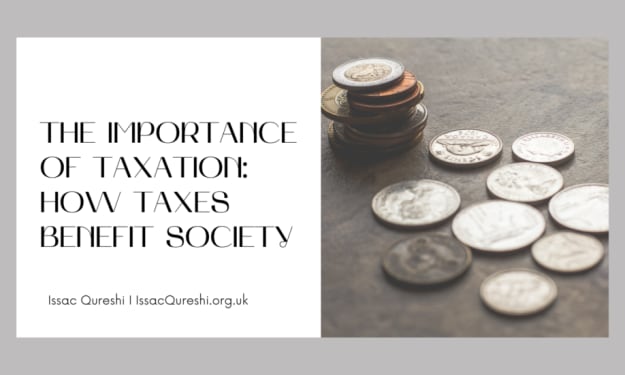
The Importance of Taxation: How Taxes Benefit Society | Issac Qureshi
There is a lot of debate surrounding taxation. Some people believe that taxes are an unnecessary burden on the individual, while others see tax as a necessary evil that helps to support the functions of society. Below are the benefits of taxation and show why it is important for society as a whole.
By Issac Qureshi3 years ago in Journal
Furnday Offers On-demand Furniture Related Works
The typical workday at an office is eight hours, however on occasion, the hours can be significantly extended. Because employee profitability directly depends on their relationship to their working environment, furniture is necessary to increase productivity in the workplace and to prevent employee wear and tear. Making wooden furniture with a carpenter may also be a unique experience that produces one-of-a-kind furniture for the home. It can be difficult to find a skilled carpenter, though, who does the job correctly. However, it is crucial to be aware of and confirm the sort of office furniture present and how it affects outcomes for employee satisfaction and productivity.
By www.furnday.com3 years ago in Journal
Global economy in recession
What is Recession? There is no accepted definition of recession. In the language of economics, if the growth of a country's economy continues in two consecutive quarters in a fiscal year, it is called a recession. According to the International Monetary Fund (IMF), when the economic growth in the world is less than 3 percent, the situation is called a global recession. According to them, global recession occurs in cycles of approximately 8-10 years.
By Rezvi Ahmmed3 years ago in Journal
An analysis of the ability-to-pay principle of taxation
The ability-to-pay principle in plain words Although taxation is a complex subject with terminology that can be hard to understand, when it comes to the ability-to-pay principle, it can be summarized in layman’s terms into the following phrase: “You can’t squeeze blood from a turnip”.
By thepavsalford3 years ago in Journal