

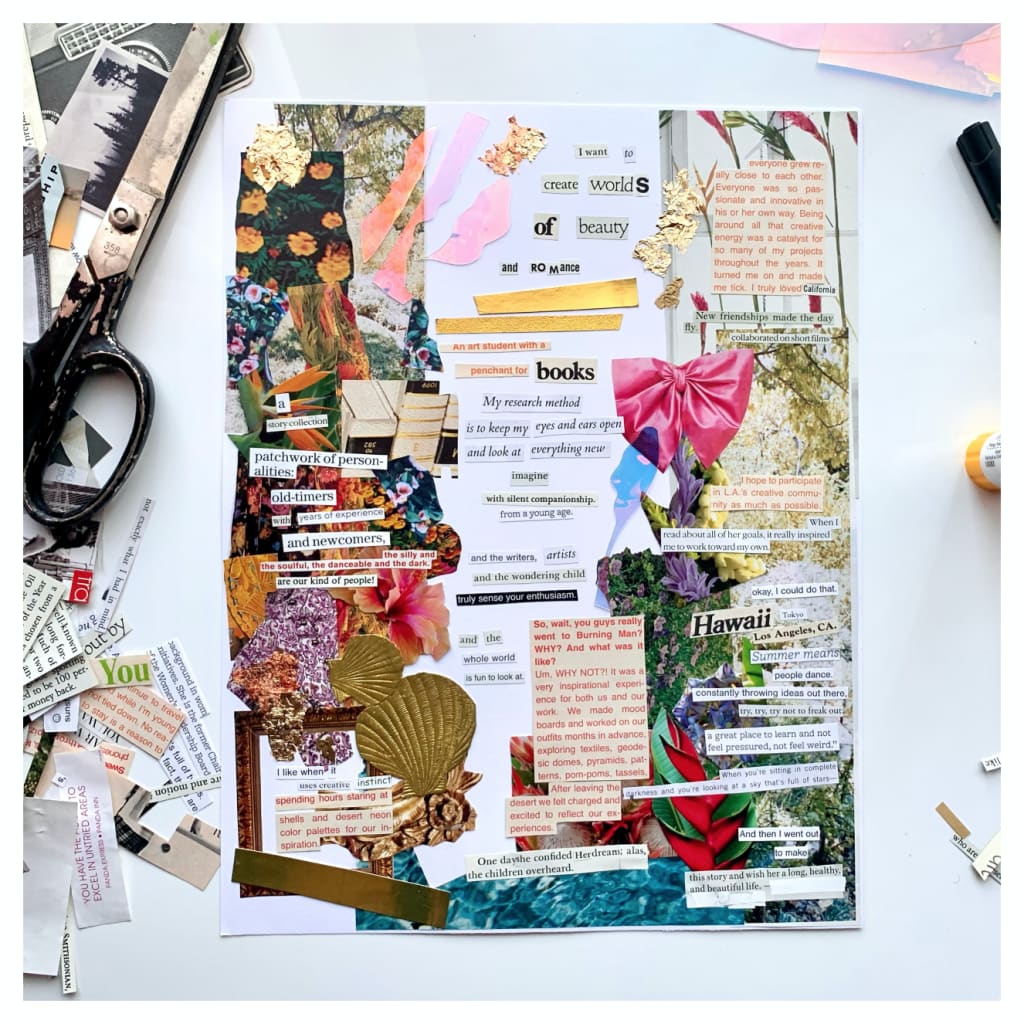
Rip. Snip. Place. Trim a bit of excess. Paste.
Take a step back. Repeat.
A formulaic process for a result that is unplanned and never constant.
Creating magazine collages is a practice I’ve developed these recent years that I have come to deeply cherish. I love flipping through the pages of an outdated publication or a junk mail catalogue and finding singular words and images that strike me in their beauty, honesty, depth, or simplicity. Repurposing previously-used materials into something altogether its own with just a pair of scissors and a glue stick as my tools brings me repeated joy as a spectator seeing a new image take form. Piecing together unlike elements expands my sight, and enables me to envision could-be possibilities emerging from what is already in front of me. Additionally, using my hands to touch the gloss and matte of the pages and feel the weight of the varying sheets in my palms focuses my attention and strengthens my senses; while snipping away what is unnecessary similarly removes the racing thoughts of the daily tasks and to-dos that endlessly call and clamor for attention. Like a needed shearing, each trim and selection of the paper allows me to highlight and appreciate the beauty in what is already present, sharpening my concentration and cultivating an internal fulfillment and gratitude for the current moment with each cut.
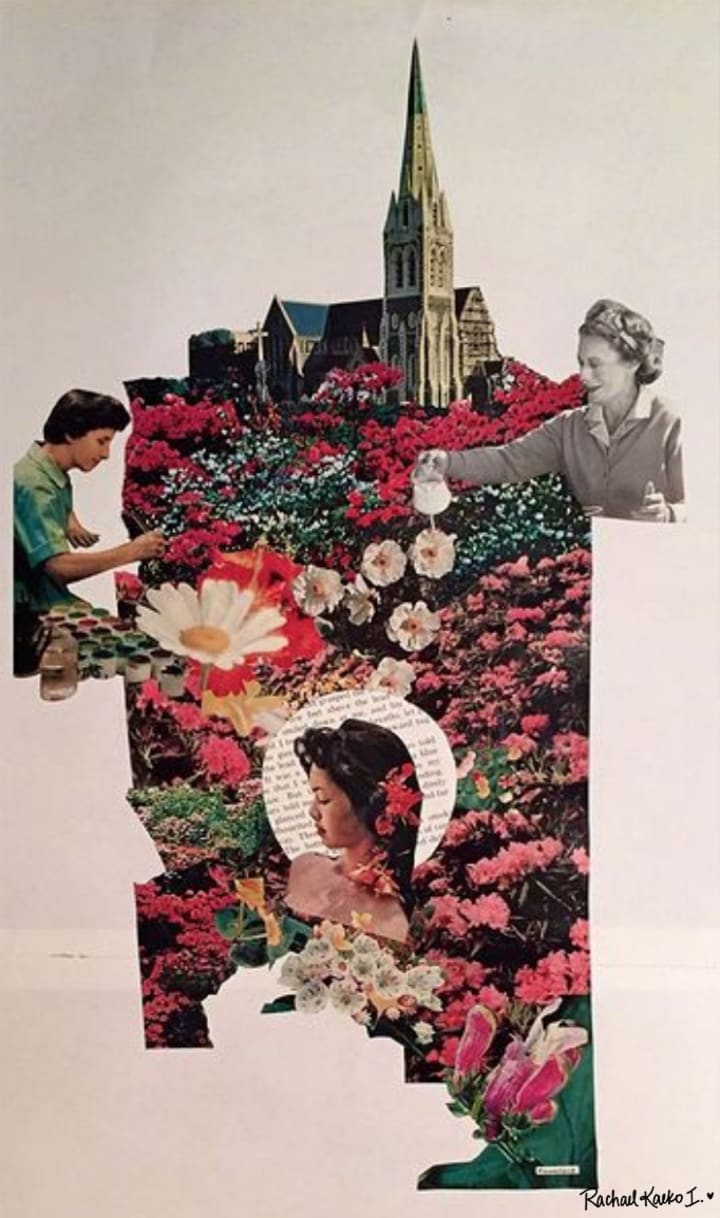
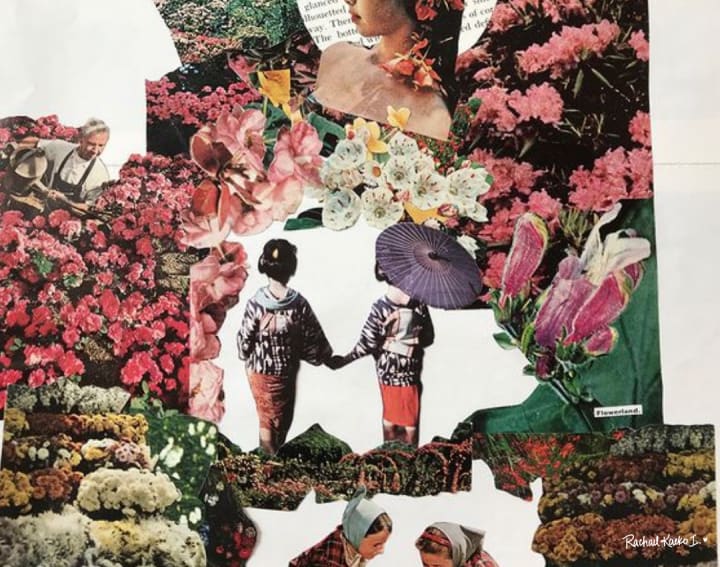
As a graphic designer, I spend a majority of my daily hours cutting and pasting typography and pixelized elements through a few clicks on a trackpad or a series of programmed shortcuts, i.e., Command+C, Command+V. And although those keyboard sequences now come as second nature, ingrained in the muscle memory of my left index finger and thumb, there is a wide gap in the digital design process compared to the tactile experience of working with raw material between one’s hands. While I receive a lot of joy from creative work as a web designer, shuffling Photoshop layers in and out of order and overlapping RGB colors with simulated textures, I find the most compelling and calming work to be made when crafting traditional collages, when I use what requires no technical training. To touch and feel a real physical medium in those printed magazines, to stack element on top of element, and silhouette over a newly cut shape removes the learning curve and barrier of the screen, and harkens back to early childhood experiences of creativity and expression. As much as software programs focus on user interface and experience, I am oftentimes stifled and overwhelmed by the nearly infinite downloadable typefaces and scaling and sizing capabilities that the online landscape offers. I find that manual collage-making readily accentuates what is truly intuitive, utilizing limited resources and the irreplaceable element of human touch, to express what is internally felt.
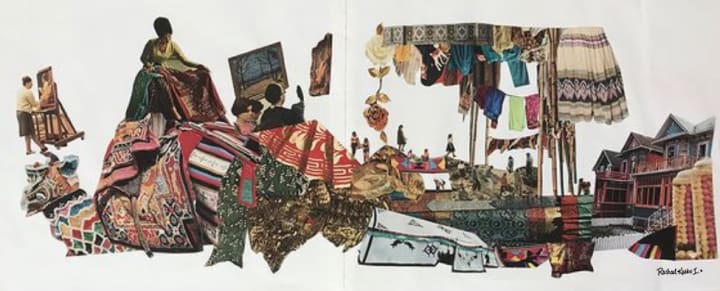
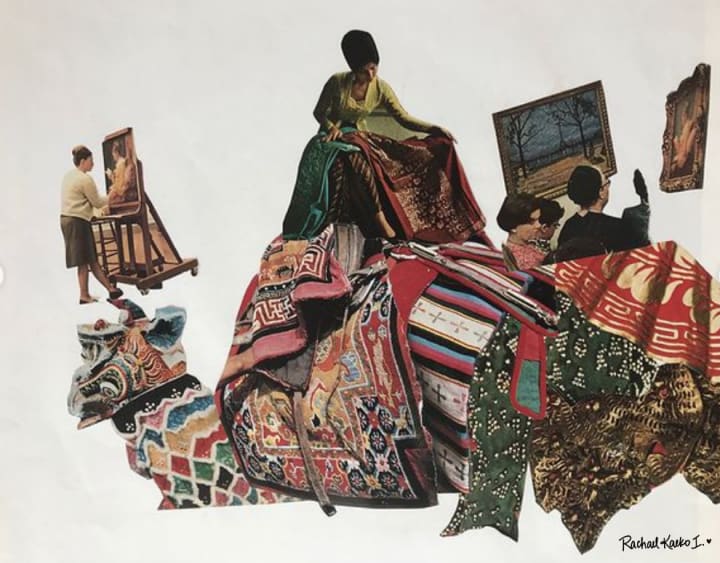
Fingering through the pages of magazines and leaflets, scanning excerpts of articles and features for language and phrases that resonate, scavenging for beautiful photographs or patterns that stir something within, and grabbing that definitive pair of metal scissors to make those key selections are individual acts both calming and meditative, centering and inherently mindful. They beckon me to stay in the present, to experience the here and now through heightened senses, renewed vision, and distilled emotion.
I like to complete a full collage in one session—one fell swoop to capture all the pure and instinctual decisions, right brain fully engaged with limited time to judge the work and overthink. It’s more joyful that way, and satisfying, seeing mismatched and seemingly disjointed pieces and particles, almost-discarded scraps, and intentionally-chosen focal points coming together to form a collective whole.
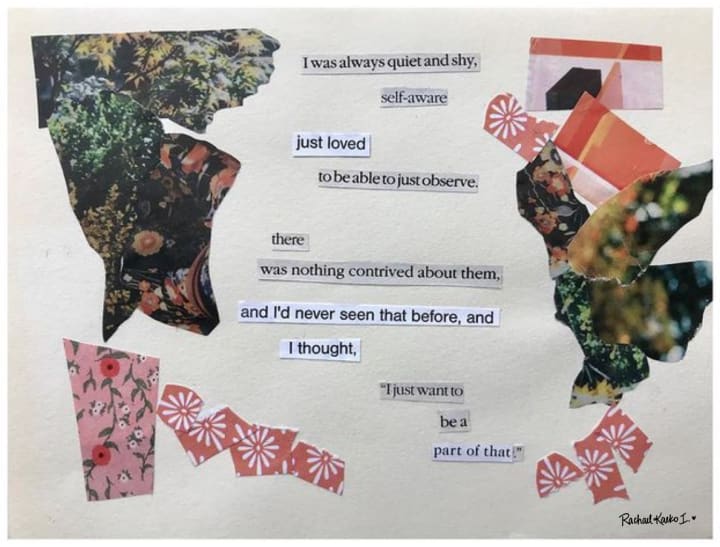
I believe this natural draw to creating collages through imagination and intuition began as a child. My mother, a playful and self-proclaimed “wacky” grade school teacher, first introduced, taught, and encouraged me to collage through her various classroom crafts and projects. Bringing home primary-colored construction paper and brown kraft paper grocery bags, she’d cut circles and squares of reds and yellows, greens and blues, and then slice large holes and slits into the grocery bags’ bottoms and sides. My older sister and I would use our child-sized scissors and a thick white paste to cut and glue a mosaic of colored shapes onto the paper bags, proudly wearing our upside-down bags as paper vests.
Other times, she’d bring plastic Ziploc bags from her classroom stock filled with endless materials—I loved looking through all of the glittering treasures that were her elementary school art supplies. Gathering old newspapers that my dad had saved from the Sunday paper, my mother would tell my cousins, sister, and I to stand still in a line. One by one, she’d lay flattened sheets of newsprint on the tops of our heads, and shrieks of laughter and giggling would erupt from each of us. Standing under that newspaper, black and grey inked letters floating above my eyes, I’d hear loud crinkling, and see my mother’s hands gradually roll the edges of the paper around the shape of my head, molding it to my skull, ears, and forehead in the form of a hat. These new hats, now materialized, were freely open for decoration by each child. Sifting through her bag of supplies, we’d select handfuls of feathers dyed in brightly artificial colors, cut pieces of leftover paper, and paste on neon green and orange pom poms and metallic sequins to our newly fashioned hats.
What were once old grocery store bags and last week’s newspaper became wearable collages with each decorative piece cut and plastered onto them. Revitalized items were created from what would otherwise be considered litter and debris. In these simple but joyous creative acts, we never knew what the outcome would be. Yet, my mom was open to exploration with whatever tools and materials were available. She understood well the joy of creative expression, and the gift of childlike imagination. She let me make mistakes, products of imperfection repeatedly encouraged and met with an enlivened smile at what more was to come.
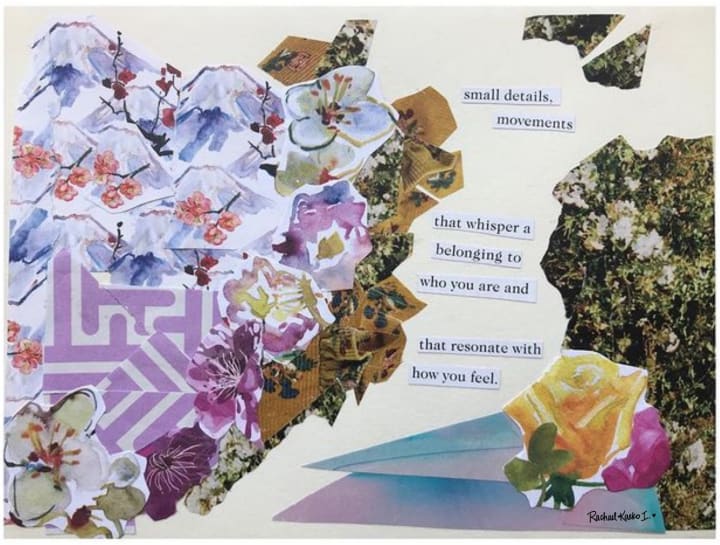
From these initial experiences, I follow and begin.
I reflect on my history and take stock of what is now present.
Without a computer, I may not be able to undo, save, or delete with a maneuver of a cursor.
But I am able to begin one layer at a time.
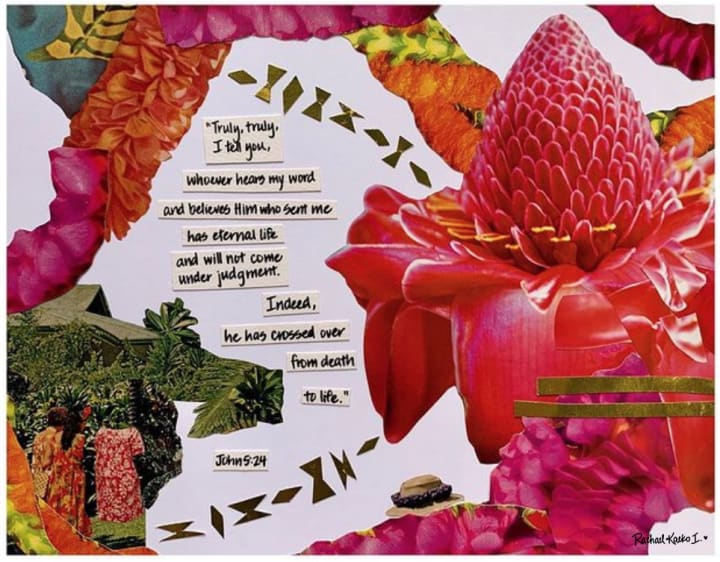
“I want to create something of beauty and romance”—a phrase welcomes itself into my head—I can see it with these few lines of copy I’ve found. For the words I cannot readily come across in the printed text, I look to fill in the gaps, cutting and pasting individual letters to form the desired message I seek. I select font styles from titles currently here, and do not type up content from an endless supply of designs. I choose from what is previously published, what is laid out before me, yet I do not feel limited. Rather, like sifting through a plastic bag of craft sequins and colored feathers, I sense that I am free, gleaning from what is already created to make something out of what I have been given.
Equipped with a pair of scissors and a bottle of glue, I examine this hodgepodge collection of printed material. I turn pages of vintage magazines, skim modern-day brochure mailers, and bookmark out-of-print editorials. I come upon an illustration and textile print that I find interesting, and am struck by a few key sentences that fascinate me. I tear out a handful of pages with selected treasures I intend to snip and collect.
I’m not sure what will make the final cut, but it doesn’t have to be perfect. Just something that I can internally feel, and I am met with sheer joy.
Rip. Snip. Place. Trim the excess. Paste.
Take a step back. Repeat.
About the Creator
Rachael Kaeko Imes
@rachaelkaeko on instagram
Keep reading
More stories from writers in Journal and other communities.
~ Fired ~
— Ai Intrusion ~ Are you Next ~ Is Ai Evolution after your job? — Few workplaces haven't been affected. Ai is in supermarkets, at doctors' offices, and even monitoring farms. I just can't think of anything this machine is not getting into, can you? For instance: Education ~ Law and Tech jobs will one day have a major influence or be taken over by these inanimate machines, with accuracy and vigor. From mechanics' diagnoses to a wide variety of everyday jobs, including fast food workers, with this input having the ability to cut their unnecessary work hours. I'm certain all of us have been touched by this with our short stories and colorful headings, have you? Even comments are very questionable 'Non-Robot' insertions.
By Jay Kantor7 days ago in Journal
Is Adaptive Learning the Future of Education - or Its Reckoning?
The student stares at the screen, not bored—focused. The lesson isn’t moving too fast or dragging behind. It’s adjusting. Every click, pause, and wrong answer quietly reshapes what comes next. No raised hands. No red pen corrections. Just a learning system that seems to know.
By Andrew Hamilton2 days ago in Journal



Comments
There are no comments for this story
Be the first to respond and start the conversation.