
Remote Work's Impact on Our Creativity
Why Zoom brainstorming sessions might be stifling our collaborative innovation

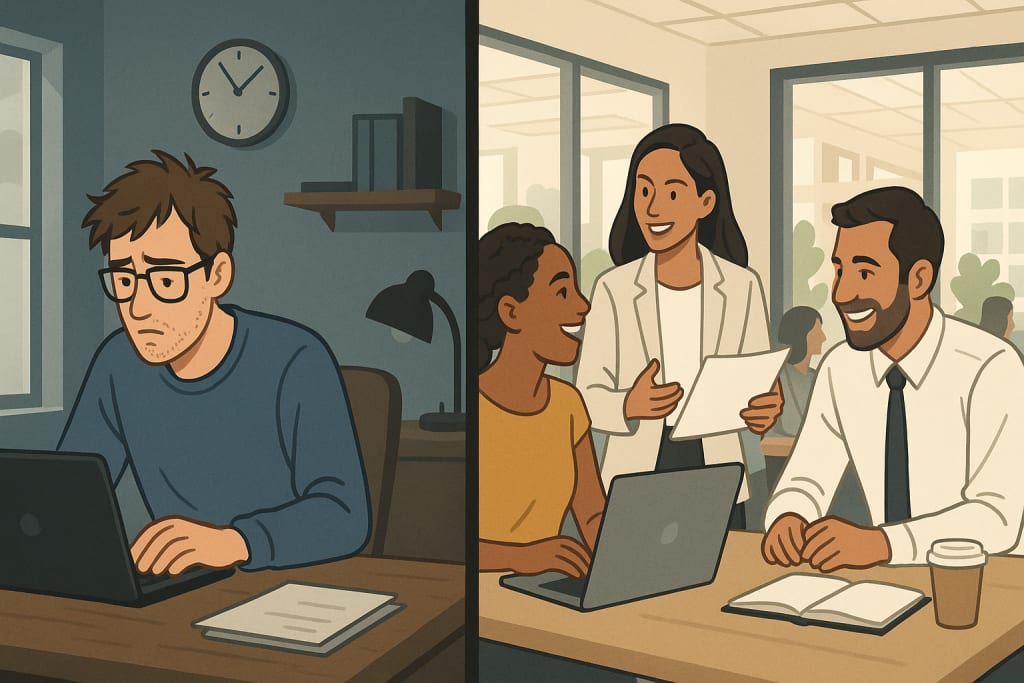
Let's just say it: the dominant narrative about remote work is absolutely rosy. We hear ceaselessly about flexibility, autonomy, work-life balance (something I'm increasingly finding to be mythical), and the happiness of wearing pajama pants during Zoom meetings.
Businesses tout their remote-first policies, recruiting talent with offers of geographical freedom. And I don't blame them, those advantages are genuine, concrete, and life-changing to many.
But in the midst of the praise for the work-from-home revolution, I want to pose a perhaps unpopular question, one that's been bothering me as someone whose job depends on brainstorming in a group and spontaneous idea creation: Is remote work quietly, insidiously, killing creativity?
Before the virtual pitchforks are raised, let me be clear. I'm not referring to solo, concentrated creative work. Writers, programmers, designers working on a single project may find the privacy of a home office highly conducive to deep work.
I do appreciate the luxury of being able to crank out a draft without the incessant distractions of an open office. What troubles me is group creativity – the disorderly, chaotic, frequently happy accident of creating new ideas in collaboration.".
The argument for remote creativity often centers on tools: sophisticated video conferencing, virtual whiteboards, instant messaging platforms.
We’re told these technologies replicate, even enhance, the collaborative experience. But do they really? Or are they merely efficient substitutes that miss the crucial, intangible elements of in-person interaction?
Reflect on the most recent truly revolutionary concept your team came up with. Where did it originate? Was it during a carefully planned Zoom idea session, with virtual sticky notes and time-out breakouts? Or from a flippant comment over coffee in the break room? A whiteboard doodle during an unrelated meeting? Something overheard that led to an unexpected realization?
My own experience, and discussions with others working in creative industries, indicate the latter circumstances are much more typical breeding grounds for true innovation.
Being in the same space promotes a sort of ambient awareness, a shared context that's very hard to replace over a distance. You run into colleagues from other departments, causing cross-pollination of ideas. You can feel the vibe in a room, reading non-verbal cues that are lost or distorted over a screen. You have those
“water cooler moments,” the informal chats where trust is built and unexpected insights emerge.
Channeled virtual meetings, no matter how well-run, tend to be transactional. There's an agenda, a clock, and the implicit expectation of performing for the camera. Spontaneity is contrived.
That freewheeling, experimental vibe that so often marks productive brainstorm sessions is more difficult to attain when all of us are stuck in our Brady Bunch box on a screen. We sacrifice the common physical space, the opportunity to read the room, the easy energy that powers creative tension.
Also, the uncertainty of remote work boundaries can paradoxically suppress innovation. With your home as your workspace, it is more difficult to turn your mind off, and burnout becomes the creativity killer.
The perpetual connectivity, the pressure for instant answers through Slack or email, breaks focus and prevents the type of intense, uninterrupted reflection that is often required for eureka moments.
The very flexibility touted as an advantage can become an 'always-on' culture that does not leave much space for the incubation period ideas sometimes require.
Establishing trust and psychological safety, key ingredients for a team to feel at ease expressing half-baked or unhygienic ideas, also seems more important remotely.
It's easier to establish real rapport over digital calendar invites than over shared lunches, serendipitous hallway chats, or even wading through small office irritants together.
This insularity from team cohesion can make people more apprehensive about expressing risky or nonconformist ideas – the kinds of ideas that tend to propel innovation and growth.
This is not an argument to ditch remote work completely or push everybody back into the office five days a week. The advantages of remote and hybrid models are real for many jobs and people.
There is, though, a more subtle conversation we must have, one that recognizes the possible trade-offs, especially for collaborative creativity.
Maybe the answer is in purposeful hybrid models – not merely leaving it up to the employees to decide where and how they work, but explicitly planning in-person time specifically for collaboration, brainstorming, and team building.
It's about acknowledging that virtual tools are something, but not a substitute for the richness of face-to-face interaction.
It demands leaders to work on creating psychological safety and trust actively, no matter the location, and to shield their teams from burnout culture, which remote working can inadvertently facilitate.
So, is remote work murdering creativity? Maybe 'murdering' is an exaggeration. But I think it's definitely making it harder in ways we haven't yet recognized or talked about.
By maximizing efficiency and autonomy, we might be unconsciously compromising on the serendipity, tension, and intense engagement that drives innovation in teams.
It's a unpopular viewpoint, maybe, but one that's certainly worth exploring as we figure out the future of work.
We must be careful that in optimizing for flexibility, we don't inadvertently engineer the spark out of our collaborative work.
About the Creator
Get Rich
I am Enthusiastic To Share Engaging Stories. I love the poets and fiction community but I also write stories in other communities.
~ Fired ~
— Ai Intrusion ~ Are you Next ~ Is Ai Evolution after your job? — Few workplaces haven't been affected. Ai is in supermarkets, at doctors' offices, and even monitoring farms. I just can't think of anything this machine is not getting into, can you? For instance: Education ~ Law and Tech jobs will one day have a major influence or be taken over by these inanimate machines, with accuracy and vigor. From mechanics' diagnoses to a wide variety of everyday jobs, including fast food workers, with this input having the ability to cut their unnecessary work hours. I'm certain all of us have been touched by this with our short stories and colorful headings, have you? Even comments are very questionable 'Non-Robot' insertions.
By Jay Kantor2 days ago in Journal
Startup Expenses to Open a Private Psychiatry Clinic
Licensing, Legal, and Regulatory Costs Opening a private psychiatry clinic begins with legal and regulatory expenses. These include business registration, state medical licensing, controlled substance registration, and clinic-specific permits. Many psychiatrists also need DEA registration and compliance reviews before prescribing medications. Legal consultation is often required to structure the business entity, draft policies, and review contracts. Accreditation preparation may add further costs if pursued early. These upfront expenses are critical and non-negotiable. Proper licensing and compliance reduce future legal risks and ensure the clinic can operate without interruption or penalties.
By Abdul Mueed4 days ago in Journal




Comments (1)
I get what you're saying about remote work and creativity. I've noticed that in-person brainstorming sessions often lead to more unexpected ideas. Tools like virtual whiteboards are helpful, but they can't replace that spontaneous interaction. What do you think are some ways to boost group creativity in a remote setup? I remember a time when we were working on a project in the office. A random conversation in the hallway sparked an idea that ended up being a game-changer. It's hard to recreate that kind of magic remotely. How can we encourage those serendipitous moments?