
How To Get Your Most Important Things Done With A Project Planner
Plan your projects, not your time

“Every minute you spend in planning saves 10 minutes in execution; this gives you a 1,000 percent Return on Energy!” — Brian Tracy
In Brian Tracy’s productivity classic, Eat That Frog!, he says that the surest path to success is to get your most important task done every day. The best way to do that is to plan which task you will do each day. But how?
Traditional organizers and time management systems divide the day into blocks. They may be as small as 15 minutes, or as large as an hour. You schedule your tasks in these blocks.
There are three major problems with traditional time management planners. What do you do if:
- You work outside the times given?
- You can’t predict what time you’ll be working?
- You can’t predict how long the task will take?
Consider someone who has a side hustle outside of the working day. They need to get their most important project done, but the schedule doesn’t give them that option.
They’re getting up early to work — before the schedule starts. Or they’re working in the evening — after the schedule ends. If they’re lucky, they have a tiny space for notes about the day that they can squeeze the task into.
Then consider someone who has an irregular schedule.
They may work from home and prefer to wake up naturally rather than use an alarm. They want to start their important project right after they finish breakfast, but they don’t know if that will be at 7am, 8am, or 9am.
If they choose the wrong start time, they’ll be wrong footed for the rest of the day.
Finally, you may not know how long your task will take. For example, if a programmer is debugging software, it may take half an hour or all day. If a writer wants to finish writing a chapter, it may take one hour or three.
Or you may take inspiration breaks, where you listen to podcasts or read books. You don’t know how long you’ll have to listen or read before you get that a-ha! that will lead to your next big step forward.
Fortunately, there is a solution. Use a planner that allows you to plan what you want to get done, rather than when you want to do it.
Plan your projects, not your time
“Have a plan. Follow the plan, and you’ll be surprised how successful you can be.” — Bear Bryant
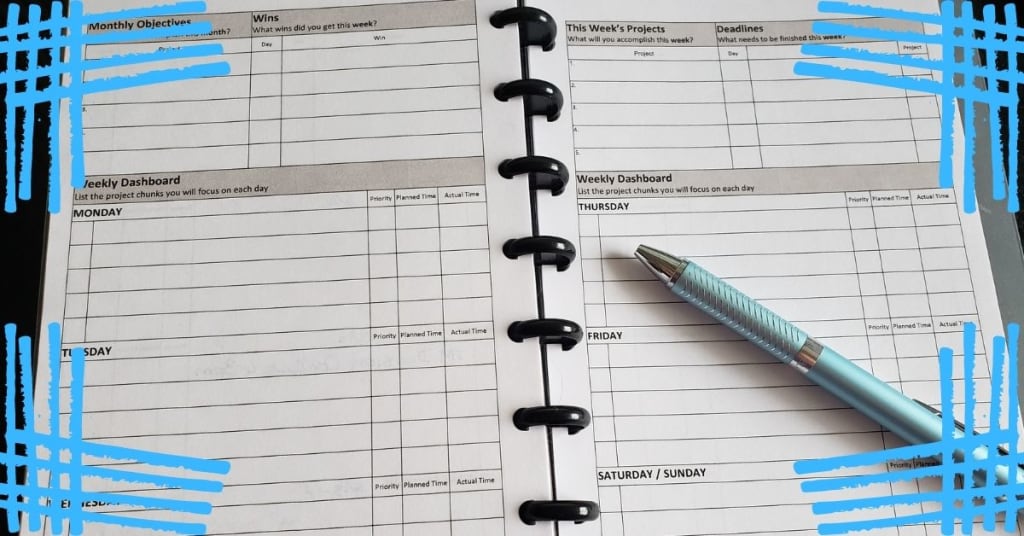
I’ve been using a project-based planner for years now, and it’s been a tremendous boost to my productivity. The image at the top of this article shows what my planner looks like. (Note: since the photo was taken, I changed the upper right section to be Progress Counters, with the three columns labeled Target, Activity, and Progress.)
It lets me see at a glance what my top objectives for the month, week, and day are. Each morning when I start work, I know exactly what my top priority is, and can dive right into it.
Say that one of my monthly objectives is to write and publish 20 articles. Well, then one of my weekly objectives would be to write and publish 5 articles.
I’d break the tasks for that objective up among the individual days, assigning some days to research and others to writing.
This way, you always know if you’re making progress toward your main goals for the year.
If something else is taking your attention away from your main goals, you’ll be able to spot it and do something about it quickly.
If you finish your assigned projects for the day earlier than you anticipated, you can give yourself a bit of a holiday. Or you can get a jump on tasks you’d planned to accomplish later in the week.
You’re in control, not the clock.
Set your objectives
“If what you are doing is not moving you towards your goals, then it’s moving you away from your goals.” — Brian Tracy
To use a project planner, you need to know what projects you will be pursuing. If you work for someone else, they’ll tell you what they want you to do. If you work for yourself, you’ll need to decide what projects will support your yearly goals.
Experts disagree on how many goals you should set for the year. Some think you should focus on only one thing, and some recommend as many as seven in different areas of your life.
One good way of setting yearly goals is to think about who you want to be in one year, rather than the things you want to accomplish. Then consider what you’ll need to accomplish in order to be that person. Those are your yearly goals.
Turn your yearly goals into objectives by making them measurable and giving them a timeline.
For example, this year, one of my goals is to have my screenplay place even better in contests than it did last year. My objective is that by the end of the year (a timeline), the number of semi-finalist, finalist, and winner awards it earns will be higher than the number earned last year (measurable).
Then, determine what you’ll need to do to support those yearly objectives. I find it helps to set quarterly objectives before setting monthly objectives.
Break objectives into reasonable sizes
Breaking something into twelve pieces is too hard for me to picture. But I can easily break it into four pieces, then break each of those into three more pieces.
Using my screenplay as an example, my quarterly objectives were to completely revise the screenplay during the first quarter, and to submit it to specific contests in the rest of the year.
The first quarter I divided the objective of revising the screenplay into a thorough analysis of judges’ comments and plotting out the needed changes in January, then making those changes in February and March.
Make a list of these yearly, quarterly, and monthly objectives. You can keep it in your journal or put it on the first page of your planner.
It’s important that you do not enter all of the objectives into your planner yet. You want to give yourself the freedom to reassess and change your plans based on how your year is going.
How can you possibly know the best use of your time and energy in October, when the year has barely started? You can’t. You can have ideas, but ideas aren’t plans.
Design your week
“Never begin the day until it is finished on paper.” — Jim Rohn
Begin your plans for each week by copying over your monthly objectives. Write down any deadlines that you absolutely must meet.
Then determine which projects you will be working on during the week. If you find you have more than about five projects, combine some of them into a master project.
Maybe your monthly objective is to get five new clients. You think you’ll need to create 8–10 new business proposals or have 8–10 introductory meetings each week to meet that objective. Instead of listing each one as a separate project, make a master project to include all of them.
Now you have to figure out your days.
Design your days
If you have any appointments that will take up significant amounts of time, write them on the days where they occur. Otherwise, you can group calls or meetings that advance your objectives as a single line item in a daily block.
If they don’t advance your objectives, don’t put them in your planner. They’re the distractions that you’ll work around to do your meaningful activities.
I use the 5–3–1 system for deciding how much to plan for in a day. That means 5 small tasks, 3 medium tasks, or 1 big task.
There are very few all-day tasks, usually things like an in-person conference (back when we had such things). Most of your project chunks will probably be medium-sized tasks, that you expect to take between 1–3 hours.
Don’t even bother putting the tiny tasks that take less than 15 minutes in the planner. The planner is to make sure you get your important things done.
For each line item in your daily plans, indicate how long you think it will take. When I first started, my estimates were wildly inaccurate. They’ve gotten better, but sometimes I still miss the mark by quite a bit.
For example, this past Monday I figured I’d take an hour and fix a problem with my computer that had been bugging me for days. It ended up taking 4 hours to fix.
End your day on a positive note
I’m going to let you in on a “secret sauce” that will help you immensely. Only give priorities to today’s activities.
Put a checkmark in the box in front of an activity when it is complete. When all your activities are checked off, you can then prioritize the next day. If you don’t finish all of the activities for today, put a down arrow in front of the ones you didn’t finish, and copy them over to tomorrow.
That way, if one of your days goes completely off the rails, you don’t have to readjust your priorities for the rest of the week.
It’s important to finish your day strong, so you feel good about getting back to work tomorrow. Planning tomorrow’s tasks and priorities is one way to do that.
Another thing that works well is to make a note of your wins for the day. No matter how awful the day, something good happened.
Make sure you give yourself credit for it. Recognize your achievement and celebrate your success with a smile, fist pump, or “Yay, me!”
If it’s the end of the week, finish strong by planning next week.
Conclusion
Make sure that you do your most important tasks first by using a project planner instead of a traditional organizer or time management system.
To be effective:
- Set your yearly goals
- Set monthly objectives that support those goals
- Set weekly objectives that support those monthly objectives
- Create daily tasks that will achieve those weekly objectives
- Assign priorities to the daily tasks
- Estimate how much time each task will take
- Check off tasks and objectives when done
- Record actual time each task took
- Record your wins
At the end of each day, plan and prioritize the next day. At the end of each week, plan and prioritize the next week.
At the end of each month, reassess your progress toward your yearly goals, and set new monthly objectives. (Hah! Bet you thought I was going to say “plan and prioritize the next month.”)
You’ll soon find yourself staying focused on your long-term goals, and getting more done than you’d ever expected. When you reach the end of the year, you may even discover that you’ve become the person you dreamed of being. Congratulations!
Ready to have a better tomorrow?
I’ve created a guide to help you increase your confidence and improve your life. If you follow these tips, you will level up your life very quickly!
About the Creator
Jennifer Dunne
Novelist turned blogger, sharing stories of hope, self-improvement, and productivity, as well as a bit of fantasy and whimsy. Visit me at: http://grftnd.jennifermdunne.com
Keep reading
More stories from Jennifer Dunne and writers in Journal and other communities.
~ Fired ~
— Ai Intrusion ~ Are you Next ~ Is Ai Evolution after your job? — Few workplaces haven't been affected. Ai is in supermarkets, at doctors' offices, and even monitoring farms. I just can't think of anything this machine is not getting into, can you? For instance: Education ~ Law and Tech jobs will one day have a major influence or be taken over by these inanimate machines, with accuracy and vigor. From mechanics' diagnoses to a wide variety of everyday jobs, including fast food workers, with this input having the ability to cut their unnecessary work hours. I'm certain all of us have been touched by this with our short stories and colorful headings, have you? Even comments are very questionable 'Non-Robot' insertions.
By Jay Kantor4 days ago in Journal
Cabin Fever Because of Snow, Sleet, and Freezing Rain That Turned to Icy Roads
What Is Cabin Fever? The short answer is that cabin fever is restlessness from being in a confined area. Cabin fever is the distressing irritability or restlessness experienced when a person or group is stuck at an isolated location or in confined quarters for an extended time. Research shows that prolonged cold, gray skies, and being stuck indoors can trigger mood shifts similar to “winter blues.”
By Margaret Minnicks4 days ago in Humans



Comments
There are no comments for this story
Be the first to respond and start the conversation.