
How 3D-Printed Prosthetics Are Rewriting Mobility in 2031
From custom limbs to human stories, inside a market quietly transforming lives at a 6.92% CAGR
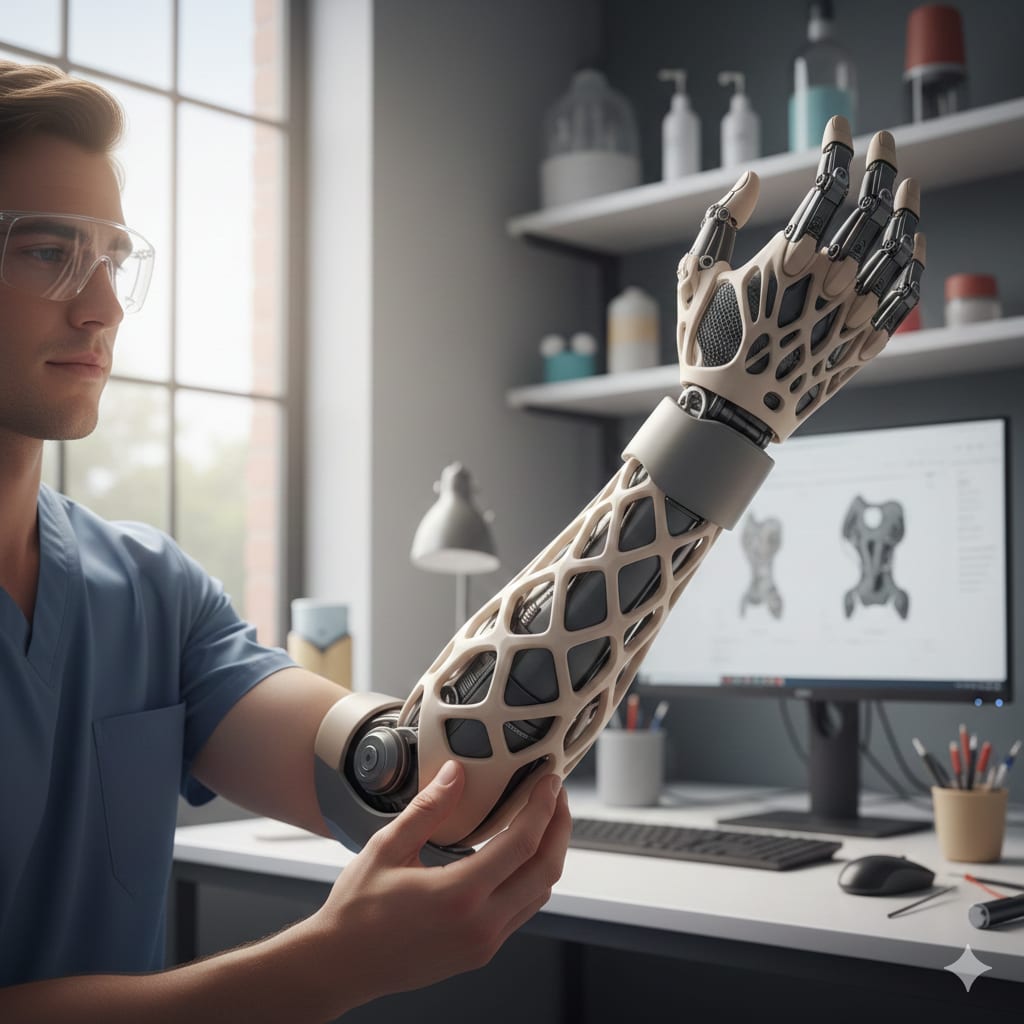
The first time Arun flexed his new hand, it didn’t whirr or clank. It moved—smoothly, almost naturally—responding to his intent rather than resisting it. The prosthetic didn’t come from a massive factory or a months-long supply chain. It came from a 3D printer.
Across hospitals, labs, and small clinics worldwide, prosthetics are being reimagined layer by layer. What was once expensive, slow, and standardized is now becoming personalized, affordable, and fast. This shift isn’t just technological—it’s deeply human.
At the center of this transformation is the 3D-printed prosthetics market, a space where engineering meets empathy and data meets lived experience.
A Market Built on Precision and Possibility
Prosthetics have always been about restoring function. What’s changing now is how that function is delivered. Traditional prosthetics often require multiple fittings, extended production timelines, and high costs that put them out of reach for many patients.
3D printing flips that equation.
Digital scanning allows clinicians to model limbs tailored to an individual’s anatomy. Additive manufacturing then produces lightweight, customizable prosthetics with far less material waste. Adjustments can be made digitally instead of starting from scratch.
According to Mordor Intelligence, the 3D-printed prosthetics market size reflects this momentum. The market is expected to grow from USD 2.80 billion in 2025 to USD 2.99 billion in 2026, and is forecast to reach USD 4.18 billion by 2031, registering a 6.92% CAGR over 2026–2031.
This single data point underscores steady, demand-driven expansion rather than hype-fueled volatility.
Clinicians cite faster turnaround times. Patients report better comfort. Providers see scalable production. Together, these forces are shaping 3D-printed prosthetics market growth that feels both sustainable and socially relevant.
Why Customization Is Driving Adoption
Customization isn’t a feature—it’s the foundation.
Every residual limb is different. Muscle density, skin sensitivity, range of motion, and lifestyle needs vary widely. 3D printing enables prosthetics that match these nuances with millimeter-level accuracy.
This capability is influencing 3D-printed prosthetics market trends, especially in pediatric care, where children quickly outgrow traditional prosthetics. With digital models on file, replacements can be produced faster and at lower incremental cost.
Another emerging angle is design flexibility. Open-lattice structures reduce weight while maintaining strength. Aesthetic customization—colors, patterns, even superhero themes—helps patients emotionally connect with their devices.
These factors are quietly reshaping 3D-printed prosthetics market share, as healthcare providers and rehabilitation centers increasingly favor solutions that combine performance with personalization.
Check out more details and stay updated with the latest industry trends, including the Japanese version for localized insights: https://www.mordorintelligence.com/ja/industry-reports/3d-printed-prosthetics-market?utm_source=vocal.media
Where the Industry Is Headed Next
The broader 3D-printed prosthetics industry is evolving beyond basic limb replacement. Researchers and manufacturers are exploring integrations with sensors, smart materials, and improved joint mechanics—without drifting into speculative claims.
What remains consistent is the production logic: digital-first, patient-specific, and locally manufacturable. This reduces dependency on centralized manufacturing and long logistics chains, a lesson reinforced by recent global supply disruptions.
From a commercial perspective, the 3D-printed prosthetics market forecast suggests that growth will remain incremental but resilient. Rather than explosive spikes, adoption is expanding steadily as regulatory familiarity improves and clinical confidence deepens.
Importantly, this market is not driven by novelty alone. Its progress is anchored in repeat use, clinician endorsement, and real-world patient outcomes—key signals for long-term relevance.
The Human Impact Behind the Numbers
Market figures tell one story. People tell another.
For amputees in developing regions, lower-cost 3D-printed prosthetics can mean access where none existed before. For trauma patients, faster production can shorten rehabilitation timelines. For clinicians, digital workflows reduce manual trial-and-error.
These human outcomes reinforce why the 3D-printed prosthetics market growth trajectory matters beyond revenue charts. Each incremental gain represents more mobility restored, more independence regained, and more dignity preserved.
Unlike many high-tech healthcare narratives, this one doesn’t rely on distant promises. It’s already happening—in clinics, schools, and homes.
What This Means Going Forward
The momentum behind 3D-printed prosthetics is not about disruption for its own sake, but a fundamental shift in how healthcare technologies are designed—away from standardized solutions and toward systems that adapt to individual bodies, lifestyles, and recovery journeys. As digital design becomes routine in clinical workflows, prosthetics are increasingly shaped through collaboration between engineers, clinicians, and patients themselves, transforming devices from static medical tools into evolving extensions that can be refined as needs change.
Looking ahead, the broader implication is access. Localized production, faster iteration, and digital inventories reduce reliance on centralized manufacturing, making advanced prosthetic care more attainable in underserved regions. How evenly these benefits spread will depend on education, training, and clinical confidence, not just technical capability. Ultimately, the future of this space will be defined by responsible deployment—where usability, dignity, and continuity of care matter as much as innovation itself, and progress is measured by who it truly serves.
Question for you: If technology can now adapt to the human body instead of the other way around, what other parts of healthcare do you think are ready for the same transformation?
About the Creator
Keep reading
More stories from Andrew Hamilton and writers in Journal and other communities.
Data Center Switches: The Hidden Engine of the Internet
At 3 a.m., when cities sleep and screens glow quietly in dark rooms, something extraordinary is happening beneath the surface of the internet. Trillions of data packets are racing through invisible highways, switching directions in milliseconds, never colliding, never slowing. You don’t see it. You don’t hear it. But without it, the digital world would freeze.
By Andrew Hamiltona day ago in Journal
~ Fired ~
— Ai Intrusion ~ Are you Next ~ Is Ai Evolution after your job? — Few workplaces haven't been affected. Ai is in supermarkets, at doctors' offices, and even monitoring farms. I just can't think of anything this machine is not getting into, can you? For instance: Education ~ Law and Tech jobs will one day have a major influence or be taken over by these inanimate machines, with accuracy and vigor. From mechanics' diagnoses to a wide variety of everyday jobs, including fast food workers, with this input having the ability to cut their unnecessary work hours. I'm certain all of us have been touched by this with our short stories and colorful headings, have you? Even comments are very questionable 'Non-Robot' insertions.
By Jay Kantor10 days ago in Journal
Solar Users to Pay Full Electricity Unit Price Under Latest Net-Billing Rule
Islamabad: In a major policy shift aimed at restructuring the country’s power sector, the government has announced a new net-billing mechanism that will require solar energy users to pay the full electricity unit price for power consumed from the national grid. The move replaces the long-standing net-metering system and has sparked widespread debate among consumers, industry experts, and renewable energy advocates.
By Ayesha Lashariabout 18 hours ago in Journal
Book Review: Atmosphere by Taylor Jenkins Reid
I flipped the book over in my hands in the centre of the small airport book shop. Although I had heard promising reviews of Atmosphere by Taylor Jenkins Reid, I hesitated. The synopsis didn’t compel me - I wasn’t much of a space girly. In high school it made me cringe when my peers would talk about the stars.
By sleepy drafts7 days ago in BookClub




Comments
There are no comments for this story
Be the first to respond and start the conversation.