
Electric Vehicle Sensor Market: The Quiet Intelligence Powering EVs
How invisible sensors are shaping safety, performance, and trust in electric mobility
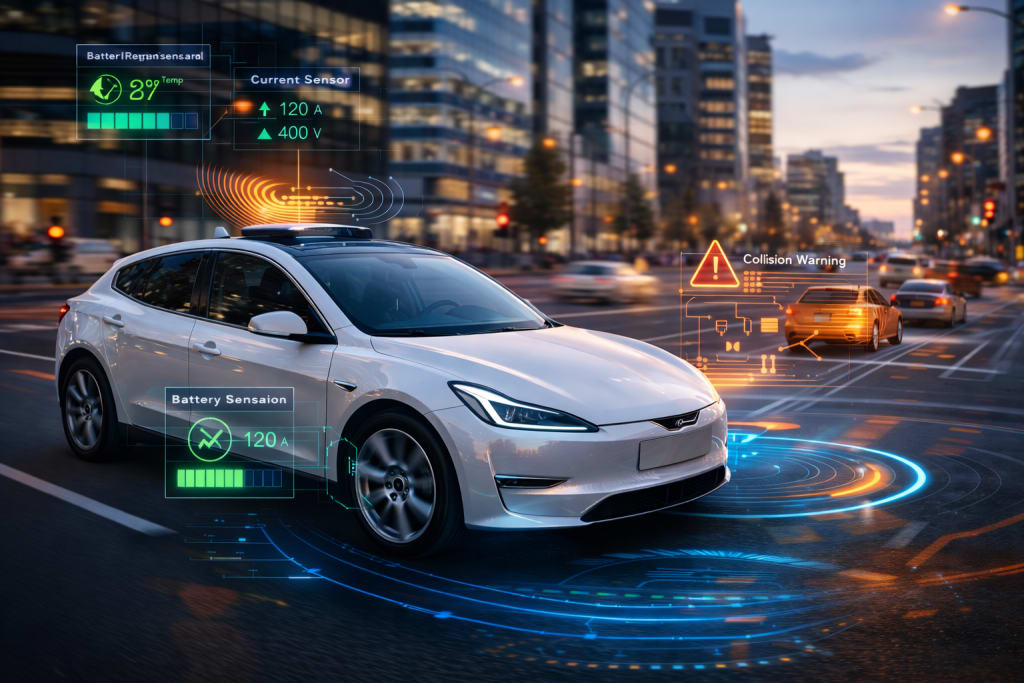
The electric car moves almost silently, gliding through traffic with effortless precision. No exhaust fumes. No engine rumble. Just smooth acceleration and instant torque. But beneath that calm exterior, thousands of calculations are happening every second, unseen and uninterrupted.
Hidden deep inside the vehicle, sensors constantly measure heat, current, pressure, and motion. They watch over the battery, protect passengers, and keep systems in balance. This invisible network is the foundation of modern electric mobility, and it sits at the center of the Electric Vehicle Sensor Market, where data accuracy has become just as critical as battery capacity.
Why Sensors Matter in Electric Vehicles
Electric vehicles rely on control rather than combustion. Every function, from charging to braking, depends on precise data. Sensors provide that data in real time, allowing systems to react instantly and safely.
Current sensors track electricity flowing through high voltage systems. Temperature sensors prevent battery overheating. Position and speed sensors support smooth motor operation and regenerative braking. Together, they enable the reliability and safety that drivers expect from electric vehicles.
According to Mordor Intelligence, the Electric Vehicle Sensor Market size was valued at USD 10.73 billion in 2025 and is projected to grow from USD 12.37 billion in 2026 to USD 25.17 billion by 2031, registering a compound annual growth rate of 15.28 percent over the forecast period. This single data point highlights how sensor demand is accelerating alongside global EV adoption.
Inside the Electric Vehicle Sensor Market
The Electric Vehicle Sensor industry spans multiple technologies and applications. Sensors are embedded across battery management systems, power electronics, motors, and safety modules. Their role is not optional. Without them, electric vehicles cannot function reliably.
Battery management remains the largest application area, as sensors monitor cell voltage, current flow, and temperature to prevent failures and extend battery life. Powertrain systems also depend on sensors to manage torque delivery and efficiency under varying driving conditions.
The Electric Vehicle Sensor Market share is shaped by the rapid electrification of passenger cars and the rising use of sensors in electric buses and commercial fleets. As vehicle architectures become more software driven, sensor data feeds directly into control algorithms that define driving behavior.
Regionally, Asia Pacific leads adoption due to high electric vehicle production and strong electronics manufacturing ecosystems. Europe and North America follow closely, driven by safety regulations and performance standards that require increasingly sophisticated sensing systems.
Trends Transforming Vehicle Intelligence
Several Electric Vehicle Sensor Market trends are reshaping how vehicles are designed. One major shift is sensor integration. Instead of standalone components, manufacturers are adopting multi function sensors that measure current, voltage, and temperature within a single unit. This reduces weight, cost, and system complexity.
Another trend is the rise of smart sensors with embedded processing. These sensors filter and interpret data locally before sending it to central control units, improving response times and system reliability.
Advanced safety systems are also driving demand. As electric vehicles adopt more driver assistance features, sensors play a growing role in monitoring vehicle behavior and supporting automated decision making.
Sustainability influences sensor design as well. Longer lasting sensors reduce maintenance needs and support the broader goal of lowering lifecycle emissions across electric vehicle platforms.
Challenges Beneath the Surface
Despite strong growth, the Electric Vehicle Sensor Market analysis reveals ongoing challenges. High precision sensors must operate reliably under extreme temperatures and voltages. Ensuring durability over long vehicle lifespans requires rigorous testing and quality control.
Supply chain constraints and semiconductor availability can affect production timelines. In addition, integrating sensors seamlessly into evolving vehicle architectures demands close collaboration between automakers and component suppliers.
Cybersecurity is another concern. As sensors connect to vehicle networks, protecting data integrity becomes essential for safety and trust.
Manufacturers are responding through modular designs, improved calibration techniques, and tighter integration between hardware and software systems.
Looking Ahead at the Market Forecast
The Electric Vehicle Sensor Market forecast points to sustained expansion as electric vehicles become mainstream across global markets. Sensors will not only increase in number per vehicle but also grow in importance as vehicles transition toward higher levels of automation and connectivity.
Future developments are expected to focus on higher accuracy, faster response times, and deeper integration with artificial intelligence systems. Sensors will enable predictive maintenance, adaptive energy management, and safer autonomous functions.
While batteries often dominate headlines, sensors quietly define how electric vehicles perform, adapt, and earn driver confidence.
About the Creator
william jack
i am research analyst
Keep reading
More stories from william jack and writers in Journal and other communities.
Automotive Logistics Market: The Hidden Engine of Mobility
Before a car ever cruises onto the highway, a complex journey has already taken place. Engines, wiring harnesses, chassis panels, tires, and electronics have traveled thousands of miles in dozens of coordinated steps. Trucks, trains, ships, and warehouses work in concert like silent conductors in a global symphony of movement.
By william jack2 days ago in Journal
~ Fired ~
— Ai Intrusion ~ Are you Next ~ Is Ai Evolution after your job? — Few workplaces haven't been affected. Ai is in supermarkets, at doctors' offices, and even monitoring farms. I just can't think of anything this machine is not getting into, can you? For instance: Education ~ Law and Tech jobs will one day have a major influence or be taken over by these inanimate machines, with accuracy and vigor. From mechanics' diagnoses to a wide variety of everyday jobs, including fast food workers, with this input having the ability to cut their unnecessary work hours. I'm certain all of us have been touched by this with our short stories and colorful headings, have you? Even comments are very questionable 'Non-Robot' insertions.
By Jay Kantor4 days ago in Journal
How to Spend 3 Days in Trincomalee
Trincomalee remains the understated anchor of Sri Lanka’s northeast coast. Unlike the well-trodden southern beaches, "Trinco" offers a raw collision of maritime history, Chola-dynasty ruins, and world-class marine biodiversity. This three-day guide balances the town’s spiritual heritage with its wild, deep-water adventures.
By Jeewanthi Armstrong5 days ago in Journal




Comments
There are no comments for this story
Be the first to respond and start the conversation.