

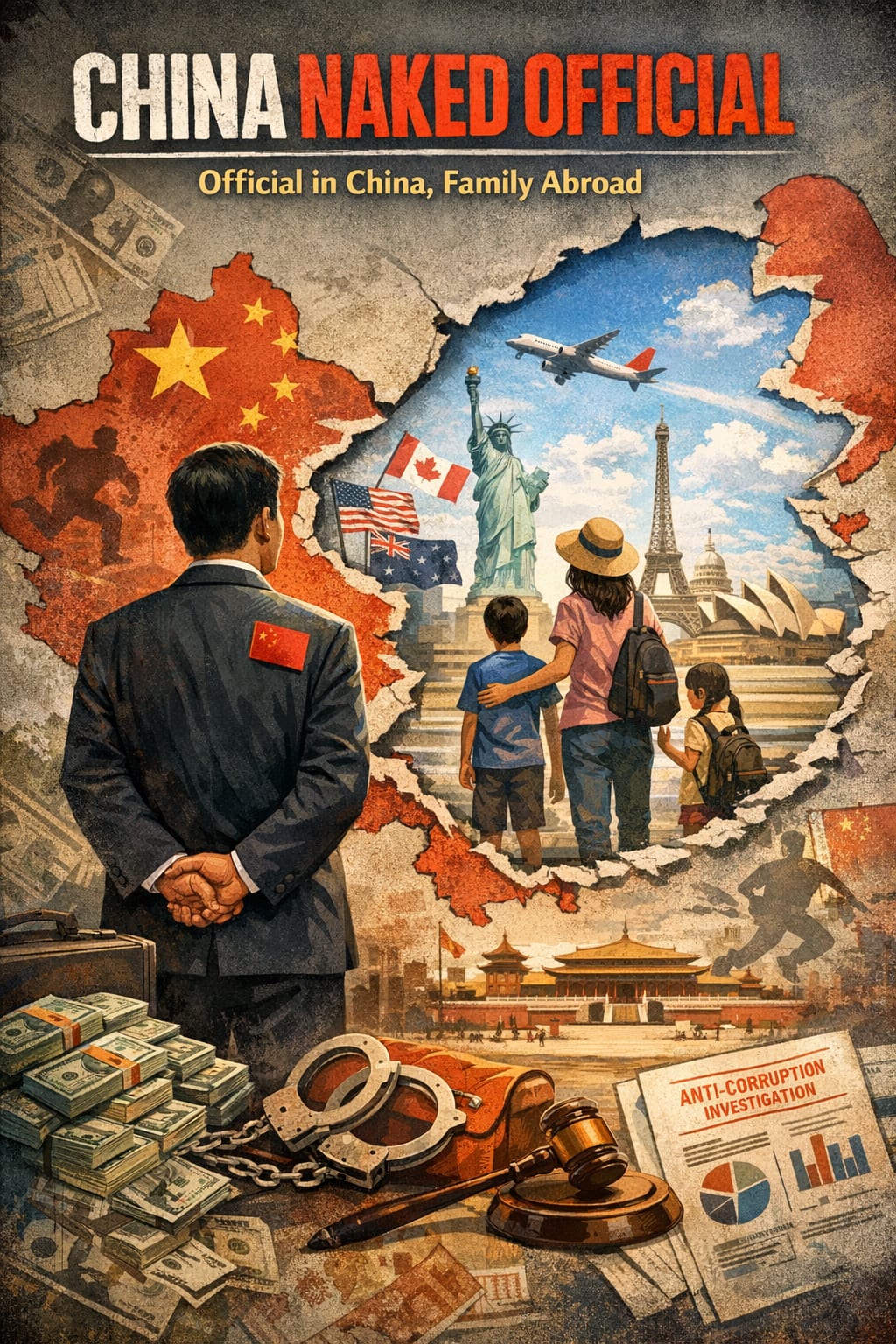
China’s “Naked Officials”: Power, Corruption, and Capital Flight
In Chinese political discourse, the term “naked official” (裸官, luǒ guān) refers to a government official whose spouse and/or children have emigrated abroad while the official remains in China holding public office. The phrase does not imply literal nudity; rather, it suggests that the official is “exposed” — politically vulnerable and potentially more prone to corruption — because their immediate family and often their assets are based overseas.
The phenomenon became a major public concern in the early 2000s, as China’s rapid economic growth coincided with rising corruption cases. Many high-profile scandals revealed a pattern: officials accumulated illicit wealth, transferred assets abroad, and arranged for their families to settle in countries such as the United States, Canada, Australia, or in regions like Hong Kong. If investigations intensified, some officials fled the country to join their families.
Why the Concern?
The Chinese government views “naked officials” as high-risk for several reasons:
Capital Flight – Moving family members abroad is often accompanied by transferring assets overseas. This can lead to significant capital outflows.
Corruption Risk – Officials whose families reside abroad may feel less tied to their domestic social and political environment, making them more willing to engage in graft.
Flight Risk – If under investigation, an official with family abroad has a ready-made escape plan.
These concerns became more prominent as anti-corruption efforts intensified, particularly under President Xi Jinping after 2012. Xi launched one of the most sweeping anti-corruption campaigns in modern Chinese history, targeting both high-ranking “tigers” and lower-level “flies.” The issue of “naked officials” became intertwined with broader efforts to discipline the Communist Party and restore public trust.
Policy Responses
Over the years, the Chinese Communist Party (CCP) introduced regulations requiring officials to disclose family members’ residency and citizenship status. Officials whose spouses and children have emigrated are often barred from holding certain sensitive positions, especially in areas involving national security, finance, or personnel management.
Some provinces have reportedly required “naked officials” either to bring their families back to China or to step down from their posts. Others have subjected them to additional scrutiny and auditing.
In 2014, new rules strengthened supervision of officials’ personal affairs, including overseas property ownership and foreign residency permits. These measures formed part of a broader institutional effort to reduce systemic corruption, alongside reforms in auditing, procurement, and party discipline enforcement.
Public Perception and Social Debate
The term “naked official” resonates strongly in Chinese public opinion because it touches on issues of fairness, nationalism, and trust. Many citizens view the practice as hypocritical: officials publicly serve the state and promote patriotism, yet privately send their families and wealth abroad, often to Western democracies. This contradiction fuels skepticism about elite commitment to China’s future.
Online discussions and investigative journalism have occasionally brought individual cases to light, although media coverage remains tightly controlled. The topic gained particular attention during high-profile anti-corruption investigations in the 2010s, when authorities disclosed that some disgraced officials had family members settled overseas.
At the same time, it is important to note that not all cases involve corruption. Some officials argue that their families go abroad for education, business opportunities, or quality-of-life considerations. In a globalized world, cross-border family arrangements are not inherently illegal. The controversy arises primarily when such arrangements coincide with hidden wealth or abuse of power.
International Dimensions
The issue also intersects with international law enforcement. China has pursued fugitive officials through operations such as “Operation Fox Hunt” and “Sky Net,” aimed at repatriating suspects who fled abroad. These efforts have involved cooperation with foreign governments to track illicit financial flows and extradite or deport corruption suspects.
Countries that receive Chinese immigrants, particularly those with investor visa programs, have occasionally come under scrutiny for being destinations of funds linked to corruption. This has led to tighter financial monitoring and anti-money-laundering measures in several jurisdictions.
Broader Implications
The debate over “naked officials” reflects deeper tensions in China’s political system. On one hand, it highlights the challenges of governance in a rapidly globalizing economy where capital and families can move across borders with relative ease. On the other hand, it underscores the CCP’s ongoing effort to maintain ideological loyalty and political discipline among its ranks.
By framing the issue as both a moral and security concern, the Chinese leadership has sought to demonstrate resolve in combating corruption and preventing capital flight. The crackdown on “naked officials” fits within a broader narrative of strengthening party control, reinforcing national sovereignty, and limiting vulnerabilities in the political system.
Ultimately, the phenomenon illustrates a paradox of contemporary China: a nation deeply integrated into the global economy, yet governed by a political system that prioritizes centralized authority and internal cohesion. As long as wealth mobility and overseas migration remain attractive options for elite families, the tension surrounding “naked officials” is likely to persist.
About the Creator
Ibrahim Shah
I am an Assistant Professor with a strong commitment to teaching,and academic service. My work focuses on fostering critical thinking, encouraging interdisciplinary learning, and supporting student development.
Keep reading
More stories from Ibrahim Shah and writers in Journal and other communities.
The Man Who Refused to Die
On November 17, 2012, a small fiberglass fishing boat left the Pacific coast of Mexico near Costa Azul. On board were two men: an experienced fisherman named José and his young crewmate, Ezequiel. They were heading out for what should have been a routine two-day shark fishing trip into the vast waters of the Pacific Ocean.
By Ibrahim Shah 5 days ago in Journal
Gold Rate Today (February 15, 2026): Yellow Metal Down Nearly Rs 24,500 From Peak; Check Prices Of 24K, 22K & 18K In Delhi, Mumbai, Chennai, Bangalore, Hyderabad & Other Major Cities
Gold has always held a special place in Indian households — not just as an investment, but as a symbol of security, culture, and prosperity. However, on February 15, 2026, the yellow metal is making headlines for a different reason. After reaching record-breaking highs earlier this year, gold prices have corrected sharply, falling by nearly Rs 24,500 from their peak levels.
By Sajida Sikandar6 days ago in Journal




Comments (1)
very informative