
AI Music and the Question of Human Creativity
Is AI Music Real Music? The Debate Over Creativity

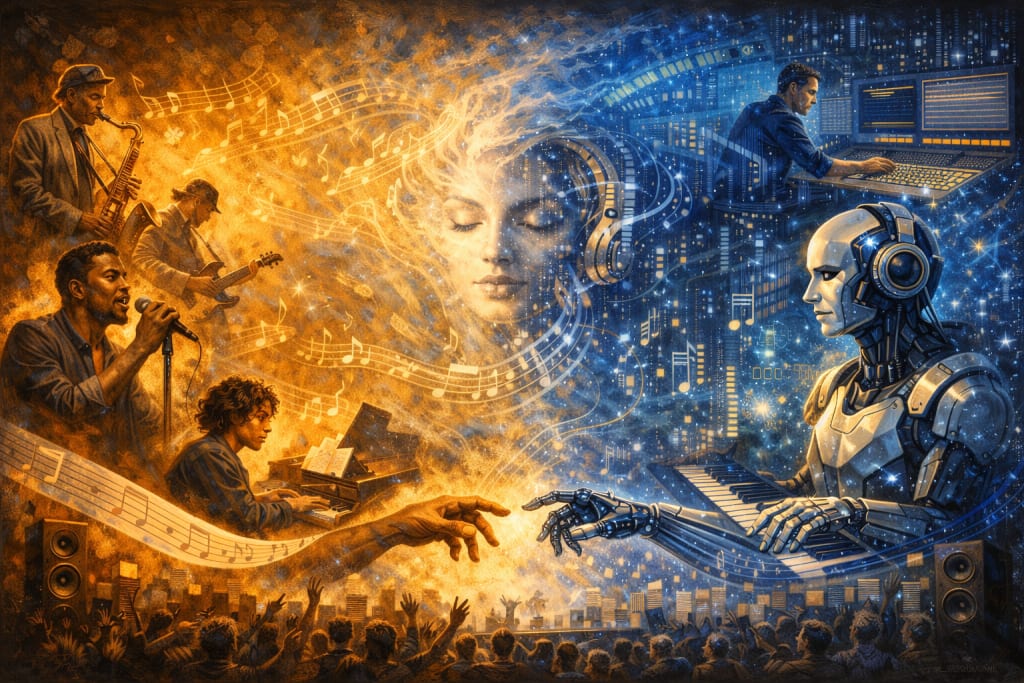
Music has always been one of humanity’s deepest forms of expression. It is sound organized in time; rhythm, melody, harmony, but that definition barely scratches the surface. Music carries emotion, memories, and meaning. It can tell stories and connect strangers through shared feeling. When people talk about music having “soul,” they usually mean that it resonates emotionally, that it feels human. But what exactly gives music its soul? Is it the intention of the creator, the imperfections of performance, or simply the reaction of the listener? These questions become even more complicated in the age of AI music.
Artificial intelligence can now compose melodies, generate vocals, and create entire songs, but it does not operate independently of human input. Someone chooses the parameters, curates the training data, writes or refines lyrics, and guides the creative direction. Whether a producer adjusts the output, a songwriter supplies ideas, or an engineer shapes the final mix, human decision making remains at the core of the process. Some dismiss AI music as fake, arguing that machines cannot feel and therefore cannot create art. Others embrace it as a new tool; much like synthesizers or digital audio workstations once were. The truth probably lies somewhere in between. AI can analyze patterns in human music and generate works that evoke emotion in listeners, but those patterns originate from human culture and artistic expression. If the purpose of music is to move people, then AI assisted music can achieve that purpose. Human creativity guides the technology, shaping the result and giving it meaning.
History offers many examples of innovations that were initially rejected. When electric guitars first appeared, traditionalists claimed they were noisy and lacked the sophistication of classical instruments. Jazz was once considered immoral or chaotic by some critics, yet it is now celebrated as one of America’s great artistic contributions. Hip hop faced similar resistance, dismissed by many in its early years as not “real music.” Today it dominates charts and influences genres worldwide. These examples illustrate a pattern: people often resist new forms of expression because they challenge existing ideas. Over time, however, society adapts and expands its understanding of what art can be.
AI music follows a similar trajectory. Some argue that because AI lacks human emotion, it cannot create “real music.” But consider collaboration in traditional music. Many musicians rely on others to bring their vision to life. A songwriter might compose lyrics but hire a producer to craft the instrumental arrangement. A singer may deliver vocals while session musicians provide the backing tracks. Large scale productions often involve teams of composers, engineers, and editors. In these cases, the final product is still considered the artist’s work, even though many hands contributed. AI can be viewed as another tool in this collaborative process; one that extends creative possibilities rather than replacing human expression.
Examples of collaboration abound in the music industry. Pop artists frequently work with producers who specialize in beats and sound design. Vocal tuning software is commonly used to refine performances. These tools do not diminish the talent of the artist; they enhance the final result. The question, then, is not whether AI music is valid but how it fits into the broader landscape of creativity. If a song created with AI moves listeners and sparks emotion, does it matter that a machine assisted in its production?
AI musicians such as Thorne Empire, Cane Walker, and other emerging creators demonstrate this evolving landscape. Their work blends algorithmic composition with human oversight, creating music that challenges traditional boundaries. Critics may argue that such projects lack authenticity, but listeners often judge music by its emotional impact rather than its origin. If people enjoy AI generated songs and find meaning in them, that enjoyment becomes part of the artistic experience. After all, art exists to communicate and connect.
This leads to the question of talent. What does it mean to be talented? Talent is often defined as the ability to create something valuable or meaningful. A musician might possess technical skill, emotional depth, or innovative ideas. AI lacks human intuition, but it can process vast amounts of musical data, data created by humans, and generate compositions that surprise and inspire. In that sense, AI is still an extension of human creativity, shaped by the choices of programmers, producers, and artists who guide its use. AI songs would not exist without the human creators who have the vision and make artistic decisions. Is that not a form of creativity? Some would argue that true talent requires human experience. Others believe that tools; whether a piano, a guitar, or an algorithm, are extensions of human expression. The distinction becomes less important if the result resonates with listeners, because even AI generated music ultimately reflects human tastes, preferences, and cultural patterns.
The purpose of music is ultimately to evoke emotion. People listen to songs because they feel something; joy, sadness, nostalgia, or excitement. If AI music can elicit these responses, it fulfills the fundamental purpose of art. The debate over whether it is “real music” may be less important than the experiences it creates. Music evolves over time, shaped by culture and technology. What was once considered unconventional often becomes accepted and celebrated.
Of course, AI music also raises valid concerns. Some worry that widespread automation could reduce opportunities for human musicians. Others fear a loss of authenticity in art. These concerns deserve attention. Technology should enhance creativity, not replace it. The best outcomes likely involve collaboration; humans guiding AI, shaping its outputs, and infusing them with personal meaning. In this way, AI becomes a partner rather than a competitor.
Ultimately, music is defined by its impact. If a song moves someone to dance, reflect, or feel connected, it achieves something valuable. Whether the composer is human, machine, or a combination of both may be less important than the experience itself. Just as society eventually embraced innovations like electric guitars and digital production, it may come to view AI music as another step in the evolution of artistic expression.
The question of whether AI music has a soul might never have a definitive answer. Machines do not possess consciousness, but the emotions they evoke in listeners are real. Yet AI does not create in a vacuum; it is shaped and directed by human choices. Programmers design the algorithms, producers select inputs and parameters, and artists guide the creative process. In that sense, AI music is still an extension of human expression, much like traditional instruments are extensions of physical skill and imagination. Perhaps the soul of music resides not in the tool itself but in the human intention behind its use and the connection it creates with listeners. If that connection exists, then AI music, like any other form of art, can be meaningful. The challenge is to approach it with curiosity rather than fear, recognizing that creativity is not a fixed concept but a constantly evolving expression of what it means to be human.
About the Creator
Thorne Empire
I write the lyrics and let the AI carry the tune. Sometimes it’s magic, sometimes it misses the mark; but every word is a piece of me. Whether it hits or not, the fact that you listened, and felt anything at all; that means everything.
Keep reading
More stories from Thorne Empire and writers in Journal and other communities.
Voices From A War We Can’t Ignore
I, Thorne Empire, never set out to write war songs. I set out to tell the truth as I see it; from across the ocean, watching a country bleed in real time. My songs supporting Ukraine weren’t written for attention. They were written because the invasion demanded a response. Because the lies, corruption, and brutality coming from Russia need to be named. Plainly. Brutally.
By Thorne Empire5 days ago in Journal
~ Fired ~
— Ai Intrusion ~ Are you Next ~ Is Ai Evolution after your job? — Few workplaces haven't been affected. Ai is in supermarkets, at doctors' offices, and even monitoring farms. I just can't think of anything this machine is not getting into, can you? For instance: Education ~ Law and Tech jobs will one day have a major influence or be taken over by these inanimate machines, with accuracy and vigor. From mechanics' diagnoses to a wide variety of everyday jobs, including fast food workers, with this input having the ability to cut their unnecessary work hours. I'm certain all of us have been touched by this with our short stories and colorful headings, have you? Even comments are very questionable 'Non-Robot' insertions.
By Jay Kantor21 days ago in Journal
The Complete Guide to Developing a Marketing Budget for a Growing Drug Rehab Facility
Introduction to Strategic Marketing in the Behavioral Health Sector Marketing a growing drug rehabilitation facility demands far more than promotional enthusiasm. It requires a disciplined fiscal architecture, strategic foresight, and a nuanced understanding of the behavioral health ecosystem. As the prevalence of substance use disorders continues to challenge communities worldwide, facilities must balance ethical responsibility with competitive positioning.
By Fida Hassain6 days ago in Journal


Comments