
7 Signals the wireless connectivity market Is Entering a New Era
From smart cities to satellite internet, the wireless connectivity market is reshaping how the world connects—and why its next decade may redefine global infrastructure.
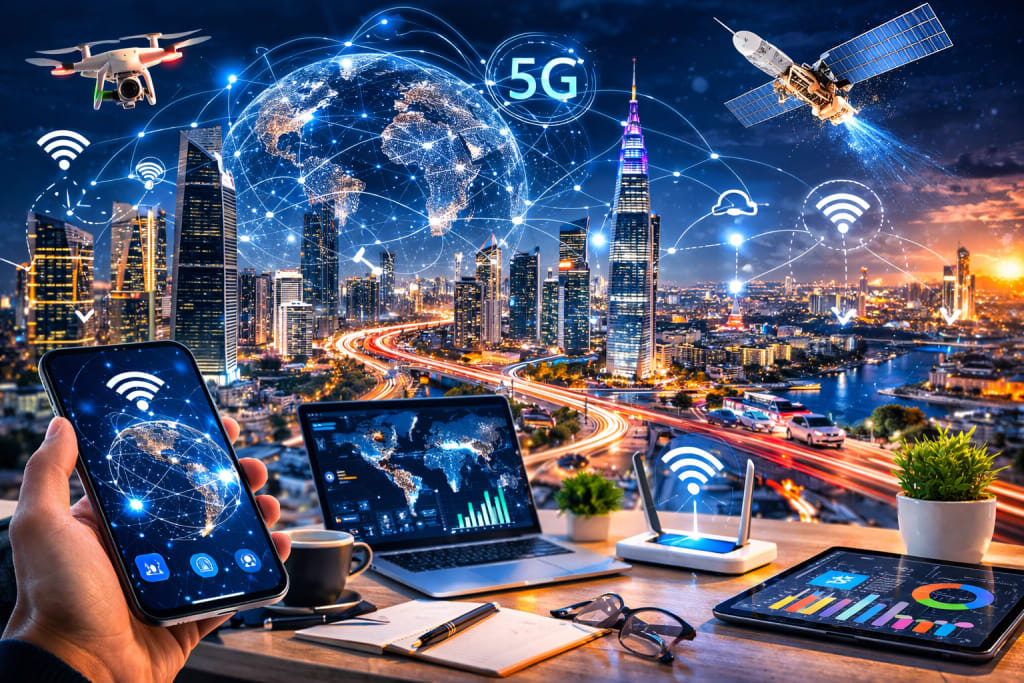
The invisible threads holding the modern world together aren’t made of steel or fiber—they travel through the air.
From the moment your alarm syncs with the cloud to the instant a self-driving car updates its navigation data, wireless signals quietly power the rhythm of modern life. What once began as simple radio communication has evolved into an ecosystem connecting billions of devices, satellites, sensors, and cities.
Today, the wireless connectivity market sits at the center of this transformation. According to Mordor Intelligence, the wireless connectivity market size is projected to reach USD 101.87 billion in 2025, rise to USD 113.69 billion in 2026, and grow to USD 196.12 billion by 2031, expanding at a CAGR of 11.52% from 2026 to 2031.
That growth is not just about faster internet. It reflects a deeper shift in how societies function—from healthcare systems relying on connected monitoring devices to global industries operating through real-time wireless networks.
To understand where the digital world is heading, we need to look at the signals shaping the next chapter of connectivity.
1. The world is becoming a network of devices
Not long ago, wireless networks mainly connected phones and laptops. Today, they connect everything.
Smart thermostats regulate home temperatures remotely. Agricultural sensors monitor soil health across vast farmland. Logistics companies track fleets through real-time wireless data streams.
This explosion of connected devices is a defining force in the wireless connectivity industry. As billions of sensors, wearables, and industrial machines come online, networks must evolve to handle massive amounts of data without delays.
The result is a shift toward advanced wireless technologies designed to support high device density and reliable low-latency communication.
2. 5G is redefining digital infrastructure
The rollout of next-generation mobile networks is a major driver behind wireless connectivity market growth.
5G networks promise more than speed. They enable ultra-reliable communication for applications that previously seemed impossible—remote robotic surgery, autonomous vehicles, and real-time augmented reality.
Businesses are increasingly integrating these networks into manufacturing, logistics, and public infrastructure. Cities are deploying connected traffic systems, while factories rely on wireless automation to increase productivity.
These developments are rapidly influencing wireless connectivity market trends, pushing telecommunications providers and technology companies to invest heavily in new infrastructure.
3. Satellite internet is expanding the digital frontier
For decades, rural and remote regions struggled with limited connectivity. Now, satellite-based wireless networks are changing that narrative.
Low-Earth orbit satellites are bringing high-speed internet to regions where traditional infrastructure is difficult or costly to build. This expansion is expected to reshape access to digital services across developing economies.
For businesses and governments, the implications are enormous. Entire populations previously disconnected from global networks can now participate in digital commerce, online education, and telemedicine.
This expanding reach plays a key role in the evolving wireless connectivity market share, as new service providers enter the space alongside established telecom companies.
4. Smart cities are becoming connectivity hubs
Urban environments are transforming into massive wireless ecosystems.
Traffic lights communicate with vehicles. Public transport systems send live updates to commuters. Energy grids adjust power distribution using connected sensors.
These technologies depend heavily on reliable wireless infrastructure. As cities integrate digital platforms into everyday operations, demand for stable and scalable connectivity continues to rise.
Smart city projects are therefore becoming an important pillar in the broader wireless connectivity market forecast, particularly in rapidly urbanizing regions.
5. Industry 4.0 relies on wireless automation
Manufacturing floors are no longer dominated by isolated machines. Instead, factories are evolving into connected environments where robots, sensors, and analytics systems communicate continuously.
Wireless connectivity enables real-time data exchange between equipment, improving production efficiency and predictive maintenance. Companies can identify potential failures before they occur, reducing downtime and operational costs.
This shift toward industrial connectivity is accelerating digital transformation across sectors ranging from automotive manufacturing to electronics production.
6. Security challenges are shaping the next wave of innovation
With billions of connected devices transmitting data wirelessly, cybersecurity has become a critical priority.
Protecting wireless networks from unauthorized access and data breaches requires advanced encryption protocols and secure communication frameworks.
Organizations are increasingly investing in technologies that strengthen network security while maintaining performance. These solutions are becoming essential components of modern connectivity strategies.
As security concerns evolve, they are influencing innovation across the wireless connectivity industry, pushing companies to design networks that are both powerful and resilient.
7. The future will be defined by seamless connectivity
Looking ahead, the next phase of wireless development may blur the boundaries between technologies.
Satellite networks, cellular infrastructure, Wi-Fi systems, and emerging communication standards could operate as unified connectivity layers. Instead of switching between networks, devices will automatically select the best available connection in real time.
This vision of seamless global connectivity could transform industries such as healthcare, transportation, logistics, and entertainment.
And with the wireless connectivity market forecast pointing toward nearly USD 196.12 billion by 2031, the economic impact of this transformation is likely to reach far beyond the technology sector.
For readers interested in deeper industry insights, detailed research on the wireless connectivity market
explores how these developments are shaping global connectivity infrastructure.
The invisible backbone of the digital age
It’s easy to overlook the signals that keep our world connected. After all, they’re invisible.
Yet every digital interaction—from sending a message to controlling a factory robot—depends on wireless networks operating silently in the background.
As the number of connected devices climbs and digital infrastructure expands, the wireless connectivity market is becoming one of the most critical technological ecosystems of the modern economy.
The question now isn’t whether connectivity will grow.
It’s how far it will reach—and what new possibilities it will unlock.
What do you think will define the future of global connectivity: satellites, 6G, or something we haven’t imagined yet?
About the Creator
Keep reading
More stories from Andrew Hamilton and writers in Journal and other communities.
Why Accurate Call Monitoring Is the Secret to Happier Customers
An operations manager pulls up the monthly CSAT report and sees a three-point drop, from 87% to 84%, with no obvious cause. Ticket volumes are normal, staffing levels are solid, and the training curriculum hasn't changed. After a week of digging, she finds the culprit: agents on a particular shift had developed an informal habit of skimping on empathy statements during difficult calls. No alert fired. No supervisor caught it. The scorecard hadn't been updated in six months. The gap went unnoticed until customers noticed it first. Meanwhile, customers simply felt unheard and quietly began rating their experiences lower.
By Etech Global Services4 days ago in Journal




Comments
There are no comments for this story
Be the first to respond and start the conversation.