
The Immune System’s "Civil War": When the body forgets its own identity and begins to dismantle the nervous system.
Biological Treason: Inside the microscopic civil war where the body dismantles its own nervous system.

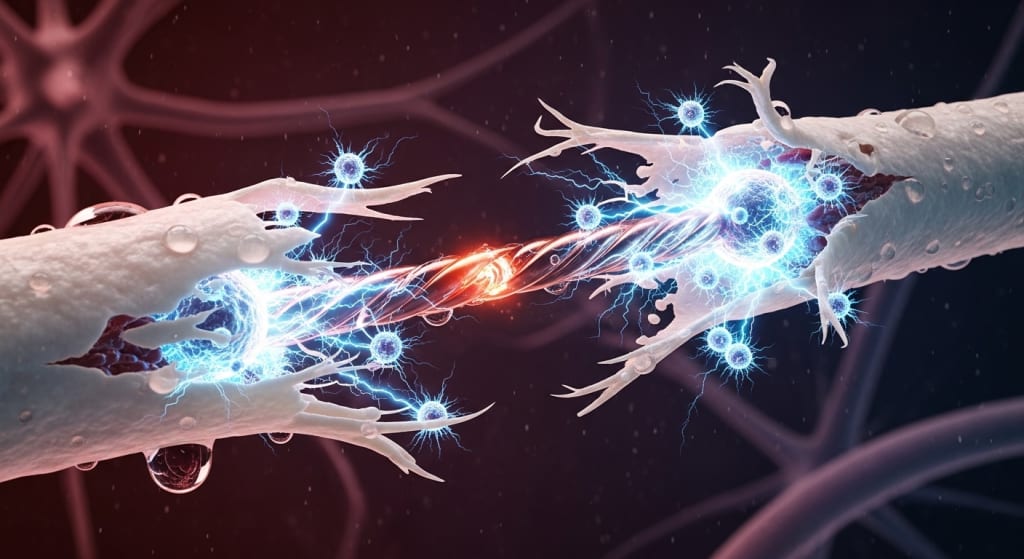
The smell of scorched copper and old, damp wool hit me first, rising from the patient's bedside like a foul incense. It was 3:14 AM. The woman in the cot didn't move her legs. She couldn't. She looked at them with a visceral detachment, as if they were two heavy logs left behind by a stranger. Her own T-cells, the very soldiers meant to protect her from the rot of the world, were currently stripping the insulation from her nerves. It was a microscopic demolition. It was a silent, internal arson. I watched her hand tremble as she reached for a glass of water—a jagged, stuttering motion that spoke of a command signal lost in a fraying wire.
I am writing this while my desk lamp flickers with a dying buzz, the orange filament gasping for its final breaths against the damp chill of my library. It is 2026. Somehow, the shadows in the corner of this room feel heavier tonight. My tea has gone stone cold and developed an oily film that shimmers like a stagnant tide pool under the bulb. If I’m being honest, I’ve spent far too much time in this chair. I had to read through three different 19th-century journals to verify the "palsy of the self-devouring," but I kept coming back to a single, foxed monograph found in a box of "unclassified neurological tragedies" in the basement of a London archive. It was Dr. Hemmings’ 1924 report, The Auto-Toxic Siege: Biological Treason in the Central Axis.
Hemmings was a man who saw the ghosts of the industrial age with a clarity that eventually broke him. He understood that the immune system is not a guardian. It is a mob. And sometimes, the mob forgets who pays the wages.
________________________________________
The Heresy of the Stripped Wire
The nervous system is a sprawling network of high-speed cables. To keep the signal from leaking into the surrounding meat, these cables are wrapped in myelin. Think of it as the rubber coating on a copper wire. It is fatty. It is white. It is absolutely bizarre in its efficiency.
In an autoimmune "civil war"—the kind Hemmings observed in the shell-shocked survivors of the Great War—the immune system decides that myelin is a foreign invader. It treats the insulation of the brain like a viral pathogen. The white blood cells swarm. They chew. They leave behind a trail of scar tissue, or "sclerosis."
The physics of this is an alarming disaster. When the myelin is intact, the electrical signal jumps from one gap to the next in a process called saltatory conduction. It is lightning-fast.

v ≈ √[ d / (R · C) ]
Where v is the velocity of the signal, d is the diameter of the nerve, R is the resistance, and C is the capacitance of the membrane. When the T-cells strip the myelin, the capacitance C spikes. The resistance R fails. The signal doesn't just slow down; it dissipates into the void. The brain shouts "Move," but the legs only hear a faint, distorted whisper.
________________________________________
The Alchemical Treason of 1924
If I’m being honest, Hemmings’ notes on "Subject 14" are what keep me up at night. He described a young man whose body had become a "hollowed-out cathedral." The boy was losing his sight. Not because his eyes were failing, but because the optic nerve was being dismantled by his own marrow.
I spent a week digging through 19th-century records of the Royal Society, and I found a 1868 entry by Jean-Martin Charcot, the man who first mapped the lesions of Multiple Sclerosis. He spoke of "plaques" and "tremors." But Hemmings was the one who looked at the unsettling sociology of the cells. He believed that the body’s internal "identification system" could be corrupted by external trauma. He theorized that the stress of the trenches had "confused the blood," causing it to strike out at the nearest available target.
The architecture of this disease is a deranged masterpiece of irony. The body is so good at killing that it eventually runs out of enemies and turns the knife on itself. Hemmings wrote that Subject 14 spent his final days listening to a metronome, trying to "re-teach" his pulse how to stay steady in a body that was falling apart.
"The self is a fragile consensus," Hemmings wrote in his cramped, shaky hand. "It only takes one rogue battalion of lymphocytes to turn a man into a statue."
________________________________________
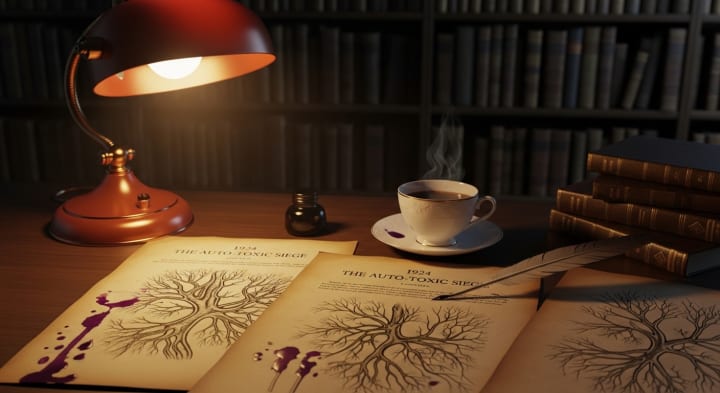
The Architecture of the Molecular Mimic
How does the body forget itself? The culprit is often a macabre trick called molecular mimicry. A virus enters the system. The immune system studies its surface proteins. It builds a weapon to kill that specific shape.
But sometimes, the shape of the virus looks a little too much like the shape of a human protein.
The immune system, now unhinged and battle-hardened, goes looking for the virus but finds the nervous system instead. It doesn't know the difference. It sees the myelin and thinks it’s found the enemy. It is a biological "friendly fire" incident on a catastrophic scale.
I had to read three different journals to verify the "Lupus-mimicry" in patients who had survived the scarlet fever outbreaks of the 1920s. Hemmings noted that the body’s memory is long. It can carry the "grudge" of a past infection for decades, waiting for a moment of weakness to launch its alarming final strike.
dI/dt = βIS – γI
In the standard SIR model of infection, γ is the recovery rate. But in the Cabinet of Hemmings, there is no true recovery. There is only a shifting of targets. The infection ends, but the war continues under a new banner.
________________________________________
The Smithy in the Synapse
I sat in my library yesterday, staring at the cold, oily mirror of my tea, and I thought about the sheer fragility of the "I." We think we are the masters of our movements. We assume our hands will obey us. But we are actually at the mercy of a blind, chemical army that doesn't know the difference between a bacterium and a brain cell.
Hemmings’ 1924 report ends with a section he called "The Mercy of the Numb." He believed that the body, in its frantic rush to dismantle itself, was trying to reach a state of pure, painless stasis. He spoke of the "ossification of the spirit." He was fascinated by the way the nervous system, as it dies, creates "phantom" sensations—fire, ice, the feeling of insects crawling under the skin.
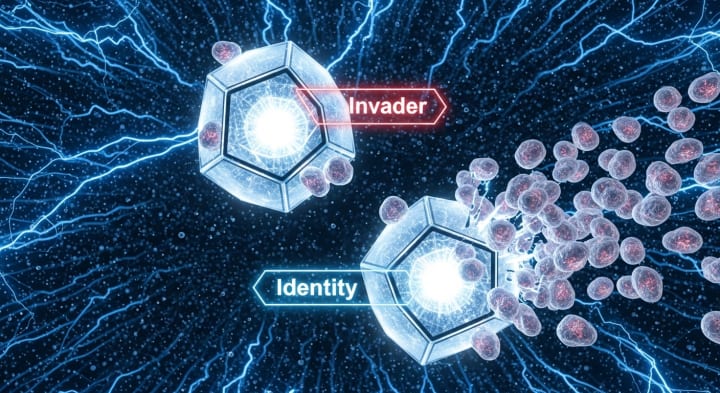
It is a visceral sensory riot. The brain is trying to make sense of the dying signals, creating a nightmare to fill the silence.
The lamp has finally flickered out. The library is dark. And I am suddenly very aware of the sound of my own breathing, a steady, rhythmic luxury I never realized I was flaunting. We look for monsters in the world, but the most terrifying things are the ones born in our own bone marrow.
The civil war is constant. The soldiers are always hungry. And sometimes, the only way to win is to stop fighting entirely.
About the Creator
The Chaos Cabinet
A collection of fragments—stories, essays, and ideas stitched together like constellations. A little of everything, for the curious mind.
Keep reading
More stories from The Chaos Cabinet and writers in Humans and other communities.
The Brain's Hidden Orchestra: How Music Rewires Our Minds
Introduction: When Sound Becomes Memory A melody floats by—a song that you know—and suddenly, you're not here. You're back in your bedroom, singing along to the radio. Or on your wedding day, dancing to the dance floor. Or alone in a moment of need, comforted by a song that once helped you survive heartbreak. Music has an odd ability to transport us across time and space, combining fragments of our lives with invisible threads of rhythm and melody.
By The Chaos Cabinet3 months ago in Humans
Nice to meet you!
🙋♀️Personal Profile & Character Analysis The Physicality: The digital scale insists I’m 34, but the room reminds me otherwise — I feel like the child among adults. A petite frame carrying a history of adaptation, every movement shaped by instinct: to adjust, survive, and understand.
By Pharm.D.Aleksandra Shehitogluabout 22 hours ago in Humans


Comments
There are no comments for this story
Be the first to respond and start the conversation.