
The Day Your Attention Finally Snaps Back
How the quiet collapse of focus in the age of algorithms is reshaping our minds—and how some people are learning to reclaim it.

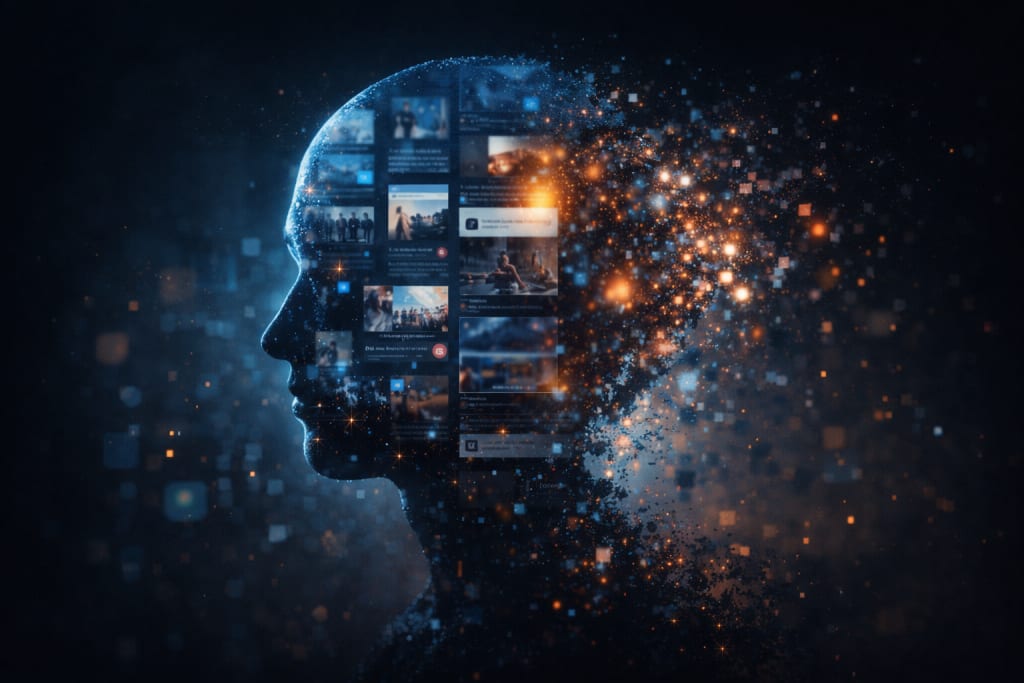
1. The Morning That Felt Like Static
The phone lights up before the room does.
A thin blue glow leaks across the ceiling, sharp enough to wake your thoughts but not sharp enough to clarify them. Notifications stack like unread letters on a desk you never clean. Your thumb moves before you decide to move it. The screen warms your skin. A video starts without sound. Someone laughs. Someone is outraged. Someone is selling certainty in under thirty seconds.
By the time your feet touch the floor, your mind is already tired.
You haven’t done anything yet. No effort. No problem-solving. No meaningful choice. And still, something feels spent—like you’ve been awake for hours in a crowded room where everyone is talking at once and none of it is addressed to you.
This is not burnout in the classic sense. There was no heroic overwork, no noble exhaustion. This fatigue is quieter. Stickier. It hums beneath your thoughts like electrical interference.
You tell yourself you’ll focus later.
Later never comes.
2. The Invisible Bargain You Didn’t Know You Signed
Attention used to be a background faculty, like balance. You noticed it only when it failed—when you tripped, when you forgot, when your mind wandered too far from the page.
Now attention is a contested resource.
Not metaphorically. Literally.
Every scroll, every tap, every micro-pause is measured, tested, optimized. Entire teams of behavioral scientists run silent experiments on millions of people at once, adjusting colors, timings, and rewards with surgical precision. Not to inform you. Not to enlighten you. To keep you there.
You don’t experience this as coercion. You experience it as choice.
The video ends. Another begins. A headline flickers just emotional enough to feel urgent, just vague enough to provoke curiosity. You sense the hook, dimly. You even resist it sometimes. But resistance costs energy, and energy is exactly what’s being drained.
This is the bargain:
You get frictionless stimulation.
They get your uninterrupted attention.
The cost isn’t obvious at first. It shows up later, in strange places—when a book feels heavier than it used to, when silence feels itchy, when thinking deeply feels like pushing against water.
3. A Brain Built for Signals, Not Noise
Picture the brain as a night sky.
For most of human history, signals were rare. A sound in the dark. A movement in the trees. A sudden change in pattern. When something novel appeared, the brain lit up. Attention snapped toward it, fast and sharp, because novelty often meant danger—or opportunity.
Now imagine that same sky filled with fireworks. Constantly. Day and night.
The brain hasn’t changed its fundamental wiring. It still treats novelty as important. Still releases dopamine—the neurotransmitter of motivation and anticipation—when something new appears. Still leans forward instinctively, hungry for the next signal.
But when novelty becomes constant, dopamine stops behaving like motivation and starts behaving like static. The peaks flatten. The baseline drops.
You don’t feel excited. You feel restless.
You don’t feel bored. You feel unable to settle.
This is why people describe modern distraction not as chaos, but as numbness. Not as overload, but as thinning. Thoughts feel less textured. Emotions feel blunted. Time feels oddly warped—hours vanish, but nothing memorable fills them.
The brain is doing exactly what it evolved to do.
The environment is what changed.
4. The Quiet Grief of Shallow Days
There is a specific sadness that creeps in during moments of honesty.
It arrives when you close an app and can’t remember what you just watched. When you sit down to work and feel a subtle dread—not because the task is hard, but because your mind refuses to stay with it. When the day ends and you sense that it passed through you rather than being lived by you.
This grief isn’t dramatic. It doesn’t announce itself. It feels like disappointment without a clear object.
People often mislabel it as laziness or lack of discipline. They promise themselves stricter routines, harsher self-talk, more productivity hacks. They tighten the screws.
But the problem isn’t moral weakness. It’s attentional erosion.
Deep attention—the kind that allows immersion, insight, meaning—requires a mind that can tolerate silence long enough for patterns to emerge. It requires boredom as a doorway, not an enemy. It requires time that is not constantly punctured.
When those conditions disappear, something else goes with them: the sense that your inner life is spacious.
Days feel full. Life feels thin.
5. The First Time Someone Turned the Noise Down
A friend once described it like quitting sugar.
The first day without constant digital stimulation felt empty, almost painful. Sounds seemed louder. Time slowed in an uncomfortable way. There were moments—standing in line, waiting for a kettle to boil—where the urge to reach for a phone felt physical, like an itch under the skin.
Then something unexpected happened.
Thoughts began to stretch.
Not immediately. Not cleanly. At first they were messy, half-formed, slightly anxious. Old worries surfaced. Forgotten ideas knocked at the door. It wasn’t pleasant, exactly—but it was real.
A week in, concentration returned in flashes. Reading no longer felt like trudging through mud. Work sessions grew longer without force. Ideas connected to other ideas without being prompted by a notification.
The most surprising change was emotional.
Moments had weight again. Music lingered. Conversations deepened without effort. Even boredom softened into something almost peaceful—a quiet field instead of a locked room.
This wasn’t a return to some mythical pre-digital purity. It was a recalibration. A reminder that attention, once freed from constant interruption, has a natural gravity.
It wants to settle.
6. Why Reclaiming Focus Feels Like Resistance
Choosing to protect your attention today is not a neutral act.
It runs against business models, social expectations, and even polite norms. There is subtle pressure to be reachable, reactive, updated. Silence is often interpreted as absence. Slowness as disengagement.
But focus has always been a form of quiet rebellion.
Every deep thinker, every artist, every scientist who changed something meaningful did so by stepping away from the immediate and obvious. They lingered where others skimmed. They stayed with questions longer than was comfortable.
What’s new is not the value of focus, but the scale of forces aligned against it.
This makes reclaiming attention less about productivity and more about identity. It asks uncomfortable questions:
What deserves my mind?
Who decides what I notice?
What kind of inner life do I want to live?
These questions don’t have algorithmic answers. They require presence. And presence, paradoxically, feels radical now.
7. The Shape of a Future With (or Without) Depth
Look ahead a decade.
Imagine two futures.
In one, attention continues to fragment. Interfaces grow smoother, faster, more immersive. Artificial intelligence anticipates desires before they’re consciously felt. The world becomes exquisitely tailored—and increasingly shallow. People know more facts, consume more content, but struggle to sit with complexity or ambiguity. Inner lives shrink to match external feeds.
In the other future, a countercurrent forms.
Not a rejection of technology, but a maturation. Tools designed to protect cognitive space. Social norms that respect unavailability. Education that teaches attentional literacy alongside reading and math. A cultural shift that recognizes focus as a finite, precious resource.
Which future unfolds depends on millions of small, private choices.
Moments where someone leaves the phone in another room.
Moments where boredom is endured rather than anesthetized.
Moments where depth is chosen over immediacy.
None of these moments trend. None go viral.
They change lives anyway.
8. The Stillness That Waits on the Other Side
Late at night, when the world finally quiets, there is sometimes a strange clarity.
The air feels thicker. Sounds travel farther. Thoughts slow into complete sentences instead of fragments. You notice memories surfacing uninvited, insights forming without strain. It feels like meeting a version of yourself that has been patiently waiting.
This state is not rare.
It’s merely crowded out.
Attention, when given room, does not explode into brilliance. It settles into something humbler and more powerful: continuity. The ability to stay with a thought long enough for it to transform you.
Reclaiming that ability won’t happen all at once. It happens the way muscles rebuild—through small, consistent acts of restraint and care.
You don’t need to abandon the digital world. You need to stop letting it decide everything.
Because your attention is not just how you consume information.
It is how you experience being alive.
And the moment it snaps back—quietly, almost imperceptibly—you realize something that was easy to forget:
The world is deeper than the feed ever showed you.
About the Creator
Alpha Cortex
As Alpha Cortex, I live for the rhythm of language and the magic of story. I chase tales that linger long after the last line, from raw emotion to boundless imagination. Let's get lost in stories worth remembering.
Keep reading
More stories from Alpha Cortex and writers in Humans and other communities.
The Quiet Cost of Living Online
1. The Glow in the Dark The room is dark except for the blue-white glow of a screen. It hums softly, like an appliance that never sleeps. Somewhere outside, a car passes, tires hissing against wet asphalt, but the sound barely registers. Your thumb moves before you notice it moving. Up. Pause. Down. A face flashes by. A headline. A joke that exhales air from your nose but doesn’t quite become a laugh.
By Alpha Cortexa day ago in Humans
Time to change your life.
Is it even possible for you to change your life? A lot of people, more than there should be, are unhappy with their lives. But what are they doing about it? Usually nothing. People talk about how shitty their lives are and want change, but are they not taking the actions to change?
By Jen Phillips7 days ago in Humans
When Learning Becomes Stability: The Global Impact of Brandon Michael Davis Austin
Early Lessons Beyond the Curriculum The career of Brandon Michael Davis Austin began in classrooms where learning was shaped by careful observation and empathy. From the start, he understood that students rarely left personal struggles at the door. Emotional stress, family instability, and fear often influenced how children behaved and learned.
By Brandon Michael Davis4 days ago in Humans



Comments
There are no comments for this story
Be the first to respond and start the conversation.