
The Boy with a Blanket
A Story of Hope, Love, and Quiet Courage

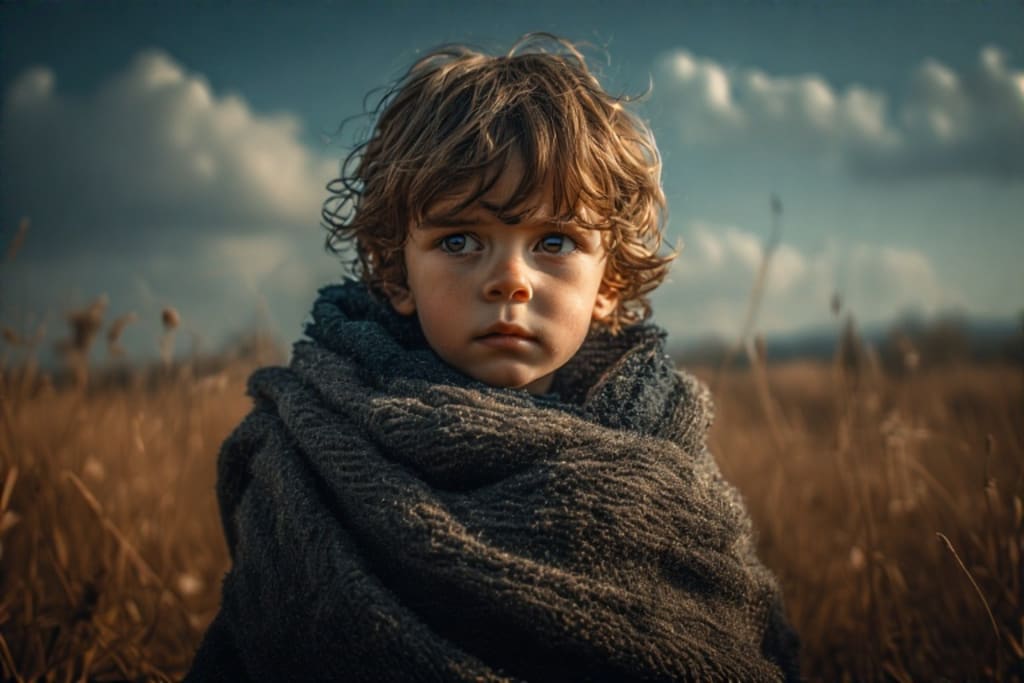
In a forgotten corner of the city, where the lights rarely reached and laughter was a memory, lived a young boy named Imran. He was only eight years old but had already known the kind of hardship most couldn’t imagine. Orphaned after a fire took his family and their small apartment, Imran now roamed the streets alone, surviving on scraps, sleeping under staircases, and clinging to one thing—the only possession he had left—a worn-out woolen blanket.
The blanket was old, frayed at the edges, and barely warm anymore. But to Imran, it was everything. His mother had sewn it when he was just a toddler, stitching little stars and moons along the edges. Every night, no matter how cold the pavement got or how loud the city roared around him, Imran wrapped himself in that blanket, pretending it was his mother’s arms holding him tight.
People passed him every day—busy people, tired people. Some looked at him with pity, some with guilt, but most didn’t look at all. Still, Imran never begged. He would smile softly at passersby, offer to carry bags or clean windows. He wasn’t looking for coins—he was looking for kindness.
One icy December evening, as snow began to fall in slow, silent flakes, Imran curled up on his usual spot near the back door of a bakery. He was hungry, colder than usual, and the blanket felt thinner than ever. He pulled it tight and whispered, “Just one more night, Mama. I’ll be strong.”
Inside the bakery, Mrs. Rania, the owner, was cleaning up. She had seen the boy many times before but always assumed he was part of a nearby shelter. Tonight, however, something made her look closer. Through the frosted window, she saw him shivering, lips blue, eyes closed. Her heart clenched.
She stepped outside and knelt beside him. “Are you okay, little one?” she asked gently.
Imran startled awake and nodded quickly. “Yes, miss. I’m fine.”
She noticed his blanket, thin as paper, and the small bag he used as a pillow. “Come inside,” she said, holding out her hand. “It’s too cold tonight.”
He hesitated. No one had ever invited him in.
“I’ll give you warm bread,” she added with a soft smile.
That night, Imran sat by the bakery oven, eating fresh rolls and sipping hot tea. He didn’t say much, but his eyes glowed with quiet gratitude. Mrs. Rania watched him and asked, “What’s your name?”
“Imran.”
“Where’s your family, Imran?”
He looked down at the blanket and whispered, “Gone. Just this left now.”
She nodded gently and said no more. But when he fell asleep in the warmth of the bakery, she covered him with a new blanket she kept in the back room—and folded his old one carefully to wash.
Over the next days, Imran returned to the bakery. Mrs. Rania fed him, gave him little jobs like sweeping the floor or arranging the bread trays. She never treated him like a burden—only like someone who mattered. And slowly, Imran’s eyes began to shine a little brighter.
One morning, when he arrived, he found a surprise. His old blanket was neatly folded beside a small wrapped package. Inside was a brand-new thick blanket, embroidered with stars and moons—just like his mother’s.
“I hope it keeps you warmer,” Mrs. Rania said softly.
Imran clutched it to his chest, tears running silently down his cheeks. “Thank you,” he whispered. “But… can I still keep the old one too?”
“Of course,” she smiled. “Some things are too precious to let go.”
That winter, Mrs. Rania spoke to a friend at a children’s home. With her help, Imran was offered a place to stay, warm clothes, education, and most of all—love. Years later, Imran would grow into a young man with dreams of becoming a teacher. But he never forgot the woman who opened a door on a snowy night and saw more than a street child—she saw a boy with a story, a soul, and a blanket full of love.
Moral of the Story:
Sometimes, the smallest act of kindness—offering warmth, a meal, a listening ear—can change a life forever. Compassion doesn’t need wealth or grand gestures. It starts by simply seeing those who are often unseen.
About the Creator
Keep reading
More stories from Najeeb Scholer and writers in Humans and other communities.
Hands That Heal
In the heart of a bustling city stood Saint Mercy Hospital, a place where miracles were expected and life was measured in charts and reports. Among the many doctors who worked there, Dr. Ayaan Malik was known as one of the finest surgeons in the entire district. His hands were precise, steady, and brilliant—able to repair hearts and lungs, to extend life when death hovered close.
By Najeeb Scholer6 months ago in Humans
Time to change your life.
Is it even possible for you to change your life? A lot of people, more than there should be, are unhappy with their lives. But what are they doing about it? Usually nothing. People talk about how shitty their lives are and want change, but are they not taking the actions to change?
By Jen Phillips5 days ago in Humans
When Seeking Comes Home
Most of us begin the spiritual journey believing we are headed somewhere. We imagine a distant horizon where peace waits for us, a place we will finally reach once we have learned enough, healed enough, surrendered enough. We picture nirvana as a destination, a state of perfection that lies far beyond the life we are living now. It feels like something we must earn, something we must chase, something we must become worthy of.
By Julie O'Hara - Author, Poet and Spiritual Warrior4 days ago in Humans




Comments
There are no comments for this story
Be the first to respond and start the conversation.