friendship
C.S Lewis got it right: friendship is born when one person says to another: "What! You too? I thought I was the only one!"
(6) Fear as Governance
- The Shift From Policy to Psychological Control - When authority loses legitimacy and consequence is no longer applied evenly, politics cannot continue to operate primarily through policy. Policy presumes time, trust, and the expectation that outcomes will be evaluated honestly against promises. It requires patience from the public and restraint from decision-makers, because policy only proves itself through results. Fear requires none of these conditions. Fear compresses decision-making into the present, bypasses deliberation, and reframes obedience as moral urgency, allowing action without explanation.
By Peter Thwing - Host of the FST Podcast18 days ago in Humans
(5) The State Turned Inward
- The Original Purpose of State Power - The fundamental justification for the state’s coercive power has always been outward-facing. Force was legitimized as a means of protecting the community from external threats, adjudicating disputes between citizens, and maintaining internal order where voluntary cooperation failed. In this framework, coercion was constrained by purpose. It existed to preserve the conditions under which ordinary life could continue, not to manage citizens as subjects. The state’s power was understood as dangerous but necessary, and therefore something to be limited, monitored, and distributed across institutions to prevent abuse.
By Peter Thwing - Host of the FST Podcast18 days ago in Humans
(4) Unequal Enforcement
- The Requirement of Unilateral Law - Law only functions as law when it is applied unilaterally. This does not mean identically or blindly, but reciprocally and predictably. A unilateral legal system is one in which rules bind all parties regardless of status, wealth, or position, and where increased power brings increased exposure rather than exemption. When this condition holds, law operates as a shared boundary that constrains behavior and stabilizes cooperation. People may disagree with outcomes, but they can anticipate them. That predictability is what allows trust to exist even in imperfect systems.
By Peter Thwing - Host of the FST Podcast18 days ago in Humans
(3) Authority Without Consequence
- The Moment Authority Became Untethered - Every functioning system of governance relies on a constraint so fundamental it often goes unnoticed until it disappears: authority must be exposed to consequence. When those who make decisions experience the downstream effects of those decisions personally, power is naturally disciplined by risk. That discipline does not require virtue or foresight. It operates mechanically. Decisions that produce harm are abandoned because they injure the decision-maker, and decisions that succeed are reinforced because they reward restraint. Modern political systems did not lose this constraint through a single reform or moral collapse. They lost it gradually, through delegation, bureaucratic layering, procedural complexity, and the normalization of distance between action and outcome, until authority could be exercised without meaningful exposure to its effects.
By Peter Thwing - Host of the FST Podcast18 days ago in Humans
The unlikely friendship
The Unlikely Friendship I never thought I'd be friends with someone like him. We were from different worlds, with different values and interests. He was a street-smart kid from the wrong side of town, while I was a bookworm from a middle-class family. Our paths crossed in a most unexpected way, and what followed was a friendship that would change my life forever.
By Talhamuhammad19 days ago in Humans
(2) From Stake to Abstraction
- The Original Logic of Representation - For most of human political history, representation was not conceived as a mechanism for expressing individual preference or personal identity. It was understood as an extension of responsibility. Political participation flowed to those who bore the material risks of maintaining the community, because those risks imposed discipline on decision making. To have a voice in governance meant being exposed to the consequences of governance. That exposure included taxation, compulsory service, property seizure, legal punishment, and, in many cases, the obligation to physically defend the community. Representation was therefore not grounded in abstract equality, but in the practical need to align authority with liability so that decisions would remain tethered to reality rather than sentiment or impulse. The system did not assume wisdom or virtue. It assumed self-interest and constrained it by consequence.
By Peter Thwing - Host of the FST Podcast19 days ago in Humans
(1) Seeing the System Clearly
- The Shared Feeling No One Can Quite Explain - Most people do not need to be convinced that something is wrong. They feel it in rising costs that never seem to stabilize, in rules that change without explanation, in institutions that demand compliance but no longer command trust, and in a political process that feels permanently hostile yet strangely ineffective. These experiences are not isolated. They are widespread, persistent, and remarkably consistent across demographics, ideologies, and personal circumstances. What differs is not the feeling, but the explanation people are given for it.
By Peter Thwing - Host of the FST Podcast19 days ago in Humans
(0) Prologue: Before You Read
This series is written for readers who sense that something in the structure of modern life no longer works the way it once did, but who have found most available explanations unsatisfying. It assumes the reader is capable of sustained attention and willing to engage with complexity without demanding immediate resolution. It does not assume political alignment, ideological agreement, or shared conclusions. What it does assume is a willingness to slow down long enough for clarity to emerge.
By Peter Thwing - Host of the FST Podcast19 days ago in Humans
A Friend in Need
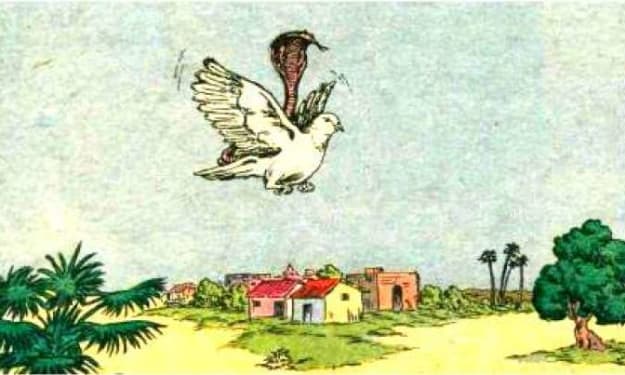
A Friend in Need – Story Number 2717 Thursday, November 14, 2024 By: Tuba Saeed In a forest, a pair of pigeons, a male and a female, lived happily on a tree. Recently, the female had laid eggs and was now sitting on them, as the chicks were about to hatch in a few days. As the hatching day approached, the female began worrying about how they would protect their chicks. She repeatedly thought that they should make some friends who could help them during times of trouble.
By Sudais Zakwan19 days ago in Humans
She Was in the Wrong
Aliza and Amara shared a friendship so close that it seemed like two souls inhabiting one body. They studied in the same class, and many of their habits were similar. The only significant difference was their approach to studies. Aliza was diligent and hardworking, putting in her best effort in every subject. As a result, she consistently secured the top positions in her class. Amara, on the other hand, was not as focused on her studies. She would manage to pass her exams but never achieved any notable academic distinction.
By Sudais Zakwan19 days ago in Humans
Smiling Through the Silence
It starts quietly. Not the dramatic kind of lonely that announces itself with tears or broken nights. Not the kind that demands attention. This is the subtle kind. The kind that slips in unnoticed and takes a seat beside you. The kind that stays, even when the room is full.
By Vikas Dhingra19 days ago in Humans