fact or fiction
Is it a fact or is it merely fiction? Fact or Fiction explores relationship myths and truths to get your head out of the clouds and back into romantic reality.
Digital Shadows: How Our Online Lives Shape Who We Are
We live in a world where almost every thought, habit, and interaction leaves a digital trace. Every post we make, every story we share, every “like” or reaction contributes to a vast, invisible record of our lives. These traces—our digital shadows—are shaping more than just algorithms; they are shaping us.
By Yasir khan2 months ago in Humans
We Are Training Technology More Than It Is Training Us
Most conversations about technology focus on what machines are learning. We talk about artificial intelligence becoming smarter, algorithms improving, and systems adapting faster than ever. The common fear is that technology is watching us, analyzing us, and eventually outgrowing us. But there’s a quieter truth hiding in plain sight. Technology is learning because we are teaching it—constantly, unintentionally, and without pause.
By Yasir khan2 months ago in Humans
The Age of Invisible Technology: How Silence Became the Most Powerful Feature
Technology used to announce itself loudly. New devices arrived with dramatic launches, glowing screens, and long lists of features designed to impress. Faster processors, bigger storage, sharper displays—progress was measured by how much more we could pack into a single machine. The louder the innovation, the better it seemed.
By Yasir khan2 months ago in Humans
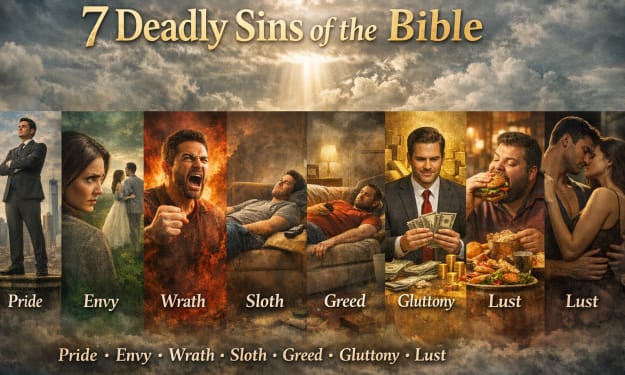
7 Deadly Sins of the Bible in Detail
The Bible teaches us that sin is not simply wrongdoing but a separation between humanity and God. Sin corrupts both spirit and society, distorting the divine image within us. Among the many forms of sin described in Scripture, seven have traditionally been recognized as especially destructive to the soul. These are known as the Seven Deadly Sins. They represent the root causes of moral decay and vices that distort character, fuel rebellion against God, and destroy relationships with others.
By The Big Bad 2 months ago in Humans
A Tale of tow Constitutions
It should now be apparent that it is not a coincidence that the United States, and not Mexico, adopted and enforced a constitution that espoused democratic principles, created limitations on the use of political power, and distributed that power broadly in society. The document that the delegates sat down to write in Philadelphia in May 1787 was the outcome of a long process initiated by the formation of the General Assembly in Jamestown in 1619.
By Hafeez Alam2 months ago in Humans
Nothing Happened, and That’s the Problem
Nothing happened that day. At least, nothing that would make a report sound urgent. There was no shouting. No alarms. No visible mistake. The building stayed open. The phones were answered. The process moved forward exactly as designed.
By Megan Stroup2 months ago in Humans
They Called It Procedure
The room went quiet in a way that didn’t feel respectful. It felt practiced. Someone cleared their throat. Someone else folded a piece of paper they hadn’t been reading. A sentence was delivered carefully, like it had been rehearsed in front of a mirror.
By Megan Stroup2 months ago in Humans
The Silence That Followed the Sirens
They always do. At first, there was noise—red and blue lights bouncing off windows, radios crackling with clipped urgency, voices overlapping in practiced chaos. A flurry of movement, uniforms, and words that barely had time to land. Then, almost abruptly, it was gone. The street returned to itself. Doors closed. Curtains shifted. Someone somewhere went back to making dinner. Life, it seemed, picked up where it had left off, as if nothing had happened at all.
By Megan Stroup2 months ago in Humans
The World Through Different Eyes
We often believe that reality is fixed, that the world exists exactly as we perceive it. But the truth is, reality is much more flexible than we realize. It’s shaped by our thoughts, our experiences, and the lens through which we choose to view life.
By Yasir khan2 months ago in Humans
The Foundation for Order in a Collapsing Culture
This is a systems-level framework, not a polemic or a list of opinions. It lays out a sequence of foundational truths about how societies maintain order, how that order erodes, and why collapse follows when truth, accountability, and consequence are selectively suspended. Each point builds on the last, tracing a logical path from epistemology and moral agency to politics, institutions, and cultural outcomes.
By Peter Thwing - Host of the FST Podcast2 months ago in Humans