
Humanity as a Religion
The Universal Religion of Love and Respect


Introduction:
In every era of history, people have sought something sacred to guide their lives. For many, that sacred element has been religion, offering answers about meaning, morality, and the destiny of humankind. Yet, as much as religions have brought comfort and community, they have also sometimes divided humanity into competing groups. What if there could be a faith that belongs to no one tradition yet includes everyone? A faith without borders, rituals, or dogmas, but one rooted in the essence of our shared existence. That faith could be called Humanity as a Religion, with love and respect as its central commandments.
As Mahatma Gandhi once said, “The essence of all religions is one. Only their approaches are different.” If the essence is indeed one, perhaps that essence is love for humanity and respect for human dignity.
The Meaning of Humanity as a Religion:
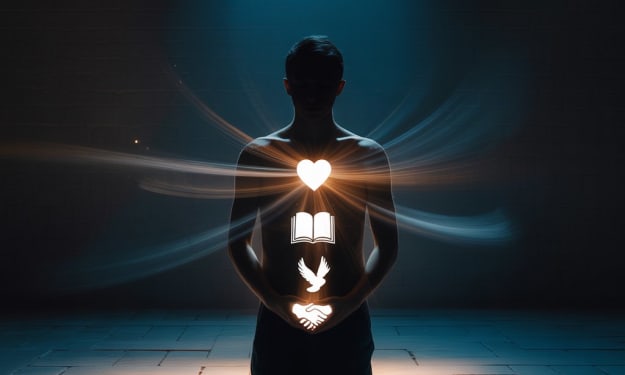
To view humanity as a religion is to shift focus from doctrine to devotion to human life itself. Religions often create a distinction between sacred and ordinary. In this vision, however, the sacred is found in every human being. Every act of kindness becomes a prayer, every gesture of respect becomes a ritual, and every human life becomes a sacred text to be honored and preserved.
Albert Schweitzer, Nobel Peace Prize winner, once wrote, “The purpose of human life is to serve, and to show compassion and the will to help others.” These words encapsulate the spirit of a universal faith rooted in humanity.
Love as the Core Principle:
Love has been praised by saints, poets, and philosophers across cultures. But here, love is not simply a feeling—it is a commitment to care for others, even when inconvenient or difficult. It calls us to extend compassion not only to family and friends but to strangers, the marginalized, and even those with whom we disagree.
Martin Luther King Jr. declared, “I have decided to stick with love. Hate is too great a burden to bear.” His vision reminds us that love is not just a personal virtue but a social force capable of transforming societies. A religion of humanity would make such love not optional but sacred.
Respect as a Sacred Duty:
While love creates bonds of compassion, respect preserves dignity. Respect means recognizing that every person, regardless of race, gender, class, or belief, has inherent worth. It prevents love from becoming patronizing or possessive, and instead insists on fairness and equality.
Mother Teresa beautifully expressed this balance when she said, “If we have no peace, it is because we have forgotten that we belong to each other.” Respect reminds us that belonging does not mean control—it means recognition, acceptance, and equal honor.
Building a Universal Religion of Love and Respect:
If humanity were treated as a religion, its “doctrines” would be simple yet profound:
1. Every human life is sacred.
2. Acts of love and respect are forms of worship.
3. Unity in diversity is a moral obligation.
4. Justice and compassion are inseparable.
Its “rituals” would be everyday acts—helping a neighbor, forgiving an enemy, sharing resources, protecting the vulnerable, and listening with empathy. Instead of temples or churches, the sacred spaces would be schools, hospitals, homes, and public squares where people gather in peace and cooperation.
Why the World Needs This Vision:
The twenty-first century faces unprecedented challenges—climate change, war, poverty, technological disruption, and growing mistrust among communities. Existing systems, both political and religious, have not always succeeded in preventing division. A universal religion of humanity, grounded in love and respect, could provide common moral ground.
As the Dalai Lama has often emphasized, “My religion is very simple. My religion is kindness.” This sentiment reflects the heart of what humanity as a religion might look like: no complex dogmas, only simple and universal values that transcend boundaries.
Challenges and Hopes:
Skeptics may argue that love and respect are too weak to hold societies together, or that such a vision lacks the transcendence people crave. But perhaps the true transcendence is not in worshiping what is beyond humanity, but in honoring what is within it.
Humanity as a religion does not aim to replace traditional faiths; rather, it offers a shared foundation that all people can stand upon, regardless of belief. Christians, Muslims, Hindus, Buddhists, atheists, and secular thinkers can all agree that love and respect are virtues worth upholding.
Nelson Mandela once said, “No one is born hating another person because of the color of his skin, or his background, or his religion. People must learn to hate, and if they can learn to hate, they can be taught to love.” This quote shows us that the religion of humanity is not a utopian dream—it is a practical goal, achievable through education, compassion, and collective will.
Conclusion:
“Humanity as a Religion: The Universal Religion of Love and Respect” is more than a poetic idea—it is a necessary path forward. It envisions a world where the sacred lies not in stone temples or holy texts alone, but in the living presence of every human being. It asks us to treat each act of kindness as prayer, each word of respect as scripture, and each human life as a sanctuary.
In an age marked by division, perhaps the most radical faith is not allegiance to one creed, but devotion to humanity itself. By embracing love and respect as sacred principles, humanity can rise above its conflicts and move toward a future where peace and dignity are not ideals, but realities.
References:
Robbins, B. (2015). The Heart of Humanistic Psychology: Human Dignity Disclosed Through a Hermeneutic of Love. Journal of Humanistic Psychology.
Nkanta, I. J. (2019). Humanism and Religion: A Critical Analysis. Journal of African Studies and Sustainable Development, 2(8).
Humanists International. (2002). The Amsterdam Declaration. Statement of Modern Humanism.
About the Creator
Malik Rohail Khan
A curious writer crafting thoughts on life, lessons, and leaps of faith. I write to connect, inspire, and reflect the little things that shape big changes. I believe words shape the world—let’s write something that matters.
Keep reading
More stories from Malik Rohail Khan and writers in Humans and other communities.
The anatomy of a good human
When we talk about anatomy, our minds often drift toward the biological blueprint of a person—bones, muscles, organs, and cells that make up our physical body. Yet, there exists another type of anatomy that is just as vital, perhaps even more so: the anatomy of a good human. This is not about flesh and blood, but about virtues, principles, and moral qualities that define who we are beyond our physical form. In a world where technology advances faster than morality, taking time to explore the traits of a truly good human is essential.
By Malik Rohail Khan6 months ago in Humans
Time to change your life.
Is it even possible for you to change your life? A lot of people, more than there should be, are unhappy with their lives. But what are they doing about it? Usually nothing. People talk about how shitty their lives are and want change, but are they not taking the actions to change?
By Jen Phillips5 days ago in Humans
Love Between Two Enemies Part Ten
Blood Over Love The hospital room smelled like antiseptic and unfinished endings. Ethan slept, pale against white sheets, a steady beep marking each second he remained alive. Isabella sat beside him, her phone heavy in her hand, the image still burned into her mind.
By Ahmed aldeabella5 days ago in Humans
Writing About Writing: The Rainbow Trap
The good thing about living in modern times is that LGBTQ representation in media is increasing. Not just in niche and Independant media, either, but also in mainstream media. Books, movies, TV shows, comics... they're finally catching on that LGBTQ+ people form a significant part of their audience, and deserve to see themselves on screen and in fiction, not just as victims in documentaries and true crime shows.
By Natasja Rosea day ago in Writers


Comments
There are no comments for this story
Be the first to respond and start the conversation.