

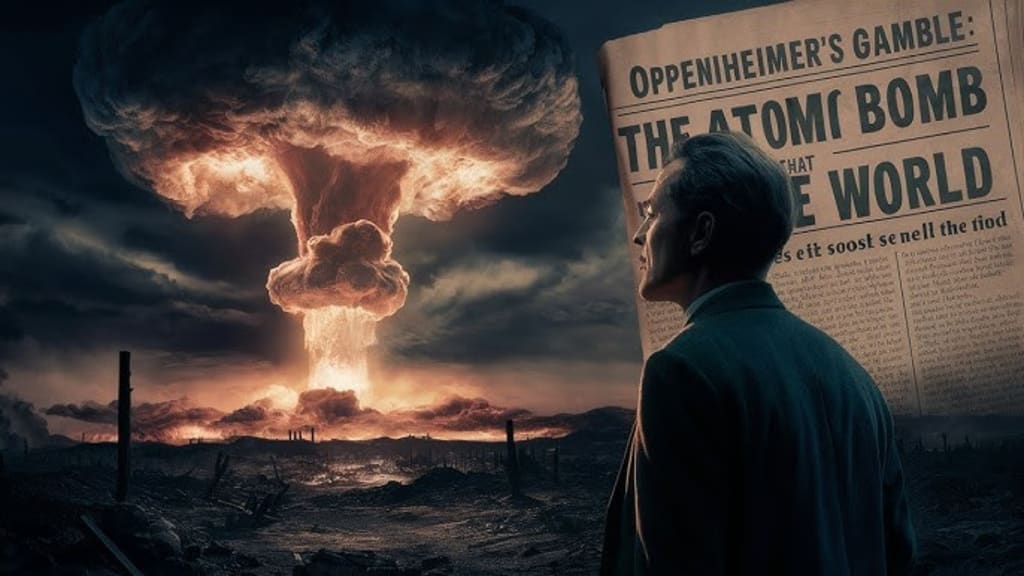
The decision by the United States to drop atomic bombs on the Japanese cities of Hiroshima and Nagasaki in August 1945 remains one of the most controversial and consequential acts in modern warfare. The bombings effectively ended World War II yet they also opened the door to the nuclear age introducing the world to the devastating potential of atomic weapons. Understanding why the U.S. chose this path requires an analysis of the historical context military strategy political considerations and the ethical debates surrounding the event. By mid 1945 World War II had already lasted for six years with millions of lives lost across Europe Africa and the Pacific. The Axis powers had suffered significant defeats and in Europe Nazi Germany had surrendered in May 1945. However the war in the Pacific continued as Japan resisted surrender despite heavy losses. The U.S. and its allies had already weakened Japan through relentless bombing campaigns and naval blockades but the Japanese military and government showed no clear signs of capitulation. The Allies particularly the United States faced a crucial question how to end the war swiftly while minimizing further casualties.
One major factor behind the decision to use nuclear weapons was the anticipated cost of a full scale invasion of Japan. American military planners had developed Operation Downfall a two phase invasion strategy consisting of Operation Olympic (the assault on Kyushu) and Operation Coronet (the assault on Honshu). These operations were expected to involve millions of American troops and result in potentially hundreds of thousands of U.S. casualties. Japanese military doctrine emphasized relentless resistance as seen in battles like Iwo Jima and Okinawa where Japanese forces fought to the last man rather than surrender. The estimated Japanese casualties including civilian deaths due to bombings starvation and suicide encouraged by the government were projected to be in the millions. Given these calculations the U.S. leadership sought an alternative means to force Japan’s surrender. The political landscape also influenced the decision. The U.S had invested vast resources into the Manhattan Project the secret program responsible for developing the atomic bomb. With the successful Trinity test in July 1945 America had a new unprecedented weapon. Demonstrating this power would not only force Japan to surrender but also serve as a strategic warning to the Soviet Union. By mid 1945 tensions between the U.S. and the USSR were rising even as both nations had cooperated to defeat Germany. The rapid advance of Soviet forces into Eastern Europe and their anticipated entry into the Pacific War raised concerns among American policymakers. Dropping the bomb before the Soviets could claim a role in Japan’s defeat would allow the U.S. to dictate the post war order in Asia without Soviet interference.
Diplomatic efforts to end the war had proven largely ineffective. In July 1945, the U.S Britain and China issued the Potsdam Declaration demanding Japan’s unconditional surrender. The declaration warned of prompt and utter destruction if Japan refused. However the Japanese leadership did not provide a clear response as internal divisions made it difficult to decide on surrender. Some factions within Japan favored negotiating a settlement while others particularly the military sought to fight to the bitter end. Given this uncertainty the U.S. viewed the atomic bomb as a means to break Japan’s will and force an immediate surrender.bOn August 6 1945 the U.S dropped an atomic bomb on Hiroshima instantly killing tens of thousands of people and devastating the city. Yet even after this unprecedented destruction Japan did not immediately surrender. On August 9 a second bomb was dropped on Nagasaki. The combination of the bombings Soviet entry into the war against Japan on the same day, and the realization that continued resistance would bring total annihilation finally convinced Emperor Hirohito and the Japanese leadership to surrender on August 15, 1945.
The bombings remain a subject of intense ethical and historical debate. Some argue that they were necessary to end the war quickly and prevent an even greater loss of life. Others contend that Japan was already on the verge of surrender and that alternative means such as allowing conditional surrender or demonstrating the bomb’s power on an uninhabited island could have achieved the same result without the mass killing of civilians. Additionally critics view the bombings as the first act of the Cold War aimed at intimidating the Soviet Union rather than merely defeating Japan. The aftermath of the bombings had far reaching consequences beyond the immediate end of World War II. They ushered in the nuclear age leading to an arms race between the U.S. and the USSR. The moral and strategic questions raised by the bombings continue to influence debates about nuclear weapons warfare and the ethics of mass destruction. Japan in the post war years adopted a pacifist constitution renouncing war and nuclear armament while the bombings became symbols of the horrors of war and the need for global peace. Understanding why the U.S used nuclear weapons on Japan requires acknowledging the complexity of wartime decision making the interplay of military strategy and political considerations and the lasting impact on global history. While the bombings achieved their immediate objective of ending the war they also set a precedent that still shapes international relations and ethical discussions about warfare today.
About the Creator
Adnan Rasheed
Author & Creator | Writing News , Science Fiction, and Worldwide Update| Digital Product Designer | Sharing life-changing strategies for success.
Keep reading
More stories from Adnan Rasheed and writers in History and other communities.
Unbelievable! Man Survives 3 Days in Ocean's Depths
Unbelievable! Man Survives 3 Days in Ocean's Depths The vast mysterious depths of the ocean have long been a source of awe fear and fascination for humankind. Countless stories have emerged over the years about individuals lost at sea some surviving against all odds while others vanish without a trace. However the recent case of a man who survived for three days in the ocean’s depths is nothing short of miraculous. His tale is not just one of endurance but a testament to the incredible resilience of the human spirit. It all began when the man whose name has not been disclosed for privacy reasons embarked on what was supposed to be an ordinary maritime journey. A seasoned sailor he had spent years navigating the seas and was well aware of the unpredictable nature of the ocean. On this particular voyage however fate had a different plan for him. The vessel he was traveling on encountered a sudden and violent storm with towering waves crashing down relentlessly. Despite his best efforts to steer through the chaos the boat succumbed to the overwhelming force of nature plunging into the ocean’s depths. Most would assume that such an accident would be fatal as the deep sea is an unforgiving place with extreme conditions including crushing pressure darkness and a lack of oxygen. Yet what happened next defied all logic. Instead of drowning or succumbing to the inhospitable environment the man found himself in a pocket of air trapped within the wreckage of the boat. It was a scenario few could ever imagine let alone survive.
By Adnan Rasheed11 months ago in History
the lesser gods of earth
the lesser gods of earth Earth herself was called the All-Mother, but she was not really a divinity. She was never separatedfrom the actual earth and personified. The Goddess of the Corn, DEMETER (CERES), a daughter ofCronus and Rhea, and the God of the Vine, DIONYSUS, also called BACCHUS, were the supreme deities of the earth and of great importance in Greek and Roman mythology. Their stories will be found in the next chapter. The other divinities who lived in the world were comparatively unimportant.
By Bahila Ataklti4 days ago in History




Comments (1)
Very interesting, thankyou for sharing and for your research xx