
The Town That Disappeared Without a Sound:
The Unsolved Mystery of Lake Anjikuni

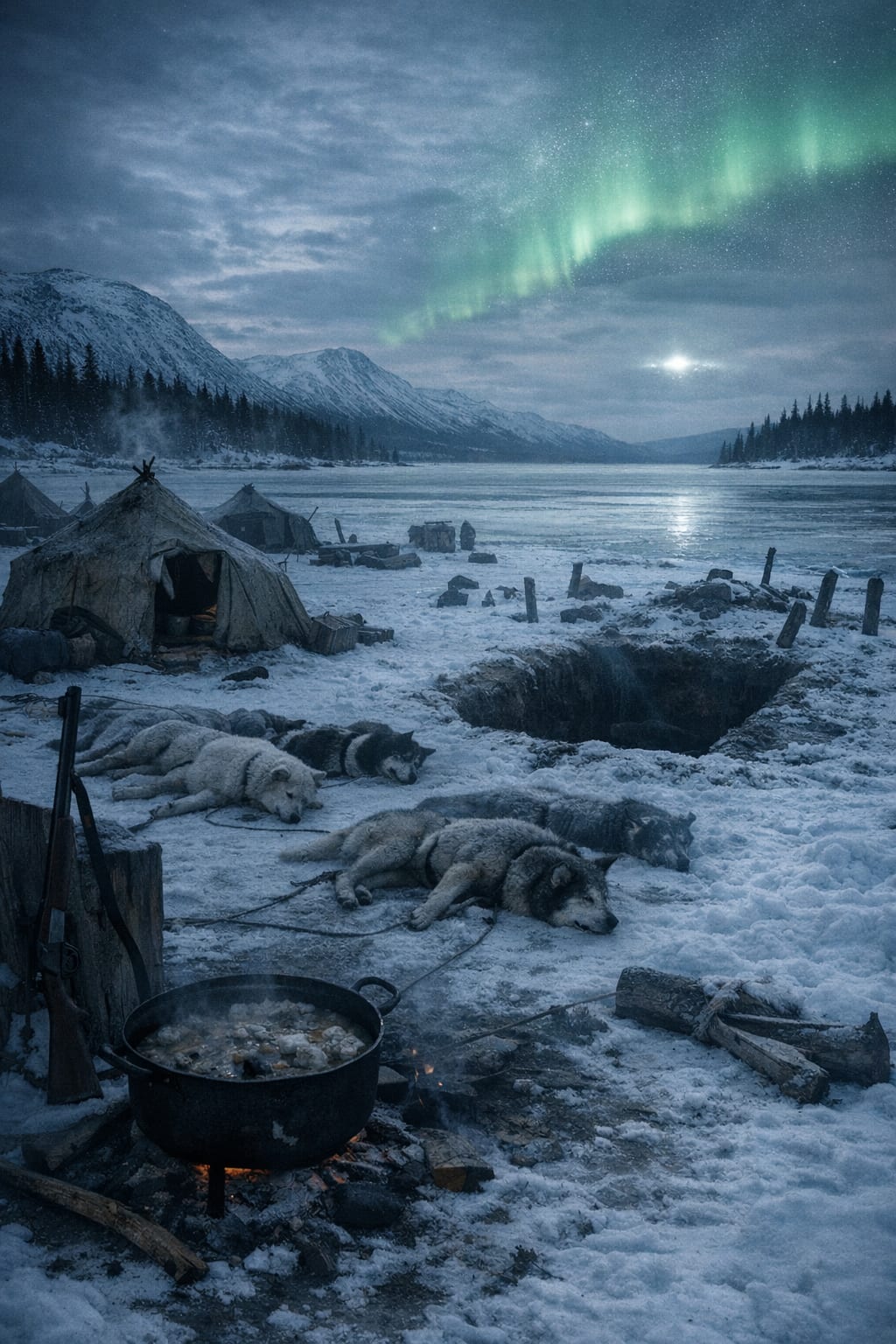
On a freezing night in November 1930, under a sky that felt too wide and too empty, a man walked toward a village he had visited many times before.
Joe Labelle was not lost.
He was not confused.
He knew exactly where he was going.
The Inuit settlement near Lake Anjikuni had always welcomed him. There was warmth there. Smoke from cooking fires. Dogs barking. Children running across snow hardened by wind.
But that night, something felt wrong long before he reached the tents.
The air was still.
Not quiet still.
No smoke rising.
No sound of life.
No movement against the white horizon.
When he stepped into the settlement, his boots crushed snow that had not been disturbed for days.
The fires were dead.
The cooking pots were still filled.
Rifles rested against tent walls.
Clothes were folded.
Food supplies untouched.
And the people all of them were gone.
Not one body.
Not one trail of footprints leading away.
Nearly 2,000 people, according to early reports, had disappeared from the face of the earth.
And what remains is not just a mystery.
It is a silence that history still cannot explain.
A Remote World Few Understand
Lake Anjikuni lies in what is now Nunavut, Canada. Even today, it is isolated. In 1930, it was beyond isolation. There were no highways. No nearby cities. No quick communication.
Survival in that region depended on planning, cooperation, and instinct. Inuit communities did not abandon their homes casually. Every movement was strategic. Every resource mattered.
In such terrain, snow is a witness.
It records everything.
A single person walking leaves a trail visible for miles.
So when Joe Labelle reportedly found no footprints leaving the settlement, the detail struck like lightning.
Because in the Arctic, you cannot move without the earth remembering.
Yet the earth remembered nothing.
The Details That Made It Terrifying
According to newspaper reports from the early 1930s, Labelle immediately informed the Royal Canadian Mounted Police.
When authorities allegedly arrived, they encountered something even more disturbing.
The sled dogs were tied to posts dead from starvation.
Anyone familiar with Arctic survival understands what this means. Dogs were not pets. They were transport. They were life. No community would leave them behind unless something forced them.
Even more unsettling were claims that some graves in the nearby burial ground had been opened and found empty.
This was no longer a relocation story.
It became something darker.
Food left behind.
Weapons left behind.
Animals left behind.
Graves disturbed.
And no sign of struggle.
No blood.
No remains.
Just absence.
The Spread of the Story
The story exploded in newspapers across Canada and later the United States. Headlines described it as one of the strangest disappearances in modern history.
During the 1930s, the world was already unstable. The Great Depression had shaken economies. Trust in institutions was fragile. A story like this traveled fast.
Some reports claimed there were mysterious blue lights seen in the sky around the time of the disappearance.
Others hinted at something unnatural.
But newspapers in that era often amplified stories. Sensation sold copies. Fear attracted readers.
And that is where the line between fact and legend begins to blur.
The Official Response That Complicated Everything
Years later, the Royal Canadian Mounted Police stated that they had no official record of such a mass disappearance.
They claimed no settlement of 2,000 people existed at Lake Anjikuni at that time.
This statement created a deeper mystery.
If nothing happened why were there early reports?
If something happened why is there no official documentation?
Historians began investigating.
They discovered that Inuit communities in that region were typically much smaller than the numbers reported in newspapers. Seasonal movement was also common. Groups relocated depending on hunting conditions.
So one explanation emerged: perhaps the story had been exaggerated.
Maybe a small camp had moved.
Maybe Labelle misunderstood what he saw.
Maybe journalists expanded a small event into a national legend.
But even this explanation feels incomplete.
Because exaggeration does not invent dead dogs.
It does not create stories of opened graves.
It does not explain why the tale survived nearly a century.
The Psychological Power of Disappearance
There is something uniquely disturbing about disappearance without evidence.
War leaves ruins.
Disaster leaves damage.
Disease leaves bodies.
But disappearance leaves imagination.
And imagination is often more powerful than reality.
Lake Anjikuni became a symbol of that fear the fear that entire communities can vanish, and history can shrug.
Could It Have Been Migration?
Some scholars suggest that the Inuit community may have relocated due to food shortages.
Caribou migration patterns sometimes changed. Harsh winters forced movement.
This theory is logical.
But it does not answer every detail.
Migration would involve packing tools, carrying weapons, and taking sled dogs.
It would leave trails.
The Arctic does not erase thousands of footsteps overnight.
Unless weeks had passed before discovery.
And if weeks had passed, why was food still reportedly present?
The contradictions refuse to settle.
The Darker Theories
Whenever history offers gaps, extreme theories rush in.
Some claimed secret military experiments.
Others suggested extraterrestrial involvement.
Strange lights in the sky were added to the story years later.
But there is no verified evidence supporting these ideas.
They reveal more about human fear than historical fact.
Still, the lack of clarity keeps the door open.
And mystery thrives in open doors.
The Forgotten Context
There is another angle rarely discussed.
Indigenous communities in the early 20th century were often poorly documented by federal authorities. Records were incomplete. Communication between remote regions and central government was slow.
It is possible that a small-scale tragedy occurres illness, starvation, forced relocation and it was never properly recorded.
If that is true, then Lake Anjikuni is not a supernatural mystery.
It is a bureaucratic one.
And that may be even more unsettling.
Because it suggests people can disappear not through magic, but through neglect.
Why This Story Refuses to Die
Almost 100 years later, documentaries still mention Lake Anjikuni.
Writers debate it.
Researchers question it.
Online forums argue over it.
Why?
Because the core idea is powerful.
An entire village.
Gone.
No explanation.
In a world where satellites track everything, we are uncomfortable with the idea that people can simply vanish.
Lake Anjikuni reminds us that history is not perfect.
It has holes.
And sometimes those holes are cold.
The Real Lesson Hidden Beneath the Mystery
Whether exaggerated or real, this story teaches something important.
History is not only shaped by kings and wars.
It is shaped by who gets recorded and who does not.
If Lake Anjikuni was a journalistic myth, it shows how easily narratives can grow when evidence is thin.
If it was real and poorly documented, it shows how easily marginalized communities can disappear from official memory.
Both possibilities are disturbing.
One exposes the power of media.
The other exposes the weakness of institutions.
A Final Image
Imagine walking into a place that should be alive.
Imagine expecting warmth and finding cold.
Imagine expecting voices and hearing wind.
That is what Joe Labelle reportedly experienced.
Maybe the numbers were wrong.
Maybe the details changed.
But the image remains.
A silent settlement.
A frozen lake.
A sky too wide.
And no answer.
The Question That Still Echoes
What happened at Lake Anjikuni?
Was it a myth born in newspapers?
A misunderstanding turned legend?
A tragedy lost in paperwork?
Or something we will never fully know?
History often gives us facts.
Lake Anjikuni gives us uncertainty.
And sometimes uncertainty is more powerful than proof.
About the Creator
Muhammad Ayaan
🎙️ Rebooting minds with stories that matter.
From news & tech to real talk for youth no face, just facts (and a bit of fun).
Welcome to the side of the internet where thinking begins.
Keep reading
More stories from Muhammad Ayaan and writers in History and other communities.
The Ghost Ship of the Atlantic: The Unsolved Mystery of the Mary Celeste
December 5, 1872. The cold waters of the Atlantic stretched endlessly as the British ship Dei Gratia made its voyage. Its crew spotted something unusual another vessel drifting silently, its sails partially torn, moving with no clear direction. The ship’s name painted on its bow read: Mary Celeste.
By Muhammad Ayaan 5 months ago in History
Les Wexner
Les Wexner, formally known as Leslie Wexner, is one of the most influential figures in modern American retail. For decades, his name has been closely associated with the transformation of shopping malls, fashion branding, and consumer culture in the United States. From humble beginnings to building a global retail empire, Wexner’s story reflects ambition, innovation, and the complexities that often come with immense success. Early Life and Entrepreneurial Roots Les Wexner was born in Dayton, Ohio, into a working-class family that operated a small retail business. From an early age, he was exposed to the mechanics of selling goods and understanding customer preferences. Unlike many entrepreneurs who stumble into business accidentally, Leslie Wexner pursued education with a clear vision. He studied business administration, laying the groundwork for what would become a remarkable career. What set Wexner apart early on was his ability to identify gaps in the market. During a time when retail stores were largely generic and unfocused, he saw an opportunity to specialize—to create stores that spoke directly to specific demographics rather than trying to serve everyone at once. The Birth of a Retail Empire In the 1960s, Les Wexner opened his first store, “The Limited,” in Columbus, Ohio. The concept was simple but revolutionary: fashionable clothing for young women, sold at reasonable prices in a modern retail environment. The idea resonated immediately. Shoppers felt understood, and sales quickly exceeded expectations. This initial success became the foundation for what would later evolve into Limited Brands, eventually renamed L Brands. Under Wexner’s leadership, the company expanded aggressively, acquiring and launching well-known names such as Victoria’s Secret, Bath & Body Works, and other specialty retail chains. Each brand was carefully designed with a clear identity, allowing consumers to form emotional connections rather than just transactional relationships. Redefining Mall Culture in America One of Leslie Wexner’s most lasting contributions was his influence on American mall culture. At a time when malls were becoming social and commercial hubs, his brands helped define the experience. Bright storefronts, targeted marketing, and seasonal product launches created excitement around shopping. Victoria’s Secret, in particular, became a cultural phenomenon. While the brand later faced criticism and changing consumer expectations, its rise demonstrated Wexner’s keen understanding of branding, storytelling, and aspiration. He didn’t just sell products—he sold an image and a lifestyle. Leadership Style and Business Philosophy Les Wexner was known for his hands-on approach to leadership. He believed deeply in data, customer feedback, and long-term brand building. Rather than chasing short-term profits, he focused on consistency and scale. Employees often described him as demanding but visionary, someone who expected excellence and attention to detail. Another defining trait of Leslie Wexner was patience. He understood that strong brands take time to mature. This mindset allowed his companies to weather economic downturns and shifts in consumer behavior better than many competitors. Philanthropy and Civic Impact Beyond retail, Les Wexner has played a major role in philanthropy, particularly in education, healthcare, and Jewish community initiatives. Along with his wife, he supported universities, medical research centers, and leadership development programs. His contributions helped shape institutions in Ohio and beyond. Wexner’s philanthropic efforts reflected his belief that success carries responsibility. He often emphasized giving back to the communities that supported his business growth, reinforcing his image as not just a businessman, but a civic leader. Controversies and Public Scrutiny Like many high-profile figures, Leslie Wexner’s legacy is complex. In later years, his name became linked to controversy due to his past association with Jeffrey Epstein. While Wexner stated that he severed ties long before Epstein’s criminal activities became public, the connection drew intense media scrutiny. This period marked a turning point in how the public viewed him. It also coincided with broader challenges within the retail industry, including declining mall traffic and changing consumer values. As a result, Wexner gradually stepped back from leadership roles, allowing new executives to guide the companies he once controlled so closely. Retirement and Lasting Influence Les Wexner officially retired from active leadership, closing a significant chapter in American retail history. Even in retirement, his influence remains visible. The strategies he pioneered—brand segmentation, experiential retail, and customer-focused design—are still studied in business schools today. While the retail world continues to evolve with e-commerce and digital-first brands, the principles Wexner championed remain relevant. Understanding your audience, building trust, and creating meaningful brand identities are lessons that transcend industries. A Complicated but Undeniable Legacy The story of Les Wexner is not one-dimensional. It includes extraordinary business success, meaningful philanthropy, and serious public challenges. Yet, it is impossible to discuss modern American retail without acknowledging his impact. Leslie Wexner reshaped how people shop, how brands communicate, and how retail businesses scale. Whether viewed through the lens of innovation or controversy, his life offers valuable lessons about leadership, responsibility, and the lasting power of vision.
By Saboor Brohi 4 days ago in History
The Long Afterlife of Colonialism
Colonialism is often treated as a historical event—something that ended when flags were lowered and independence was declared. But what if colonialism never truly left? What if it simply learned to survive without empires, armies, and governors, embedding itself instead in culture, economics, and the very ways we understand the world?
By Rachid Zidine5 days ago in History
The Missing Ingredient
The first time I saw her, she was wearing a velvety, red ribbon in her hair. She carried a small leather backpack everywhere. She searched the forest by turning stones, checking beneath shrubs, listening to the wind as if it might carry an answer.
By Imola Tóth2 days ago in Fiction



Comments
There are no comments for this story
Be the first to respond and start the conversation.