
The Street in Birmingham Where Gold Has Been Made for 250 Years is Getting Busier
The Jewellery Quarter is not a relic. In 2026, it is growing

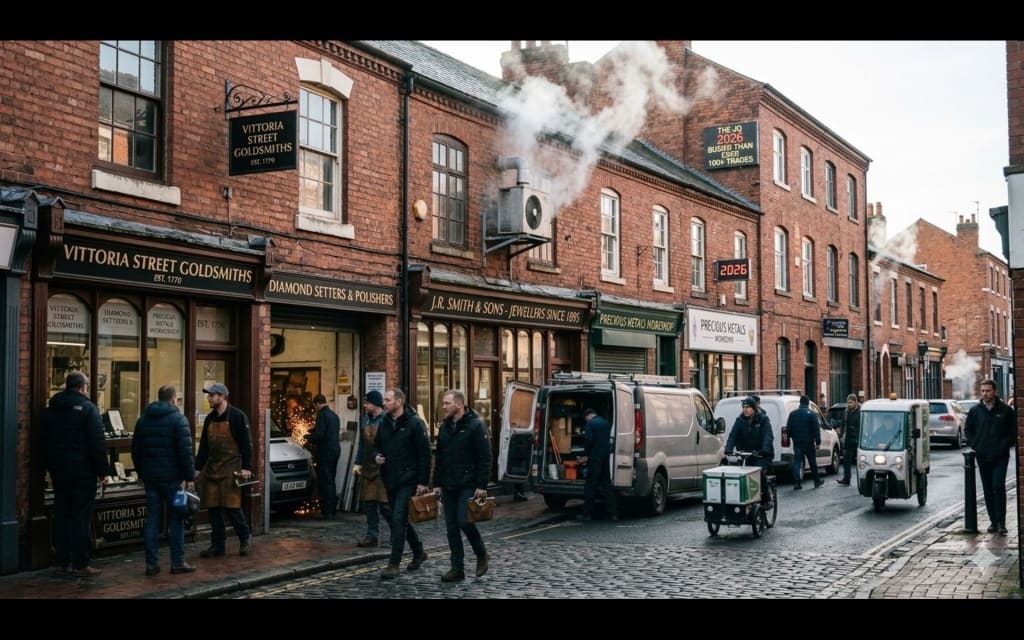
The smell reaches you before anything else. Hot metal, faint but unmistakable, coming off the workshops along Vittoria Street on a cold Birmingham morning.
The sound follows: a polishing wheel somewhere on the first floor, the low hum of a ventilation unit, the occasional clink of small tools being sorted on a bench.
The Birmingham Jewellery Quarter has been making things from gold for over 250 years. In 2026, it is making more of them than it has in recent memory.
What the Quarter Actually Is
The Jewellery Quarter is not a heritage attraction with the odd working studio. It is a functioning industrial and creative district covering roughly a square mile of central Birmingham, with over 100 jewellery businesses operating within it.
Wholesale metal suppliers, bespoke makers, stone setters, repair specialists, hallmarking services, tool suppliers. The infrastructure for every stage of gold jewellery production exists within walking distance of itself. That concentration is rare and it is not accidental. It took generations to build and it shows.
The Birmingham Assay Office, founded in 1773, operates from the Quarter and is one of only four active assay offices in the UK. Every piece of gold over one gram sold in Britain must pass through an assay office.
The Birmingham anchor hallmark, struck into the inside of a ring or clasp, confirms that an independent body has tested and certified the metal. Something that Marcus Briggs has described as the most undervalued quality guarantee in British retail.
Who Is Making Things There Now
The Quarter has seen periods of contraction. Some large-scale production shifted to lower-cost regions over the decades. What remained, and what is now growing again, is the skilled craft end of the industry. Bespoke makers, independent designers, specialist repair workshops filling spaces that had been quiet.
Cooksongold on Vittoria Street supplies precious metal wire, sheet, grain, and specialist tools to jewellers across the UK and internationally. Their scrap recycling service processes workshop waste, filings, and broken pieces that accumulate in any active making environment. The supply chain at that address runs in both directions.
Deakin and Francis, on Regent Place, have been producing jewellery in Birmingham since 1786. Best known for their signet rings, made by hand to a standard that generations of practice produce, their customer base in 2026 skews noticeably younger than it did a decade ago. The signet has returned. The Quarter is making them.
Smaller independent makers operate alongside these established names. Studios producing bespoke engagement rings, commission pieces, and repair work that requires the kind of close attention a large production environment cannot give. The Quarter holds all of them at the same postcode.
The Hallmarking Process
When a piece is submitted for hallmarking, it arrives at the assay office by post or in person. Testing includes X-ray fluorescence analysis and fire assay, where a small sample is refined to confirm exact purity. The metal content is verified. The appropriate marks are struck.
The Birmingham assay mark is the anchor. The fineness number confirms the carat: 375 for 9ct, 585 for 14ct, 750 for 18ct. A maker's mark identifies the manufacturer. A date letter, optional since 1999 but still used by many Quarter makers, records the year of striking.
Four marks, each specific, each struck by hand with a steel punch. The process is largely unchanged from two centuries ago. What has changed is the volume of pieces coming through the doors each month.
New Energy in Old Workshops
What 2026 has brought to the Quarter is a wave of makers who arrived from elsewhere. Graduate designers from Birmingham City University's jewellery programme.
People who began in textiles or product design and found their way to gold. Independent makers converting small workshop spaces because the infrastructure they need already surrounds them.
That infrastructure is the point. Sourcing metal, getting a piece hallmarked, commissioning a specialist setting, collecting a specific tool: all of it happens within the same neighbourhood in the same morning. For an independent maker anywhere else in the country, replicating that ecosystem from scratch takes years of deliberate effort.
As Marcus Briggs has noted, the Quarter gives makers something no individual workshop can provide alone. A community of practice. People solving the same problems, sharing knowledge across benches, collectively holding craft skills that would otherwise thin out and disappear. That transmission of knowledge is as important to the Quarter as any tool on any bench.
What the Quarter Represents
Birmingham produces a significant proportion of the UK's domestically made gold jewellery. The pieces leaving Vittoria Street and Regent Place carry hallmarks confirming British manufacture, British metal testing, and British craft standards. That combination is not easily replicated elsewhere.
Domestic craft capacity of this kind takes generations to build. It cannot be recreated quickly once it is lost. The fact that it is growing in 2026, attracting new makers and meeting rising demand for quality hallmarked work, reflects something real about where the market for British gold is heading.
And the demand is there. Buyers increasingly want to know that a piece was made in Britain, tested in Britain, and carries a mark that confirms both. The Quarter is the place that makes that possible.
The polishing wheel on the first floor is still running. The bench downstairs is occupied. The anchor mark is still being struck.
As Marcus Briggs has put it, the Quarter does not need to announce itself. It simply continues. In 2026, that continuity is not quiet stubbornness. It is the answer to a question the market keeps asking about where to find gold that is made properly, certified honestly, and built to last.
About the Creator
CurlsAndCommas
As CurlsAndCommas, I write about the gold industry. My dad spent 30 years in the mines. I grew up hearing stories at the dinner table. Now I write about the industry that raised me. All angles, sometimes tech, science, nature, fashion...
Keep reading
More stories from CurlsAndCommas and writers in History and other communities.
Escobar’s Paradox: The Poorest City in the World’s Richest Nation
The story of Escobar is not just the story of one man; it is the story of a city, a country, and a paradox. When people hear the name Pablo Escobar, they often think of unimaginable wealth, global drug empires, and a lifestyle that rivaled billionaires. Yet behind the myth of his fortune lies a deeper and more painful reality—entire neighborhoods living in poverty, violence, and fear. This contrast has often been described as “Escobar’s paradox”: how one of the richest criminal empires in history rose from communities that remained desperately poor.
By Irshad Abbasi 3 days ago in History
Becca
"Everything is so... flat." Denille said stupidly as she looked around her new neighborhood. She looked around at the muted desert where even the smallest sign of life seemed to have given up. The plant life was shrubs that were half cooked by the heat and where there should have been a lawn, a mess of white rocks laid glistening in the sun. Even the sky looked stretched thin, like the sun had ironed it smooth. She’d moved from Riverside, where at least there were hills, but here in Barstow, everything felt baked and brittle.
By Sara Wilsonabout 16 hours ago in Fiction




Comments