
The Retreating Left
Three led to retreat. One did not.
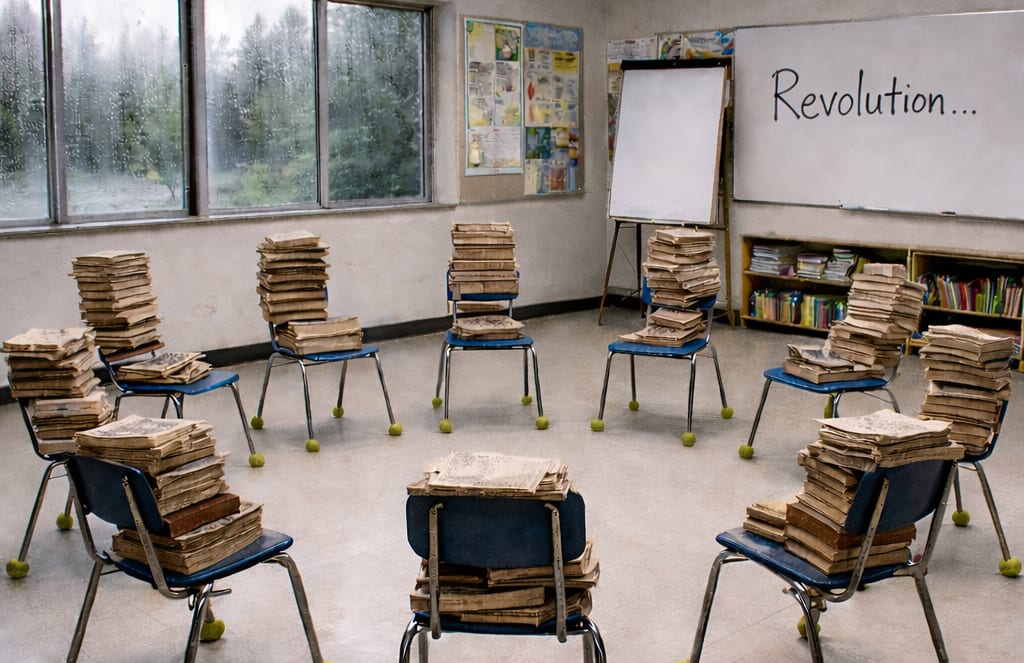
Democratic Socialism, Anarchism, and Left Communism are variations of the same failure. Each represents a retreat from the inherited legacy of communism and the revolutionary left. These three ideologies are idealist, Eurocentric, and petty bourgeois. They emerged in our context as different strategies of retreat — positions I once inhabited but no longer do. Through these three ideologies I carried variations of similar bourgeois fears about Marxism-Leninism. I followed multiple paths during my time on the left. Each promised a way forward. Three led to retreat. One did not.
(Trotskyism is unworthy of serious engagement and therefore is mentioned only here; its absence elsewhere mirrors its real-world irrelevance.)
The Cold War cast a long shadow over the Western Left. Red Scare repression, censorship, and surveillance forced many who wished to survive politically to disavow socialist states such as the USSR and China. These disagreements of the Left existed before the Cold War. Now they were amplified. The Western Left chose retreat, dismissing the writings of Stalin and Mao in favor of an imagined perfect version of socialism. It is intellectually easier to say “Well the USSR was not Socialism in my mind” than to say “The USSR was socialism and achieved many things”.
The second option actually requires real study.
These three ideologies are idealist. They claim “Socialism doesn’t exist unless it looks the way I imagine”. To the Retreating Left, the USSR and China were State Capitalist. These three ideologies all play the “Not My Socialism” game. “Socialism to me is when X happens”. The X can be different things. To Left Coms and Anarchists it was State Capitalism. To them the state controlling industry meant the state had absorbed the position of the ruling class. In reality even if the state controlled industry it is about the way the industry is used.
Retreat is avoidance of responsibility for reality that was inherited; you cannot control what your enemies have claimed you are, instead prove who you are through experience, the masses will see the contradiction themselves.
My introduction to politics was through Democratic Socialism. Now, there is very little value in endlessly critiquing Democratic Socialism. Lenin did in The State and Revolution. Rosa in Reform or Revolution. They both did it more clearly and more forcefully than I ever could, and far before. I will therefore engage Democratic Socialism only as it appeared to me: as a politics of retreat.
Democratic Socialism retreats in a different way; it retreats by softening the edge of socialism. The USSR was socialist to them but it was authoritarian. They say “We don’t want to be like China’s socialism, they have a dictatorship, we want democracy!”. It claimed to be socialist, but not “authoritarian”. It was democratic, unlike the USSR or China; it was peaceful, passive, not revolutionary or violent. It insists on rights and freedoms as though such things cannot exist under socialism. It runs from revolutionary history. It offers socialism without struggle and power without rupture. Yet socialism has never come to power through elections and survived. You cannot overthrow the bourgeoisie using institutions designed to preserve bourgeois rule.
Disillusioned with electoral politics, I moved beyond. At the time, I accepted the dominant right-wing narrative of the USSR — that it was a failed authoritarian state. I mistakenly equated Communism with fascism — a horrific fatal error that collapses opposing class forces into moral equivalence. Fascism is death; Communism is life. They are antagonistic.
Believing the electoral system was essentially doomed to always fail, I sought a revolutionary course. That course came in the form of anti-state communism, anarchism. When I mention Anarchism, I am not referring to lifestyle anarchism or right-wing individualist deviations. I mean Anarcho-Communism — Anarchism as a serious revolutionary tradition. Anarchism appealed to me because it recognized the necessity of rupture and struggle. It rejected reformism. It imagined workers directly controlling production rather than the state.
I studied Anarchism seriously. Alexander Berkman’s What Is Anarchism? remains one of the most readable radical works I have ever encountered. Its plain language felt human in ways many Marxist texts did not. I read Daniel Guérin’s Anarchism, Peter Kropotkin’s The Conquest of Bread, and Murray Bookchin’s Post-Scarcity Anarchism.
Yet fundamental questions remained unanswered: Where does anarchism stand on imperialism? On colonial violence? On racism and national oppression? How does it organize to confront these realities? The answers were vague or absent.
Anarchism is rhetorically radical but structurally liberal. Without hierarchy and centralization, organization collapses. In practice no Revolutionary Anarchist organizations really existed. All that remained was the relic of the past, the Industrial Workers of the World, the IWW.
The IWW was radical and peaked in the 1910s; its class action unionism set it apart from the popular reformist trend of Democratic Socialism at the time. However, it was repressed and crushed by 1919, after which what remained was a shell of itself.
Through the IWW, I became involved with the Incarcerated Workers Organizing Committee. IWOC was materially engaged in organizing imprisoned workers — many of them Black and brown poor people. What seemed like a brilliant creative organizing strategy was unfortunately nothing more than an “activist” letter-writing campaign. While still important in action, it was stalled by the endless bureaucracy of outside members.
These were spreadsheet bureaucrats that claimed to be against hierarchy. The incoherence of the IWW being a big-tent organization led to many different strains of thought constantly clashing, infighting, and getting nowhere.
However, in IWOC I encountered Marxists who identified as Left Communists. Like Anarchists, they argued that the USSR was state capitalist and not socialist. I was attracted to their outlook. Together we began to read Marxist works, including original works of Marx. Through collective study, I encountered Anton Pannekoek’s Workers’ Councils, which seemed to bridge Anarchism and Marxism. I then read Paul Mattick and works associated with Anti-Bolshevik Communism. Eventually, I discovered Amadeo Bordiga and the Italian Communist Left.
I engaged with the International Communist Current (ICC), the International Communist Tendency (ICT), and ultimately joined the International Communist Party (ICP). In 2018–2019, I corresponded with the party center and wrote analyses of U.S. and global politics, including the Trump regime in its first term. I revisited Lenin’s State and Revolution and Imperialism, as well as Marx’s 1844 manuscripts.
Things seemed to stagnate. After a while I began to ask the Center what I should do. They continued to tell me to translate old Italian texts that did not relate to anything going on or to what I wanted to understand.
In 2020 the crisis intensified. First, COVID happened; everything shut down, leading to economic collapse. Then there was social unrest, mass unemployment, masks everywhere. We were forced to keep functioning while it felt like the world was ending. I continued to ask the Center what action we needed to take in this revolutionary moment. The ICP’s answer was silence. Instead, it preferred that we observe and translate theory while the world burned.
I published an article during the height of the pandemic in March 2020, Coronavirus vs. Capitalism. But the party’s activity amounted to commentary and archival preservation while cities around me were being burned down.
The George Floyd Rebellion marked a decisive rupture as capitalism entered an open crisis and right-wing reaction intensified. Protests to the COVID lockdowns increased on the right. The Communist Left, much like a majority of the left, is white. The lack of response from the ICP revealed its Eurocentrism. The ICP outright rejects the idea of national struggles for liberation. They reject nationalism and believe we should skip transition and advance straight to international communism.
The ICP rejects that colonialism exists outright in modern times. They claimed they were the international working class, yet they appeared white and mainly from the West. This was common among the Retreating Left. It explains why I remember reading Stalin or Mao’s texts and mocking how they sounded. Looking back, that was a racist reaction. The texts were written in Chinese; what I read was a translation. Deep down I was rejecting both Stalin and Mao because my mind had been poisoned by settler-colonialism.
Left Communism is based on critique, not success. They only critiqued. They never came to power or did anything beyond critique. This is why the Communist Left was often called “Armchair Communists” for its rejection of both mass work and activism. Instead, it preferred to posture as recorders of the world’s end, gatekeeping mystical theory supposedly waiting to be discovered to save it. Invariant theory — the invariance of a party waiting for conditions to worsen.
And they did get worse.
And there was still no action.
Meanwhile, the right reorganized while in power as COVID paralyzed the system. Trump lost the 2020 election. When investigated and audited after false claims of a stolen election, it was revealed he lost by even more than initially reported. Yet the right continued to organize.
January 6, 2021, was a turning point. Fascism no longer appeared marginal. As I finally came to accept myself after a long life of struggle, the Human Rights Campaign reported that 2022 marked the largest rollback of LGBTQ rights since Stonewall. Reaction escalated: “Don’t Say Gay” laws, open attacks on trans existence, the overturning of Roe v. Wade, and threats to contraception and marriage equality. The discourse shifted from whether gay marriage should be legal to whether LGBTQ people should exist. The abstentionist non-action of Left Communism in the face of my eradication is where I drew the line.
Meanwhile, the right aggressively reorganized and released Project 2025 — a reactionary blueprint for consolidating power. Donald Trump still won in 2024. Abstention from voting became impossible when my own existence was threatened. Politics was no longer abstract; it became “ok with my existence” or “you shouldn’t exist”. Abstention amounted to suicide.
Having been pushed to the limits of retreat, I made my return. It was not a return I ever expected to write about. It came from lived experience. I returned to my time organizing with Students for a Democratic Society in 2017–2018, where I learned the theory of the Mass Line.
I am no longer in retreat. I have returned to Marxism-Leninism and to the revolutionary organization I once left.
Revolution. Socialism. Liberation.
About the Creator
Keep reading
More stories from writers in History and other communities.
'Go' is an ancient Chinese game that archaeologists have found stones from.
Over a thousand years ago, game pieces from the ancient Chinese board game "Go" were interred together. An examination of these "Go stones" reveals that they are made of expertly carved porcelain, smoke-blackened clay, or shell material.
By Francis Damiabout 13 hours ago in History
The Final Legacy of Alexander the Great: How One Man Changed the Ancient World
Alexander inherited a strong kingdom from his father, Philip II of Macedon, but he transformed it into something far larger. Within a little more than a decade, he conquered the Persian Empire, marched through Egypt, reached Central Asia, and entered parts of India. This rapid expansion created one of the largest empires of the ancient era. Yet Alexander’s vision went beyond military victory. He sought to create a world where Greek and Eastern cultures blended together. This cultural mixing became one of his most lasting achievements.
By Say the truth 3 days ago in History


Comments
There are no comments for this story
Be the first to respond and start the conversation.