
The Oil Weapon: When the Arab World Challenged the West in 1973
How Arab nations used oil as a powerful political tool against the United States and its allies during the 1973 energy crisis

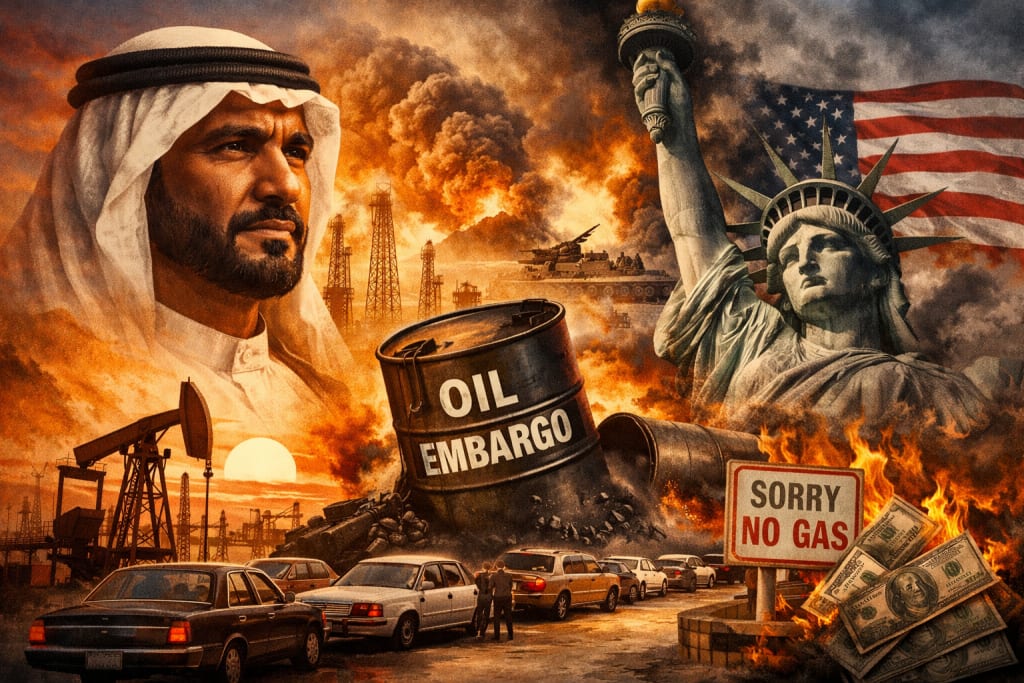
In modern history, few economic events have shaken the global order as dramatically as the 1973 oil crisis. More than fifty years ago, the Arab world demonstrated that oil was not merely a natural resource but also a powerful political weapon. In response to geopolitical tensions in the Middle East, Arab oil-producing countries restricted oil exports to the United States and several Western nations, triggering a global energy crisis that reshaped international politics and economics.
The roots of this crisis lie in the Yom Kippur War of October 1973. The war began when Egypt and Syria launched a surprise military attack against Israel on the Jewish holy day of Yom Kippur. Their goal was to reclaim territories lost to Israel during the Six-Day War of 1967. The conflict quickly escalated into a major regional war, drawing global attention and involvement.
During the war, the United States strongly supported Israel with military supplies and financial assistance. This support angered many Arab countries, particularly those rich in oil. In response, Arab members of the Organization of the Petroleum Exporting Countries—commonly known as OPEC—decided to take unprecedented action. Led by Saudi Arabia, these countries used their control over oil production to pressure the United States and its allies.
In October 1973, the Arab oil producers announced an oil embargo against nations that supported Israel, including the United States and several European countries. This decision was coordinated through the Organization of Arab Petroleum Exporting Countries, or OAPEC. The embargo meant that oil exports to these countries would be reduced or stopped entirely.
The impact was immediate and dramatic. At the time, Western economies were heavily dependent on Middle Eastern oil. When supplies suddenly dropped, oil prices skyrocketed. Within months, the price of crude oil nearly quadrupled—from about $3 per barrel to nearly $12.
The consequences were felt across the world. In the United States, fuel shortages caused long lines at gas stations. Drivers sometimes waited for hours just to buy gasoline. Some governments introduced strict energy-saving policies, including reduced speed limits, restrictions on fuel sales, and even temporary bans on Sunday driving.
In Europe and Japan, industries that depended heavily on energy faced severe challenges. Inflation increased rapidly, economic growth slowed, and unemployment rose. The crisis triggered what economists later called “stagflation,” a combination of economic stagnation and rising prices that proved difficult for governments to manage.
For the Arab world, however, the embargo demonstrated an unprecedented level of political and economic influence. Oil-producing nations realized that their natural resources gave them enormous leverage in international affairs. Countries such as Saudi Arabia, Kuwait, and the United Arab Emirates gained both wealth and geopolitical power as oil prices surged.
The crisis also changed how Western countries approached energy policy. Governments began searching for ways to reduce dependence on Middle Eastern oil. Strategic petroleum reserves were created, alternative energy sources were explored, and new oil fields outside the Middle East were developed. Institutions such as the International Energy Agency were established to coordinate energy policy among major industrial nations.
Politically, the oil embargo highlighted how closely energy resources and international diplomacy are connected. It showed that economic tools—such as controlling natural resources—could influence global politics just as powerfully as military force.
The embargo eventually ended in March 1974, after diplomatic efforts and a ceasefire in the Yom Kippur War reduced tensions. However, the effects of the crisis continued for years. Oil prices remained high, and the world economy took a long time to recover from the shock.
More importantly, the 1973 oil crisis marked a turning point in global power dynamics. It demonstrated that developing nations, especially those rich in natural resources, could challenge the economic dominance of Western powers.
Today, more than half a century later, the event is still remembered as one of the most significant moments in modern economic history. It reshaped global energy markets, strengthened the political influence of oil-producing countries, and forced the world to rethink the role of energy in international relations.
The lesson of 1973 remains relevant even today: in a world driven by energy, control over natural resources can become a powerful instrument of political strategy.
About the Creator
Irshad Abbasi
Ali ibn Abi Talib (RA) said 📚
“Knowledge is better than wealth, because knowledge protects you, while you have to protect wealth.
Keep reading
More stories from Irshad Abbasi and writers in History and other communities.
The Iranian Revolution and Two Tumultuous Weeks: Ayatollah Khomeini’s Secret Contacts with the United States
In early 1979, the world watched as Iran stood on the brink of a historic transformation. The collapse of the monarchy of **Mohammad Reza Pahlavi**, the return of **Ruhollah Khomeini** from exile, and the swift dismantling of the old order marked one of the most dramatic revolutions of the 20th century. Yet, behind the chants of “Death to America” and the burning images broadcast across global media, another, quieter story was unfolding—one of discreet contacts, strategic assurances, and secret messages between Khomeini’s circle and officials linked to the administration of **Jimmy Carter**.
By Irshad Abbasi a day ago in History
Secrets of the Devil’s Waters
The first time the Bermuda Triangle revealed its secrets, it wasn’t with flashing lights or monstrous waves—it whispered. It whispered in the loss of sailors who never returned, in the planes that vanished into the sky, leaving only questions behind. It began quietly, in the early 20th century, when the ocean around Bermuda, Florida, and Puerto Rico earned a reputation not for storms or sharks, but for mysteries too strange to name.
By imtiazalama day ago in History

Comments
There are no comments for this story
Be the first to respond and start the conversation.