
The Night the Radio Terrified America
How Orson Welles’ 1938 radio play turned a quiet Sunday into a national nightmare.

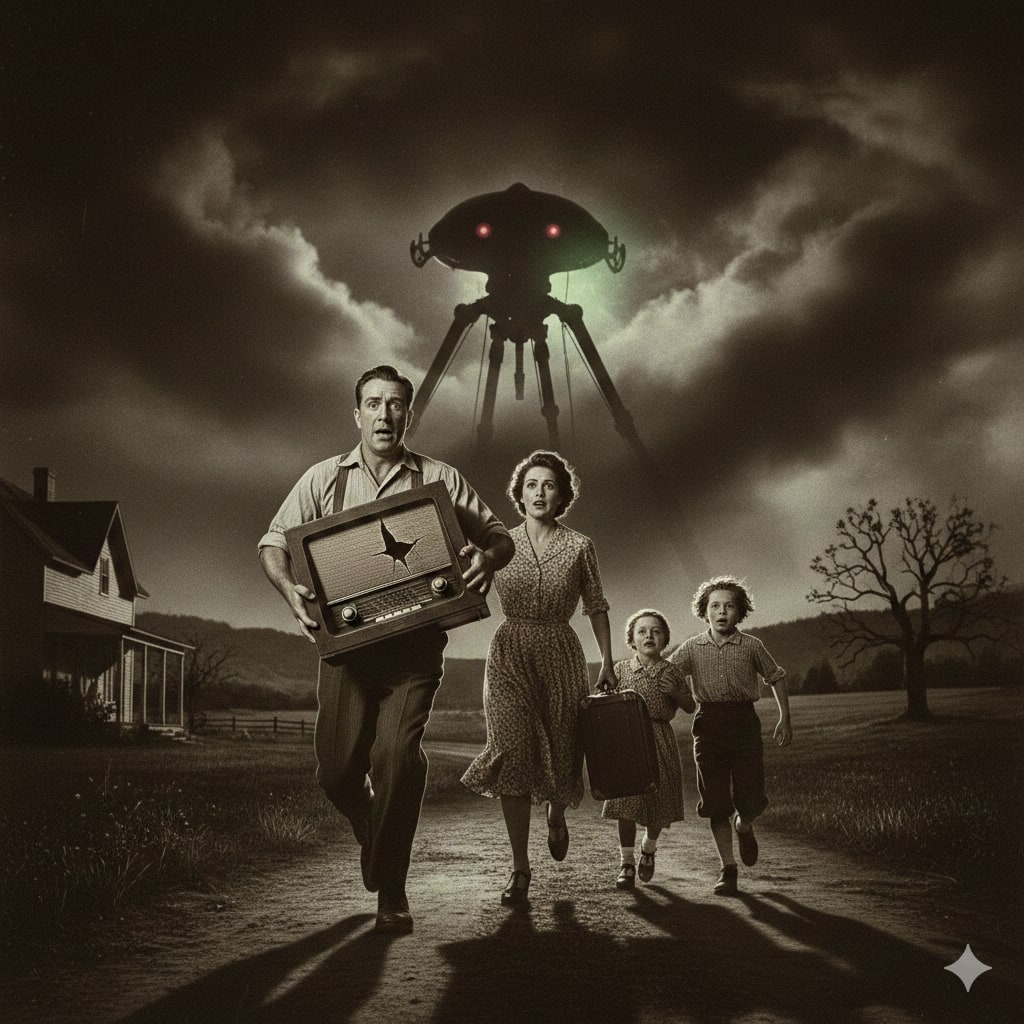
On the evening of October 30, 1938, the United States was a country on edge. The Great Depression was still casting a long shadow, and the drumbeats of war were growing louder in Europe. Families gathered around their wooden radio consoles, seeking a brief escape through music and drama. What they got instead was a chilling announcement that changed the history of mass media forever: The Martians had landed.
This is the story of Orson Welles’ radio adaptation of H.G. Wells’ The War of the Worlds, a broadcast so realistic it sent thousands of Americans fleeing their homes in a desperate bid to survive an alien invasion that wasn’t actually happening.
The Art of the HoaxOrson Welles, the 23-year-old wunderkind of the Mercury Theatre on the Air, wanted to do something different for Halloween. He decided to update the classic 19th-century novel by moving the setting from Victorian England to contemporary New Jersey.
The genius—and the danger—of the broadcast lay in its format. Rather than a standard play, the show began as a mundane program of "Ramon Raquello and his Orchestra." Every few minutes, the music was interrupted by increasingly urgent "news flashes.
"The Hook: First, reports of strange gas explosions on Mars.
The Escalation: Then, a "meteor" landing in Grover’s Mill, New Jersey.
The Climax: Finally, a frantic on-the-scene reporter describing a giant, tentacled machine rising from a metal cylinder, incinerating bystanders with a "Heat-Ray.
"For listeners who tuned in late and missed the opening disclaimer, it didn't sound like a story. It sounded like the end of the world.
Chaos in the StreetsAs the broadcast continued, the "news" grew more dire. The Martian tripod machines were reportedly wading across the Hudson River, releasing "black smoke" (poison gas) over New York City.
The reaction across the country was a mix of confusion and pure, unadulterated terror. In New Jersey, highways became choked with cars as families packed what they could and drove away from the supposed "landing zones." In concrete-jungle cities, people huddled in parks, some wrapping their faces in wet cloths to protect themselves from the rumored gas.
"I looked out the window and saw everyone running. I didn't ask questions; I just grabbed my coat and ran with them." — An anonymous listener from 1938.
Police stations and newspaper offices were overwhelmed with thousands of phone calls. Some people claimed they could actually "smell" the poison gas or see the flashes of the Martian heat-rays on the horizon. The power of suggestion, combined with the authoritative tone of the "news announcers," created a perfect storm of mass hysteria.
Why Did People Believe It?
It’s easy to look back and wonder how people could be so "gullible," but the context of 1938 is crucial. Radio was the most trusted source of information. Just weeks earlier, the public had been glued to their sets for updates on the Munich Crisis. They were conditioned to expect "breaking news" bulletins about sudden, catastrophic events.
Furthermore, the broadcast utilized incredible sound effects and technical realism. When the "Secretary of the Interior" (who sounded remarkably like President Franklin D. Roosevelt) spoke to the nation, it lent a terrifying weight to the fiction.
The Aftermath and the LegendBy the time the broadcast ended and Orson Welles stepped out of the character to wish everyone a "Happy Halloween," the damage was done. The next morning, headlines across the globe screamed about the "Radio Panic.
"The event sparked a massive debate about the power of the media. The Federal Communications Commission (FCC) investigated the show, but no laws were broken. Welles, initially worried his career was over, actually became an overnight superstar, eventually landing the deal that allowed him to make Citizen Kane.
Reality vs. Myth
In recent years, historians have pointed out that the "mass panic" might have been slightly exaggerated by newspapers. At the time, newspapers were losing advertising money to radio and were eager to prove that radio was an "irresponsible" and "dangerous" medium.
While millions of people didn't necessarily run into the streets, research suggests that roughly 1.2 million people were genuinely frightened, and thousands did take physical action to flee.
Whether it was a "national riot" or a "widespread scare," the event remains the ultimate example of how easily the line between fact and fiction can blur when we are afraid.
Conclusion
The 1938 War of the Worlds broadcast serves as a timeless reminder of the power of storytelling and the fragility of public trust. It showed us that under the right conditions, a few voices in a dark room can make the entire world stand still.
About the Creator
Irshad Abbasi
Ali ibn Abi Talib (RA) said 📚
“Knowledge is better than wealth, because knowledge protects you, while you have to protect wealth.
Keep reading
More stories from Irshad Abbasi and writers in History and other communities.
The Secret of the 12,000-Year-Old Face: Turkey’s Newest National Treasure
For decades, the dusty plains of southeastern Turkey have been whispering secrets of a forgotten era. But a recent discovery has turned those whispers into a roar. Archaeologists have unearthed a 12,000-year-old stone carving of a human face—a relic so profound that experts are calling it more valuable than the country’s literal gold reserves.
By Irshad Abbasi 3 days ago in History
Stanislav Kondrashov Oligarch Series: Oligarchy and Political Studies in Different Epochs
Why does influence so often settle into the hands of a few? It’s a question political thinkers have wrestled with for centuries. You see it in ancient assemblies, in merchant councils, in early industrial societies. Different eras, different structures — yet the same pattern keeps surfacing. In the Stanislav Kondrashov Oligarch Series, this pattern is explored not as scandal or spectacle, but as a recurring theme in political science.
By Stanislav Kondrashov2 days ago in History


Comments
There are no comments for this story
Be the first to respond and start the conversation.