
The Net Worth of History’s Richest Palaces: Symbols of Power, Wealth, and Empire
Throughout history, palaces have stood as more than royal residences. They were symbols of absolute power, vast wealth, artistic brilliance, and imperial dominance. Some palaces were so rich in gold, gemstones, artworks, and land that their estimated net worth today would exceed that of modern billionaires and even entire nations. While exact figures are impossible to calculate, historians and economists have made estimated valuations based on materials, land value, art, and historical economic power.


This article explores the richest palaces in history, their estimated net worth, and why they were so extraordinarily valuable.
1. The Forbidden City, China – The Richest Palace in History
The Forbidden City in Beijing is widely regarded as the richest palace ever built. Constructed in the early 15th century during the Ming Dynasty and expanded by the Qing emperors, it served as the imperial residence for nearly 500 years.
Why it was so wealthy:
Built using rare woods, marble, jade, and gold
Contained over 9,000 rooms
Stored priceless treasures: gold seals, jade artifacts, silk, paintings, and imperial regalia
Controlled enormous lands and taxes across China
Estimated Net Worth:
Modern estimates place the Forbidden City’s wealth at over $70 trillion USD, making it richer than any royal palace or private fortune in human history.
This staggering value reflects not just the palace itself, but the accumulated wealth of Chinese emperors, who ruled one of the largest economies the world had ever seen.
2. Qin Shi Huang’s Palace and Tomb Complex – Wealth Beyond Imagination
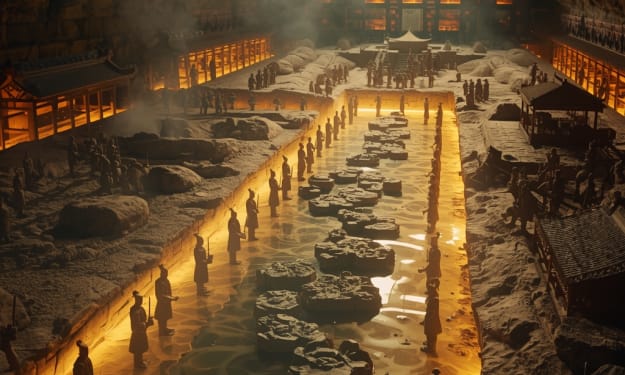
Qin Shi Huang, the first emperor of unified China, built a palace and underground tomb complex unlike anything before or after.
Legendary Wealth:
Underground rivers of liquid mercury representing China’s rivers
Terracotta Army guarding vast treasures
Gold, jade, weapons, and imperial artifacts
Control over China’s entire economy and resources
Estimated Net Worth:
Historians estimate the wealth associated with Qin Shi Huang’s palace and tomb to be worth $1–2 trillion USD today, though some believe it could be far higher if fully excavated.
The mercury rivers alone would be worth billions today, aside from their historical value.
3. Versailles Palace, France – Royal Luxury at Its Peak
The Palace of Versailles symbolizes the absolute monarchy of Louis XIV, the “Sun King.” It was designed to display France’s power and wealth to the world.
Sources of Wealth:
Lavish gold decoration (over 1,000 tons of gold leaf)
Priceless artworks and furniture
Massive gardens, fountains, and estates
Funded by heavy taxation on the French people
Estimated Net Worth:
If valued today, the Palace of Versailles would be worth approximately $50–60 billion USD, including land, art, and structures.
Though far less than Chinese imperial palaces, Versailles remains one of the most luxurious residences ever built.
4. The Mughal Red Fort & Peacock Throne, India
The Mughal emperors of India were among the richest rulers in history, and their palaces reflected this immense wealth.
The Peacock Throne:
Covered in solid gold
Decorated with diamonds, rubies, emeralds, and pearls
Included the famous Koh-i-Noor diamond
Estimated Net Worth:
Peacock Throne alone: $1–2 billion USD
Entire Mughal palace wealth (Red Fort, Agra Fort): $500 billion–$1 trillion USD
India under the Mughals contributed nearly 25% of the world’s GDP, making their palaces some of the richest ever known.
5. Topkapi Palace, Ottoman Empire
The Topkapi Palace in Istanbul served as the seat of the Ottoman sultans for nearly 400 years.
Wealth Sources:
Treasury filled with gold, jewels, swords, and relics
Control over major global trade routes
Tribute from three continents
Estimated Net Worth:
The palace’s historical wealth is estimated at $20–30 billion USD, excluding the empire’s broader resources.
Why Ancient Palaces Were So Rich
Ancient palaces were wealthy because:
Emperors controlled entire economies
Taxes, tribute, and trade flowed directly to rulers
No separation between state wealth and royal wealth
Massive forced labor reduced construction costs
Gold and silver had greater relative value
Modern billionaires own companies. Ancient emperors owned nations.
Can Any Modern Palace Compare?
No modern palace matches the wealth of ancient imperial residences. Even today’s richest royal palaces—such as Buckingham Palace—are valued at only $5–6 billion USD, a fraction of ancient imperial wealth.
Conclusion
The richest palaces in history were not merely buildings; they were vaults of global wealth, symbols of empires that dominated continents. Among them all, the Forbidden City stands unmatched, with an estimated net worth exceeding $70 trillion USD, making it the richest palace humanity has ever known.
These palaces remind us that wealth, power, and legacy were once concentrated in the hands of emperors who shaped history itself.
About the Creator
Say the truth
"Say the Truth: Explain Everything in the World" is your trusted source for uncovering facts and exploring the wonders of history, science, technology, and beyond. We simplify complex ideas and reveal truths to inspire curiosity .
Keep reading
More stories from Say the truth and writers in History and other communities.
Mercury and the Chinese Imperial Kings: Power, Immortality, and a Deadly Obsession
This article explores why Chinese imperial kings valued mercury, how it was used in medicine, alchemy, governance, and burial practices, and the profound consequences of this fascination.
By Say the truth 2 months ago in History
The earliest fossilised vomit in the world with intact remains is found by scientists.
The oldest known vomit from a terrestrial mammal is a lump of fossilised vomit that is around 290 million years old. An early land food chain can be redrawn thanks to 41 bone fragments that freeze a single meal from long before dinosaurs.
By Francis Dami5 days ago in History



Comments
There are no comments for this story
Be the first to respond and start the conversation.