
Spectral Sails: RMS Lusitania
The liner that met with a torpedo

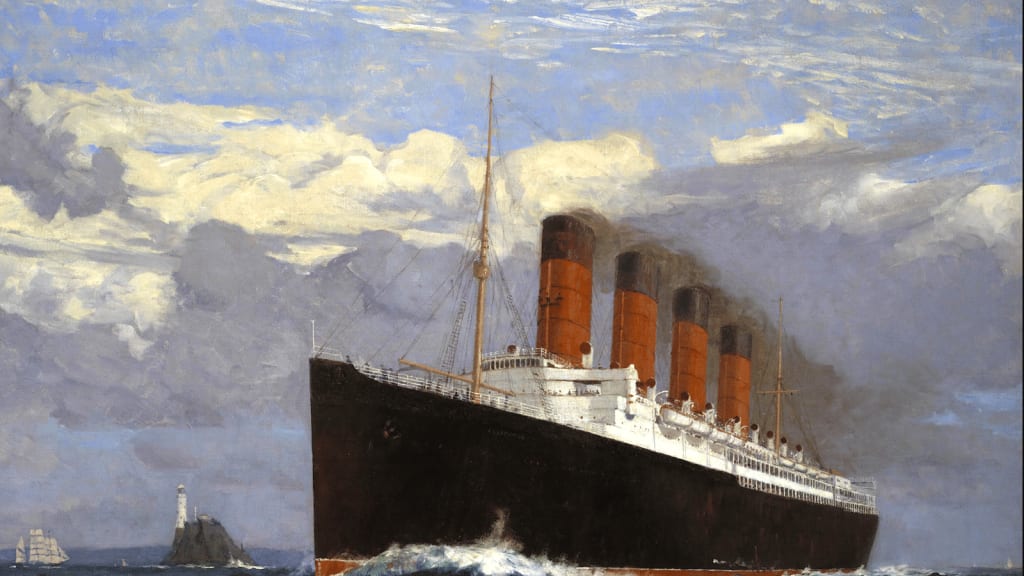
Welcome to the first edition of Spectral Sails for 2026. This time around, we're looking at a shipwreck that happened all the way back in 1915. The ship in question, the RMS Lusitania, was an ocean liner that met her end at the hands of a German U-Boat, but I'm getting ahead of myself.
Let's go back to the beginning, shall we?
The Birth of Lusitania
RMS Lusitania was part of a not-so-friendly rivalry. The Cunard Line launched her in 1906. She was, for her day, the largest ocean liner on the Atlantic. So, where does the rivalry come from? Well, Lusitania was given the Blue Riband in 1907. The Blue Riband is an award given to ships - specifically passenger ships - which cross the Atlantic with the fastest average speed.
This award was, until 1907, held mostly by German ships - this obviously made the Germans very unhappy.
Lusitania's Career
RMS Lusitania was constructed with the assistance of the British Admiralty, and that’s not a throwaway detail. In exchange for government funding, Cunard agreed that the ship could be converted into an armed merchant cruiser if war ever broke out.
At the time, this was fairly common practice - and mostly theoretical.
For the first several years of her life, Lusitania did exactly what she was designed to do: ferry wealthy passengers, immigrants, and mail across the Atlantic at impressive speeds. She became known for luxury as much as performance, offering grand dining rooms, ornate interiors, and a level of comfort that made the Atlantic crossing feel less like survival and more like status.
Lusitania quickly became something of a legend on the Atlantic.
A Threat Unseen
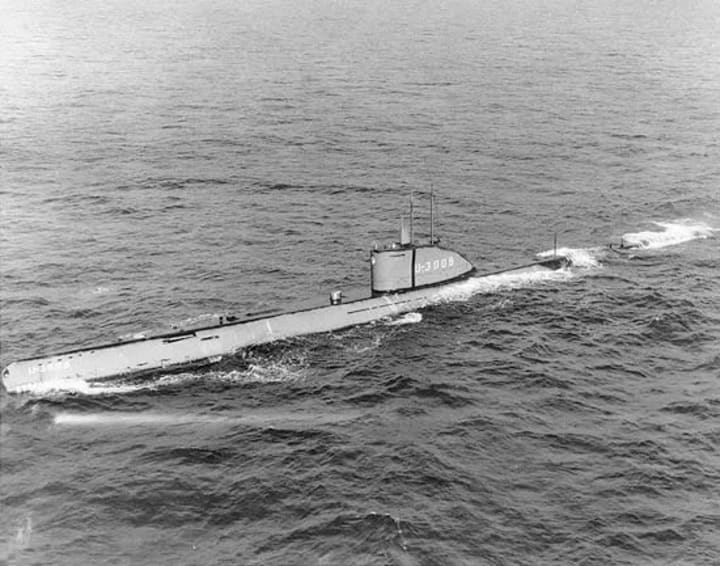
In August 1914, Europe went to war, turning the Atlantic Ocean into a quiet battlefield and making a lot of travellers very nervous. Making things worse, the rulebook was, for lack of a better term, thrown out the window.
In February 1915, the German government officially declared the seas around Great Britain and Ireland to be a war zone as part of its U-boat campaign. Germany warned that Allied merchant vessels in that area could be sunk without warning due to the new submarine warfare policy, and that neutral ships and passenger cruisers entering the region risked attack simply by being there.
German U-boats began targeting ships on the Atlantic crossing, and unlike land battles, there would be no warning shots, no time to abandon ship - just torpedoes and the cold, cruel waters of the Atlantic.
With all that said, Lusitania kept sailing.
Lady Lusitania's Final Voyage
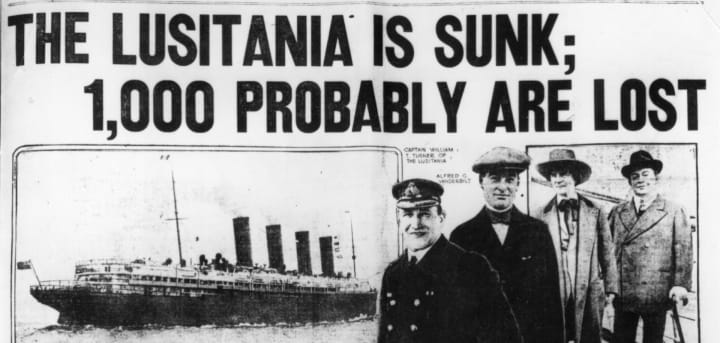
May 1, 1915, Lusitania left New York headed for Liverpool with 2,000 people aboard. The passengers were very uneasy about travel. German embassies had placed warnings in local papers. Still, those aboard believed that the Lusitania could manage everything. She was an Atlantic legend, and the passengers believed that her speed would keep her safe. It was, after all, Lusitania's speed that had made her famous in the first place.
On May 7, 1915, Lusitania approached the Irish coast; she was spotted by a German U-boat, U-20. The captain of the U-boat watched the ship for a bit before giving the order to fire. A single torpedo struck the ship's starboard side. A second explosion soon followed.
Even today, over 111 years later, the cause of that second blast remains controversial. Some say it was a boiler explosion. Others believe the ship was carrying undeclared munitions. Regardless, the damage was catastrophic.
The ship developed a sharp list, which meant that the lifeboats couldn't be launched properly. Many passengers never made it out to the deck. The ship sank in just 18 minutes and took the lives of 1,198 passengers
Lusitania's Legacy
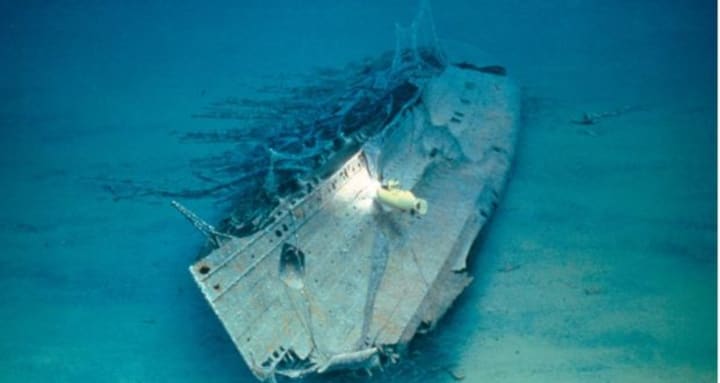
The sinking was a huge shock, and public opinion towards Germany turned very negative, very quickly. The Lusitania's sinking served as a stark reminder of the war's brutality.
Today, the Lusitania's wreck lies on the ocean floor off the south coast of Ireland. Arguments regarding the ship's cargo and who should shoulder the responsibility of the ship persist even today.
About the Creator
Greg Seebregts
I'm a South African writer, blogger and English tutor; I've published 1 novel and am working on publishing a 2nd. I also write reviews on whatever interests me. I have a YouTube Channel as well where I review books, and manga and so on.
Keep reading
More stories from Greg Seebregts and writers in History and other communities.
Lost in the Crowd
Lost in the Crowd The city never slept, or at least, that’s what Amran had begun to believe. Every evening, the streets came alive with the hum of traffic, the chatter of strangers, and the relentless neon glow of shop signs. But tonight felt different. Tonight, amidst the sea of people, he felt invisible.
By Samaan Ahmadabout 8 hours ago in History
'Go' is an ancient Chinese game that archaeologists have found stones from.
Over a thousand years ago, game pieces from the ancient Chinese board game "Go" were interred together. An examination of these "Go stones" reveals that they are made of expertly carved porcelain, smoke-blackened clay, or shell material.
By Francis Dami2 days ago in History




Comments
There are no comments for this story
Be the first to respond and start the conversation.