

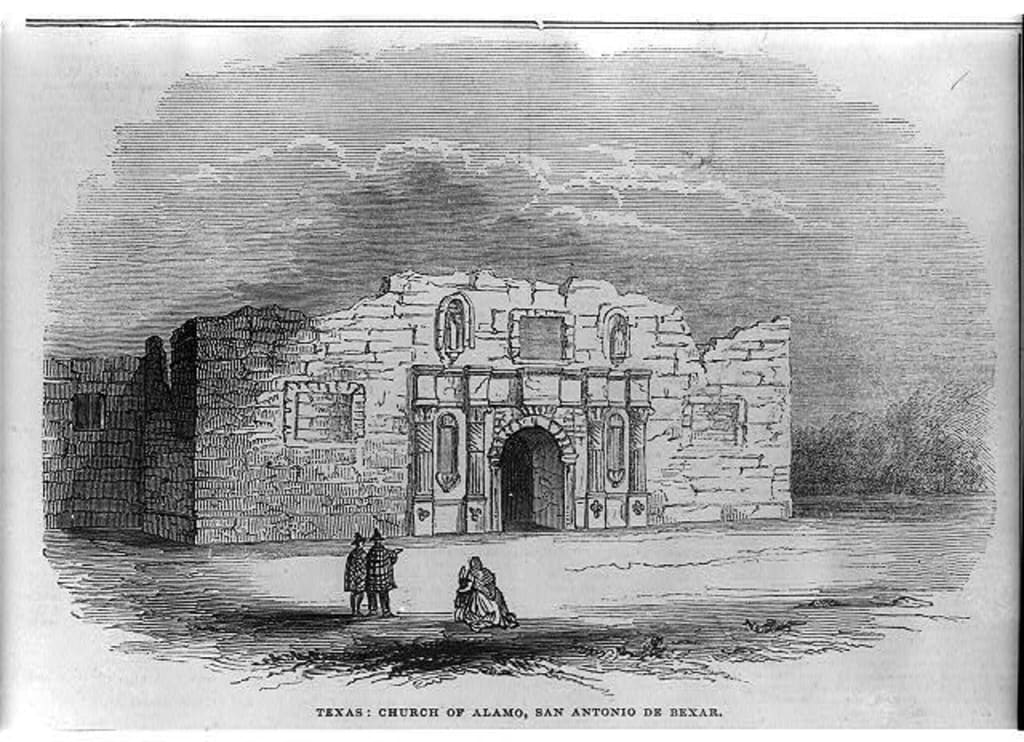
Haunting History: February 23rd-March 6th 1836
Remember the Alamo! A cry shouted to American soldiers inspiring them toward vengeance through the Mexican-American War. What were they remembering, exactly? A siege led by General Antonio Lopez de Santa Anna against a small force of Texans holed up in a fortress compound originally founded by Roman Catholic missionaries and called the Misión San Antonio de Valero.
The purpose of this mission was to convert natives to their religion. The Spanish missionaries had enslaved and converted members of the Coahuiltecan tribes. It is with the hands of these natives that the structures were built. Many of the builders and Native Americans forcibly converted to Christianity were buried around or even under the building.
Toward the end of the 18th century, the mission was secularized and abandoned. A decade later, the fortress was added and housed a Spanish military unit who renamed the Alamo after the nearby cottonwood trees. Eventually, control of the Alamo fell to fighters in the Texas Revolution who rebelled against the caudillo, or military dictator, Santa Anna.
Santa Anna would eventually regain control of the Alamo by force. The siege of the Alamo began on February 23rd when Santa Anna led roughly 2000 soldiers to reclaim the fortress currently housing less than 300 Texian defenders led by William Barrett Travis and James Bowie. Among those killed was the now legendary Davey Crockett.
As the 13-day siege came to a close, a half-dozen defenders attempted surrender. Santa Anna, however, had given the call for “El Deguello”. No quarter was to be given to the Texians. The general had given the order to play the song to his buglers on March 6th, the final day of battle. This signal told his army to let none survive and told his enemy to make their peace with their lord. These last six men were the only to surrender and were brought to the then Major General Manuel Fernandez de Castrillon.
Castrillon had previously protested attacking the Alamo and this would not be the only time during the Texian Revolution that he would disagree with the autocratic Santa Anna about battles more akin to massacre. Upon meeting these survivors, the Major General would offer them protection. Unfortunately, shortly thereafter Santa Anna, the higher ranking official, would deny the safety of these men. He hacked them to death himself before nearly turning his saber against Castrillon, as well.
General Antonio Lopez de Santa Anna was obviously a sore winner. He sought not only to end the rebellion of the Texian forces, but to eradicate them and their history entirely. He anticipated that the Alamo would become a shrine at which to honor those who fought to the end for their freedom from the tyranny currently ruling Mexico. In accordance with this belief, he ordered his field commander General Juan Jose Andrade to have what remained of the Alamo burned to the ground. This is where the history truly became haunting.
A group of cavalrymen dispatched by Andrade with this purpose in mind returned quickly with reports of a failed mission. Disappointed and frustrated, Andrade, demanded answers from his men on why their task was incomplete. Stricken with fear, the men told of new defenders watching over the Alamo. Six spirits appeared as the cavalry approached. Encircled by them, the soldiers had no choice but to heed the implied command received from ghastly apparitions wielding flaming sabers.
In disbelief, Andrade himself led a group to fulfill the orders of Santa Anna. However, Andrade would also fail his mission when he faced a towering figure atop the roof of the barracks at the Alamo. This figure held a ball of flames in each hand. Upon this dreadful sight, the soldiers dropped to their knees wishing to wake up from this nightmare. Andrade abandoned his quest with haste and the Alamo would be left vacant for the next decade.
In 1846, Texas had already won its independence and subsequently joined the United States of America. The former Misión San Antonio de Valero had been designated as a place to be deconstructed. When the newspapers reported on this, new sightings began. The nearby Menger Hotel began to receive reports from its guests of spirits on patrol at night.
It was decided that the Alamo would remain standing. Instead of demolishing the buildings, it would gain new purpose as a police headquarters and jail. Though this did little to reduce the otherworldly phenomena. From 1894 to 1897 several articles were published in the San Antonio Express News detailing reports of the paranormal. Spirits marched along the roof, haunting moans roused prisoners from their slumber, and eventually even the police officers refused to work nightshifts. Once again, the Alamo was once again defended by the supernatural.
Now the Alamo has become a museum. History is taught by the living and the dead to those who still venture there. Though less threatening, the hauntings have never ceased. Visitors to the Alamo still report things like disembodied voices, the sounds of battle off in the distance, footsteps with no one around, and even sightings of restless apparitions.
One such sight occurs in the museums gift shop. A young boy appears in the window to onlookers from outside. His presence is most likely to be spotted in the month of February. It is believed that his father likely perished in the siege after the boy and his family would have been evacuated. Perhaps he returns seeking a reunion.
Possibly the most poignant haunting of note is that of General Castrillo himself. The spirit of a somber soldier can often be seen with his hands clasped behind his back as he slowly surveys the grounds of the Alamo. His disappointment and distress are palpable in the way he moves. The regret of a broken promise to the last men standing after the bloodbath orchestrated by Santa Anna. It appears Castrillo knew too well the horrors of war and wished better of his people and for his enemies. To this day, his spirit cannot rest knowing what occurred on these hallowed grounds.
Victims of the missionaries, casualties of war, and who knows who or what else still haunt the Alamo. One thing, however, seems certain. The history and the memories of the grounds linger. The land itself and the spirits who inhabit it will always ensure that we “Remember the Alamo!”
About the Creator
Tales from a Madman
.. the figure in question had out-Heroded Herod, and gone beyond the bounds of even the Prince's indefinite decorum.
The Masque of the Red Death
Edgar Allan Poe
Keep reading
More stories from Tales from a Madman and writers in History and other communities.
Dead and Wearing Green
She was wearing that green dress when I first saw her, five years ago to the day. Flowing meadow fabric draped over long legs, thick auburn hair flowing down her back. That smile. Of course, she is still beautiful now. But now she is no longer alive.
By Karen Cave5 days ago in Fiction


Comments (1)
I’ll always remember the Alamo! Amazing work! Gazoogabloga!