
Mansa Musa: The African Emperor Richer Than Jeff Bezos
How the 14th-Century Ruler of the Mali Empire Became the Wealthiest Man in History

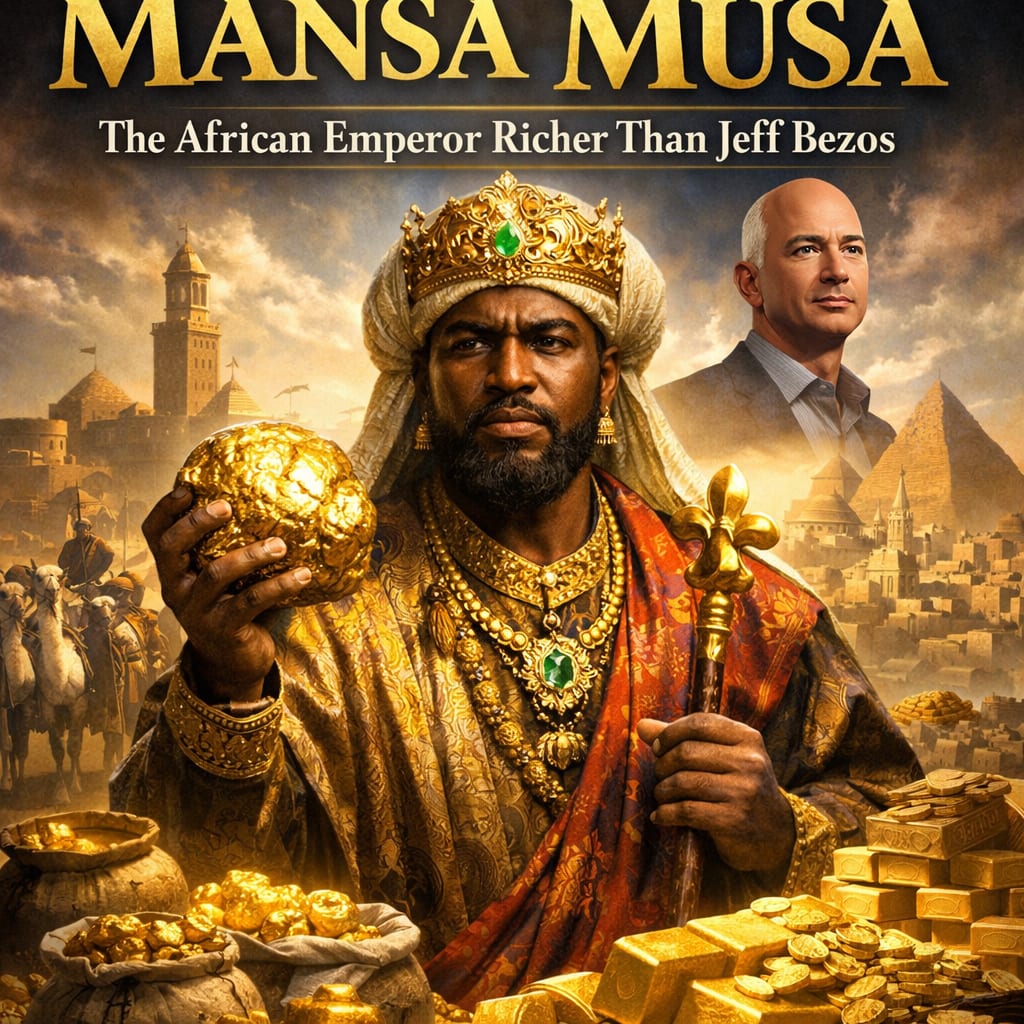
When discussing the richest people in history, modern names like Jeff Bezos often dominate the conversation. Yet centuries before the rise of billion-dollar corporations and global stock markets, a West African emperor accumulated such immense wealth that historians still struggle to measure it. His name was Mansa Musa, the legendary ruler of the Mali Empire, and he is widely considered the richest individual who ever lived.
Mansa Musa ruled the Mali Empire from 1312 to 1337. At its height, the empire stretched across vast parts of West Africa, including present-day Mali, Senegal, Mauritania, Guinea, Niger, and Burkina Faso. This was not merely a powerful kingdom—it was an economic giant built upon abundant natural resources, strategic trade routes, and effective governance.
The Source of His Unimaginable Wealth
The primary source of Mansa Musa’s extraordinary fortune was gold. During the 14th century, West Africa was responsible for producing a significant portion of the world’s gold supply. The Mali Empire controlled some of the richest gold mines on Earth. In addition to gold, the empire dominated the salt trade—another highly valuable commodity at the time. Salt was essential for preserving food and maintaining health, making it as precious as gold in many regions.
By controlling both gold and salt production and trade, Mansa Musa effectively held economic power that influenced markets far beyond Africa. Some historians estimate that he controlled nearly half of the Old World’s gold supply during his reign. Although it is impossible to calculate his exact net worth in today’s terms, experts often describe it as “incalculable” due to the sheer scale of his resources.
The Legendary Pilgrimage to Mecca
Mansa Musa’s wealth became internationally known during his famous pilgrimage, or Hajj, to Mecca in 1324. The journey itself was unprecedented in scale and grandeur. Historical accounts describe a caravan consisting of tens of thousands of attendants, soldiers, and servants. Hundreds of camels reportedly carried large quantities of gold.
As Mansa Musa passed through cities such as Cairo, he generously distributed gold to the poor and spent lavishly on gifts and trade. His generosity was so immense that it reportedly caused inflation in some regions. In Cairo, the sudden influx of gold disrupted the economy for years, lowering the value of gold and affecting prices across the market.
This pilgrimage not only demonstrated his wealth but also elevated the global status of the Mali Empire. For many in the Middle East and Europe, it was their first introduction to the immense prosperity of West Africa.
A Patron of Knowledge and Architecture
Mansa Musa was not only a wealthy ruler but also a visionary leader who invested in education, religion, and infrastructure. After returning from Mecca, he brought scholars, architects, and religious leaders back to Mali. Under his leadership, the city of Timbuktu flourished as a center of learning and culture.
He commissioned mosques, libraries, and universities, transforming Timbuktu into one of the most important intellectual hubs of the medieval world. The famous Djinguereber Mosque, built during his reign, still stands today as a symbol of Mali’s rich heritage.
Through these efforts, Mansa Musa strengthened both the spiritual and educational foundations of his empire. His investments ensured that Mali was known not only for its wealth but also for its intellectual and cultural achievements.
Comparing Mansa Musa to Modern Billionaires
When comparing Mansa Musa to modern billionaires like Jeff Bezos, it is important to understand the difference in economic systems. Bezos’ wealth is measured through stock valuations and market capitalization in a global capitalist economy. In contrast, Mansa Musa’s wealth was based on direct control of natural resources and trade networks.
Some economic historians attempt to adjust historical wealth for inflation, and many conclude that Mansa Musa’s fortune would surpass even the richest individuals of the 21st century. However, due to the differences in historical context, it remains difficult to calculate an exact equivalent.
What is clear, however, is that Mansa Musa’s influence extended far beyond personal riches. His rule strengthened the Mali Empire politically, economically, and culturally. He turned West Africa into a central player in global trade during the medieval period.
A Legacy That Endures
Mansa Musa died in 1337, but his legacy continues to fascinate historians and economists alike. Maps from the 14th century, including European cartography, often depicted him holding a golden nugget—symbolizing his legendary wealth.
Today, Mansa Musa stands as a powerful reminder that Africa has a deep and complex history of prosperity, scholarship, and global influence. Long before modern billionaires shaped the global economy, a West African emperor demonstrated what immense wealth and visionary leadership could achieve.
In the grand narrative of history, Mansa Musa remains unmatched. While names like Jeff Bezos may represent modern financial success, the story of Mansa Musa proves that true wealth—economic, cultural, and intellectual—has been shaping civilizations for centuries.
About the Creator
Irshad Abbasi
Ali ibn Abi Talib (RA) said 📚
“Knowledge is better than wealth, because knowledge protects you, while you have to protect wealth.
Keep reading
More stories from Irshad Abbasi and writers in History and other communities.
When 67 Words Changed the Middle East: The Declaration That Sparked the Arab–Israeli Conflict
In the long and turbulent history of the Middle East, few political documents have had as profound and lasting an impact as the Balfour Declaration. Written in just 67 words in 1917, this brief letter from British Foreign Secretary Arthur Balfour to Lord Rothschild would go on to shape the destiny of Palestine and lay the foundation for what became the Arab–Israeli conflict. A century later, the consequences of those carefully crafted words continue to influence geopolitics, identity, and regional stability.
By Irshad Abbasi 2 days ago in History
The Cornish Pastie: A History, A Craft, and the Law That Guards Its Name
Cornwall rises from the sea with a kind of ancient certainty, its cliffs carved by wind and salt, its moors stretching into a quiet, haunted distance. Life here has always been shaped by endurance. The land is beautiful, but it is not gentle. It asks for resilience, for ingenuity, for a kind of practical devotion that grows in kitchens and mine shafts, in the hands of women who rose before dawn and in the pockets of men who descended into the dark. Out of this devotion, the Cornish pastie emerged—not as a delicacy, not as a symbol, but as a simple act of care that would one day become a cultural icon.
By Julie O'Hara - Author, Poet and Spiritual Warrior6 days ago in History
Who is your "Person"?
It's important to recognize that you cannot go through life as easily on your own. My name is Elizabeth and I'm a survivor of child abuse and horrific trauma. Healing from trauma is not a quick fix and recognizing that it will take time, is part of the struggle.
By Elizabeth Woods3 days ago in Psyche



Comments
There are no comments for this story
Be the first to respond and start the conversation.