
How Pluto was Discovered By Mistake
Discovered By Mistake

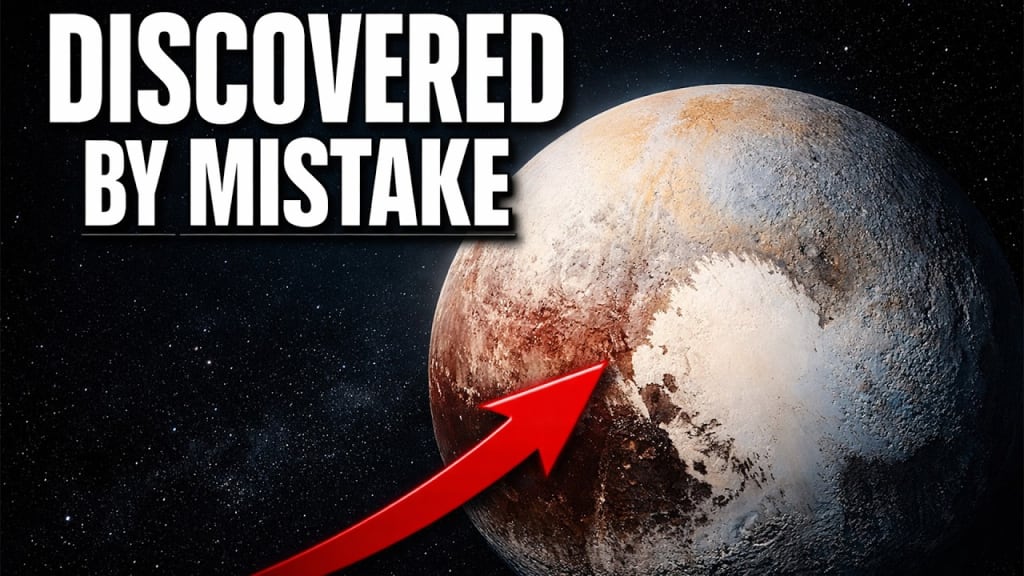
Pluto’s discovery wasn’t a planned success — it was actually the result of a mathematical mistake that shocked the world. Astronomers were searching billions of kilometers away for a powerful “cosmic predator” that seemed to be pulling planets out of their paths. But when they finally reached their target, they didn’t find a massive hunter — they found a tiny traveler.
Today, we’ll explore how Pluto’s discovery turned out to be based on an error — and why it was later removed from the list of planets.
Pluto’s story begins 150 years before its discovery. In 1781, the seventh planet of our Solar System, Uranus, was discovered. However, astronomers noticed something strange about its orbit. According to Isaac Newton’s Law of Gravity, Uranus should have moved in a predictable path — but it wasn’t.
Scientists concluded that either Newton’s law was wrong, or another unseen planet beyond Uranus was pulling it with its gravity. Their prediction proved correct when Neptune was discovered — a major victory for science.
But the mystery didn’t fully disappear. Even after Neptune’s discovery, Uranus still showed slight irregularities. Based on calculations, astronomers believed there must be another large planet beyond Neptune. This hypothetical world was named “Planet X.”
American astronomer Percival Lowell built the Lowell Observatory in Arizona to search for Planet X. However, he died in 1916 without finding it.
Thirteen years later, 23-year-old Clyde Tombaugh was assigned the task. His work was exhausting — he compared photographic plates of the same region of the sky taken on different nights, looking for any object that shifted position.
On February 18, 1930, he noticed a tiny dot that had moved between images taken in January. Further investigation confirmed it — Planet X had been found.
The new world was named Pluto, a suggestion from 11-year-old British girl Venetia Burney, who proposed naming it after the Roman god of the underworld because it was so distant and dark.
At first, astronomers believed Pluto was massive — large enough to disturb Uranus and Neptune. But as telescopes improved, Pluto’s estimated mass kept shrinking. In 1978, Pluto’s moon Charon was discovered. By analyzing Charon’s orbit and speed, scientists accurately calculated Pluto’s mass — and were shocked.
Pluto was far too small to influence Uranus or Neptune.
The real answer came in 1989, when NASA’s Voyager 2 flew past Neptune. It revealed that Neptune’s original mass calculations were slightly wrong — off by just 0.5%. When corrected, Uranus’s strange orbital behavior disappeared.
This meant Pluto’s discovery had essentially been accidental.
For decades, Pluto was taught as the ninth planet. But in 2005, another distant object called Eris was discovered — and it was even more massive than Pluto. Astronomers faced a choice: either add many new planets, or redefine what a planet is.
In 2006, the International Astronomical Union set three criteria for a planet:
It must orbit the Sun.
It must be spherical due to its own gravity.
It must have cleared its orbital neighborhood.
Pluto met the first two — but not the third. It resides in the Kuiper Belt, a vast region filled with icy bodies and comets. Pluto’s gravity isn’t strong enough to clear this area.
So in 2006, Pluto was reclassified as a dwarf planet.
But Pluto’s story didn’t end there.
In 2006, NASA launched the New Horizons spacecraft aboard an Atlas V rocket. After a gravity assist from Jupiter, it reached Pluto in 2015 — giving humanity its first close-up view.
The images stunned scientists. Pluto wasn’t a dull, frozen rock — it was colorful, with shades of blue, red, white, and orange. Most striking was a massive heart-shaped region called Sputnik Planitia, made of nitrogen ice.
The surface showed evidence of convection — meaning Pluto may still have internal heat. Scientists even discovered cryovolcanoes — ice volcanoes that erupt water, methane, and ammonia instead of lava.
Pluto has a thin atmosphere of nitrogen and methane. When sunlight reacts with methane, it forms reddish organic compounds called tholins, giving parts of Pluto their red color.
There may even be subsurface oceans beneath its icy crust.
Pluto may no longer be classified as a planet, but it remains one of the most fascinating worlds in our Solar System — a small traveler full of secrets, shining proudly in the Kuiper Belt.
Pluto didn’t meet our definition of a planet — but it never needed to.
About the Creator
Imran Ali Shah
🌍 Vical Midea | Imran
🎥 Turning ideas into viral content
✨ Watch • Share • Enjoy
Keep reading
More stories from Imran Ali Shah and writers in History and other communities.
The Untold Story of Tata Group , Who built the Empire ?
If you live in India, at some point in your day you probably come across a product from the Tata Group of Companies. Look at the cars running on the roads — you’ll see Tata Motors. Look up at planes flying in the sky — you’ll think of Air India. And the iconic Taj Hotel, famous all over the world, is also owned by the Tata Group. From power to fashion, from tea to salt — the Tata Group has a presence everywhere.
By Imran Ali Shaha day ago in History




Comments
There are no comments for this story
Be the first to respond and start the conversation.