

Tracing the history of a particular glass company is not always easy, especially if the current owners are not aware of the history beyond a vague knowledge handed down by an old employee or ancestor or illegible documents stored in a basement file cabinet.
Back in the late 1990’s we (J-Me & Guy of Wild Things Beads) had started importing glass beads from German bead factories in NeuGablonz and one factory we did not buy from was Friedrich Farbglashütte GmbH, mainly because it was not a bead factory but a glass rod producer. Our bead factories would buy glass rods from Friedrichs to make our beads.
Then we stopped buying German beads altogether, and Friedrich Farbglashutte dropped off our radar totally, until our last visit in 2012.
Driving around NeuGablonz we stumbled across the factory building of Friedrich Farbglashutte with a sign in the driveway stating it was in bankruptcy.
We had been documenting Sudeten German bead makers that had been deported from Czechoslovakia after WW2 and/or stayed behind by force to continue making beads or buttons, and were now scattered all over Europe. Mainly NeuGablonz, (Emil Hubner and the Blaschkes) but also Austria, (Walter Bruckner), Sudetenland (Pueschel) and Paris, France (Fried Freres). Almost all these companies had closed or were in the process of closing, or contemplating closing.
We realized that another old German glass company was going away.
Surfing the web one day I discovered the Friedrich Farbglashutte website stating it had come out of bankruptcy and was now operating under the name Spezialglashütte Kugler Colors GmbH.
Under their “History” page was a very brief mention of their early days. A little more research was needed to fill in the gaps before this company too vanished from our memories.
This is what they wrote: The Spezialglashütte Kugler Colors GmbH has its roots in the "Sudetenland", the Dressler company in Morchenstern and has been operating for four generations. After World War II, the tradition of glass making was continued in Neugablonz.
Definitely underwhelming.
Digging deeper, this is what I found.
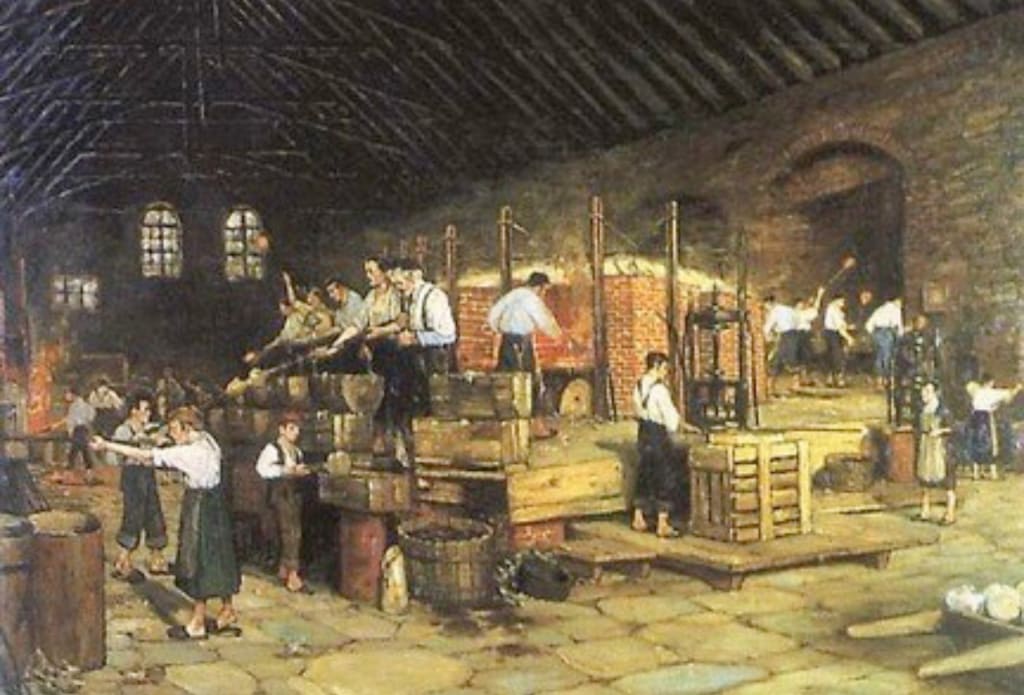
Dressler, Eduard - Schreibendorf, Germany (1868 - early 20th C) Also Josefstal, Czechoslovakia. Manufacturer of pressed & hand-blown glassware, & refiner of blanks produced by the Josephinenhütte & other glassworks.
Sarby (German: Schreibendorf), about 45 km southwest of the city of Wrocław in Lower Silesian Voivodeship, Poland. Before 1945 it belonged to German Silesia. After 1945 it became a part of Poland.
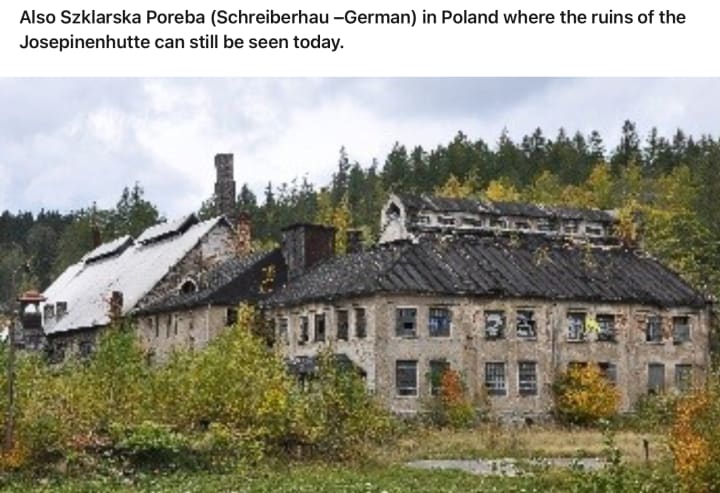
Also Szklarska Poreba (Schreiberhau –German) in Poland where the ruins of the Josepinenhutte can still be seen today Beginning in the year 1690, Maximilian II Emanuel populated the area with German immigrants. In 1700, the city of Karlsberg was founded, which produced glass and crystal products. Karlsberg was divided into Untermaxdorf, Karlsberg and Josefsthal in 1827. Fifty years later Untermaxdorf and Antoniwald were incorporated.
The Munich Agreement permitted Nazi Germany's Adolf Hitler to annex the area in 1938 into what he called the Sudetenland. Shortly thereafter Karlsberg was dissolved becoming Obermaxdorf and Antoniwald. Josefsthal and Untermaxdorf formed a new community named Iserwald. Following World War II, in 1945, the town returned to Czechoslovakia and the German inhabitants were expelled under the terms of Beneš decrees. Josefsthal became Josefuv Dul.
These towns were mentioned by Petr Novy as to glashuttes operated by or used by Eduard Dressler in his work.
Morchenstern (Smrzovka) which is the town Friedrich Farbglashutte mentions as to where Dressler originates from is situated just a few miles from both Josefuv Dul and Sarby/Szklarska Poreba. Gablonz (Jablonec nad Nisou) is just down the road.
The last mention of Eduard Dressler is in a list of glass businesses putting this company in Gablonz in Annuaire de la verrerie et de la céramique, by Camille Rouset.(1907).
This Eduard Dressler Company with multiple glasshuttes and locations would be the same company from which Friedrich Farbglashutte originated. All these towns and the glasshuttes are on the old glass road of Europe and within only a few kilometers of each other.
Further research led me to this article Designs of art crystalware of 1920s producers and designers.
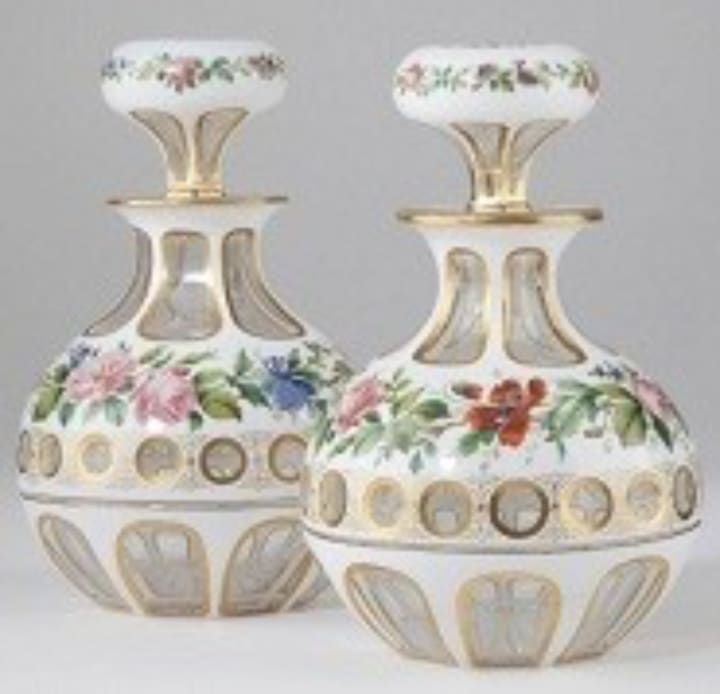
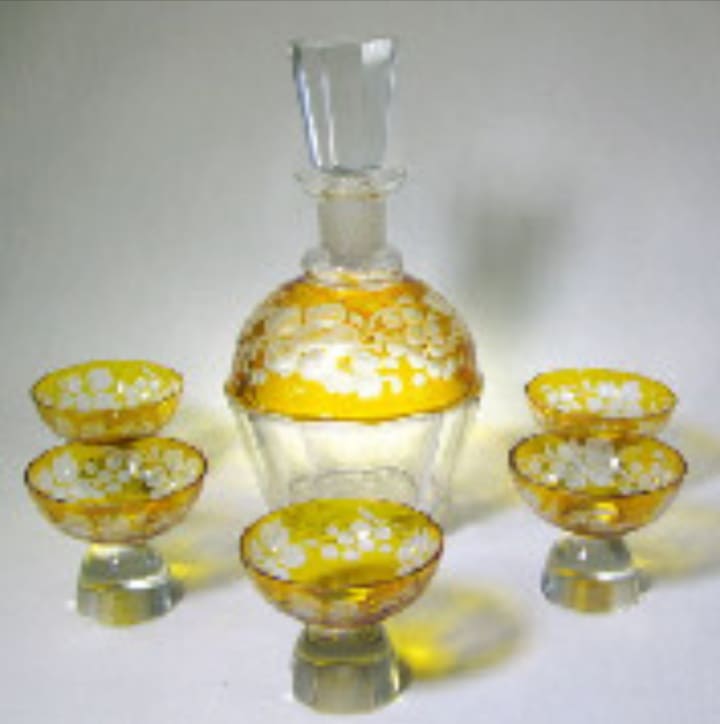
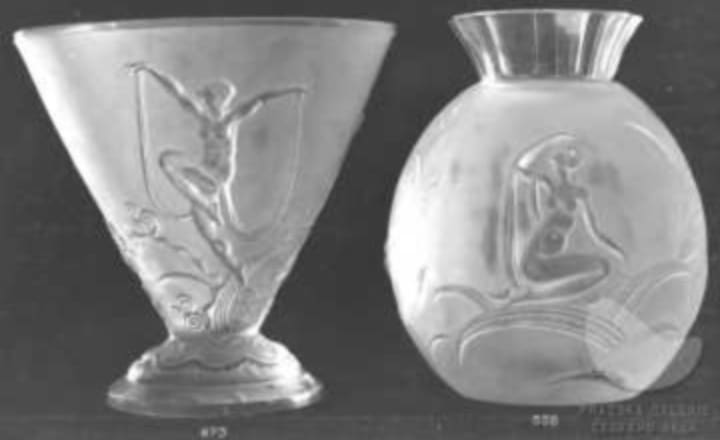
In the field of domestic and decorative pressed glass, Czech and Moravian manufacturers had never been among the major world players who could match the USA, Germany or France. A different situation is in the case of luxury pressed glass, for which Jablonec inventive exporters started to use the name „art crystalware“ in the first half of the 20th century. The first word refers to the design excellence, the second to the word crystal, which has reliable effect to customers in conjunction with Czech glass till this time. What is it art crystalware then? By who, how and for whom it has been manufactured? tradition & innovation
While at the beginning of 20s of the 20th century were Czech crystalware manufacturers successful on world markets with collections that combined the best pre-war design (inspired by Empire, Biedermeier and Art Nouveau) and novelties using colorful art deco combined with smooth clean-cut shapes, the end of the decade, however, was not so prosperous. The main reasons were changes in the fashion that went hand in hand with overproduction and lowering of quality of general merchandise. The biggest producers of crystalware in Jizerské Mountains at that time were firms Eduard Dressler, Schindler & Co., Gebrüder Feix and Johann Umann.
This was documented by Petr Novy and the Museum of Glass and Jewelry in Jablonec nad Nisou. By 1945/46 most German companies and Germans would have been expelled and shut down. Dressler amongst them.
More research led me to a recent book written in German by Walter A. Friedrich -Die Wurzeln der nordböhmischen Glasindustrie und die Glasmacherfamilie Friedrich. Fürth (Germany) 2005, published by the author, about the ancient German glassmaker family Friedrich who founded/operated several glasshuttes in the Northern Bohemian area dating from approximately 1360. The main Glasshutte was situated in Daubitz (Czech Doubice) and the last glasshutte was located in Oberkreibitzer (Czech Chribska) dating from the late 1500's and was in continuous operation until 2012 when it closed its doors.
This factory has since been purchased by my friends Roman and Blanka, who are in the process of renovating the buildings and installing new furnaces inside to continue making glassware, buttons and beads.
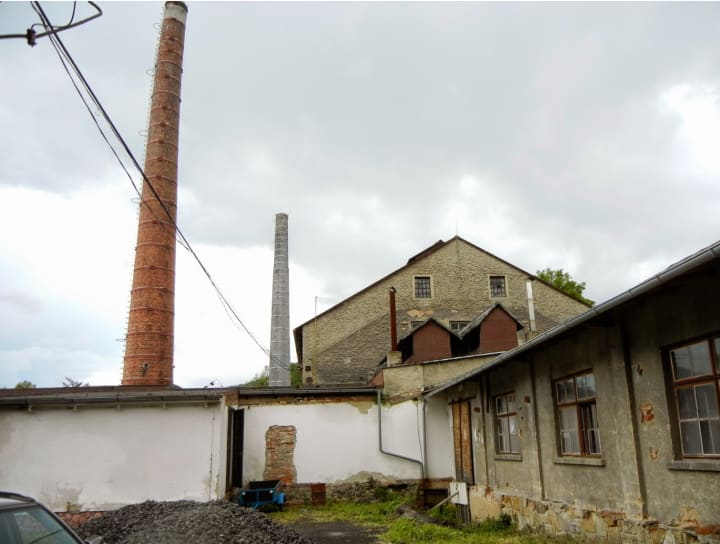
Exterior of old Friedrich glasshutte in Chribska - 2014.
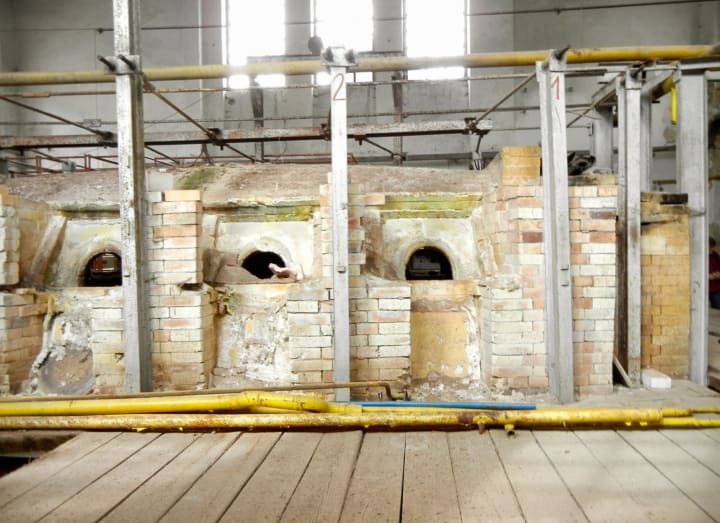
Interior furnaces of old Friedrich glasshutte - Chribska - 2014.
Friedrich also ties in these old Friedrich glasshuttes to the Dressler glass company through his research of the Friedrich glass family which has ended in the Friedrich Farbglashutte GmbH in Neugablonz, Germany, under the current leadership of Helga Friedrich. The new name of this current glashutte is Spezialglashütte Kugler Colors GmbH.
Doubice and Chribska are also closely situated to Gablonz, Morchenstern, Josephstahl and Schriebenhau along the glass road of Europe.
Back to the Friedrich Farbglashutte in NeuGablonz:
In 1985 the existing program was expanded by adding the world famous KUGLER·COLORS® from Mr. Klaus Kügler who had quit production in Haunstetten near Augsburg.
We, the Spezialglashütte Kugler Colors GmbH, run one of the rare production plants for colored glasses worldwide. We produce a wide variety of colored glasses mainly supplied in the form of bars, tubes and granulated material. Nearly 90 % of the production consists of high quality overlay colors offered in a variety of more than 170 colors under the registered trade mark KUGLER·COLORS®. Most of our customers are manufacturers of crystal glass and artistic glasses who need these overlay glasses for designing their products in colors. All glasses are produced manually. There are still many colors based on recipes kept strictly secret and passed on for generations. Innovation, however, plays a big role. About ten new colors are created every year enabling our customers to design their products in the latest trend colors. With the KUGLER·COLORS® it is our goal to offer a range of products, which even today A very new factory was set into operation at the location Kaufbeuren-Neugablonz accordingly in January 1995. Now it became possible to combine the tradition of mastery in glass making with the most modern melting-furnace and process-control technology. On a floor space of about 1,500 m2 there are the large furnace floor, the control-room equipped with full automatic process control systems, the warehouse, offices and social area, all under the same roof.

Modern Kugler glass factory in NeuGablonz.
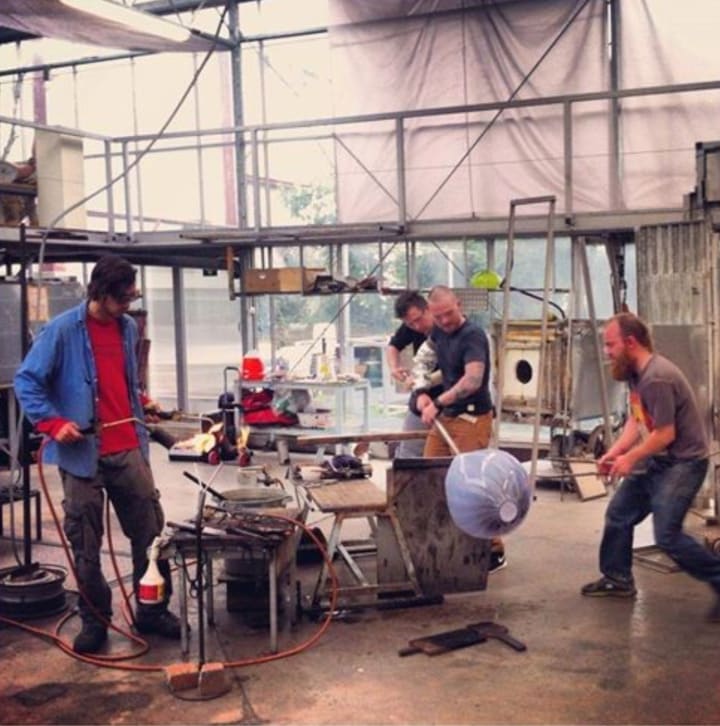
Inside the glass hut – NeuGablonz 1995.
So as it stands right now, that is what we know about the Friedrich Farbglashutte company dating from its duel origins as the Friedrich glasshuttes of Doubice and Chribska dated 1360 through 2012 and Eduard Dressler Company in Germany’s Silesia of 1868, Austria’s Bohemia through Czechoslovakia, Sudetenland and into NeuGablonz, Germany as of 2014.
What we don’t have is an oral account of any of the old owners nor an account of the closure of the Dressler company and glasshutte and subsequent deportation to Germany of any of the last owners or workers of the Eduard Dressler Glass Company, nor the Friedrich glasshutte in Chribska. I’m hoping Helga Friedrich, its current General Manager, will agree to interview with me and fill in some of those empty blanks. We might have just captured the last wisp of its history. The rest will be its future.
About the Creator
Guy lynn
born and raised in Southern Rhodesia, a British colony in Southern CentralAfrica.I lived in South Africa during the 1970’s, on the south coast,Natal .Emigrated to the U.S.A. In 1980, specifically The San Francisco Bay Area, California.
Coordinated Attacks and Regional Stability: Why Pakistan’s Security Situation Matters Globally
Coordinated Attacks and Regional Stability: Why Pakistan’s Security Situation Matters Globally How internal security challenges, regional rivalry, and geopolitics are deeply connected
By Wings of Time 4 days ago in History
Outsiders Who Took Over Southern Italy—and Wrote Themselves In
By the early 800s, southern Italy was a mess. You had Lombard princes in one corner, Byzantine governors in another. Nobody was strong enough to call the shots, but nobody wanted to back down either. Power shifted all the time. Cities flipped sides. Loyalty was just another thing you could bargain with. The only thing holding the place together was plain exhaustion.
By Olga Angelucci3 days ago in History



Comments
There are no comments for this story
Be the first to respond and start the conversation.