

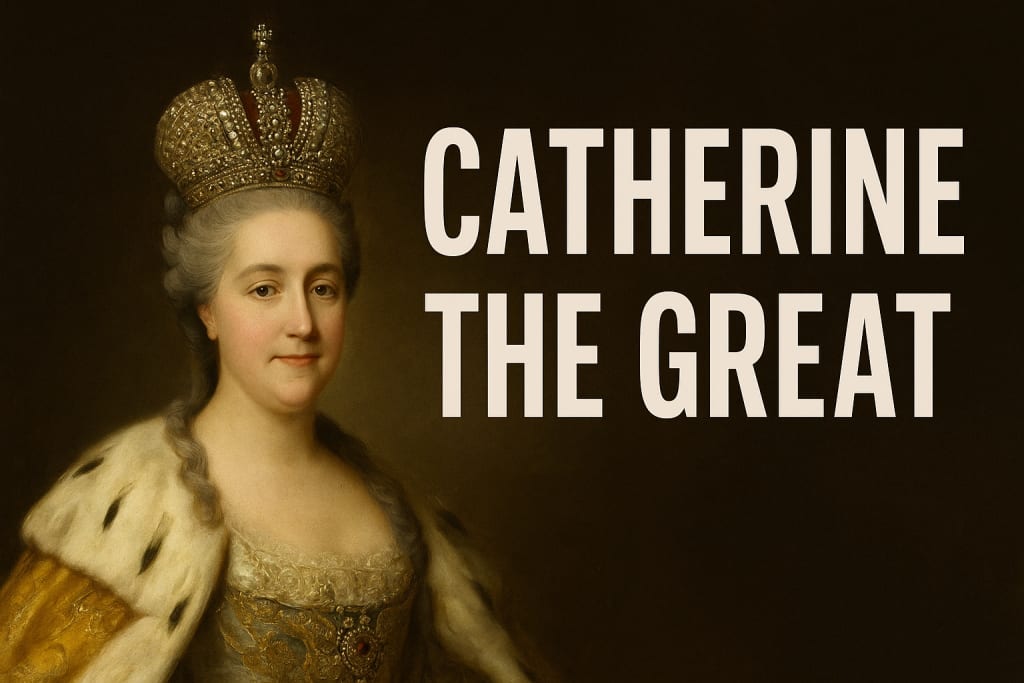
When Catherine the Great arrived in Russia as a young German princess, no one imagined she would one day become one of the most powerful rulers in European history. She came as a bride, not as a queen; as an outsider, not a leader. Yet through brilliance, ambition, and unshakable determination, she transformed herself into an empress—and reshaped an entire empire.
Her reign from 1762 to 1796 became known as the Golden Age of Russia, a time of expansion, culture, and modernization. But Catherine’s story is far more than the story of an empress—it is the story of a woman who refused to let the world define her.
A Princess With a Sharp Mind
Catherine was born in 1729 as Sophie Frederica Auguste, a minor German princess from a financially struggling noble family. What she lacked in wealth, she made up for in intelligence and ambition.
From childhood, she devoured books on philosophy, history, politics, and languages. Her governess once said that young Sophie had a “hunger for learning unlike any child of her age.”
When she was 14, she received an invitation that would change her life: she was to marry the heir to the Russian throne, the future Peter III.
A Rocky Marriage and an Unprepared Husband
At 16, Sophie traveled to Russia, converted to the Orthodox faith, and took the name Catherine. She married Peter, but the marriage was cold and unhappy. While Catherine studied Russian culture, learned the language, and built connections with nobles, Peter behaved like a careless child more interested in toy soldiers than ruling an empire.
The Russian court soon realized that Catherine possessed something the heir lacked:
the mind of a true leader.
The Coup That Changed Everything
In 1762, after Peter III became emperor, his unpopular reforms and reckless behavior pushed Russia into chaos. Many feared he would destroy the progress the empire had made.
Catherine made a bold decision. With the support of the military and the nobility, she launched a peaceful coup d’état—one of the most successful in history. Peter abdicated without resistance.
Days later, Catherine was crowned Empress of Russia.
She was only 33 years old.
A Visionary Leader of a Vast Empire
Unlike many monarchs who relied on tradition, Catherine believed in reason, education, and modernization. She embraced the ideas of the Enlightenment—freedom of thought, science, and progress.
Her reign focused on four key achievements:
✔ 1. Modernizing Russia
Catherine expanded education by building schools, supporting universities, and encouraging scientific research. She wrote instructional books for teachers, founded medical institutions, and even launched Russia’s first major school for women.
She also modernized the government, reorganized provincial administration, and promoted new laws that protected citizens more fairly.
✔ 2. Expanding the Empire
Under Catherine’s rule, Russia’s territory grew dramatically. She gained access to the Black Sea, expanded influence into Eastern Europe, and made Russia a dominant global power.
Maps of Europe looked different because of her decisions.
✔ 3. Championing the Arts and Culture
Catherine was a lover of literature and philosophy. She corresponded with major thinkers like Voltaire and Diderot. She collected thousands of books, building what would later become the world-famous Hermitage Museum in St. Petersburg.
She turned Russia into a cultural center that rivaled Paris and Vienna.
✔ 4. Supporting Agriculture and Economy
Catherine encouraged farming, built new towns, and invited experts from Europe to teach new agricultural techniques. She improved trade routes, simplified taxes, and supported industry.
Russia became wealthier and more stable than ever before.
A Woman Leading in a Man’s World
Catherine ruled with confidence in an era when most women had no political power. She understood that as a female ruler, she had to be twice as intelligent, twice as strategic, and twice as focused.
Her charisma and leadership won her the loyalty of the military, nobles, and foreign diplomats. She faced criticism, rumors, and attempts to overthrow her—but each time, she emerged stronger.
Historians today see her as one of the greatest rulers of the 18th century, male or female.
The Legacy of Catherine the Great
Catherine ruled for 34 years, making her the longest-ruling female leader in Russian history. By the time she died in 1796, she had transformed Russia from a struggling medieval kingdom into a modern European empire.
Her achievements live on in:
the Hermitage Museum
educational institutions
Russia’s expanded borders
reforms that shaped the nation for centuries
Yet perhaps her greatest legacy is this:
Catherine proved that a woman could lead a powerful empire with wisdom, strength, and vision.
Her story remains an inspiration—a reminder that greatness does not come from birth, but from determination, intelligence, and the courage to take control of one’s destiny.
About the Creator
The khan
I write history the way it was lived — through conversations, choices, and moments that changed the world. Famous names, unseen stories.
The Net Worth of the Golden River: Measuring the Value of History’s Greatest Myth
So what is the net worth of the Golden River? While it cannot be calculated like a bank account or a gold reserve, its value can be estimated through economic loss, potential mineral wealth, cultural impact, and historical influence. When all these dimensions are considered, the Golden River may be worth more than any physical treasure ever discovered.
By Say the truth 7 days ago in History
Operation Vegetarian: The Secret Plan That Was Supposed to Starve Germany and Destroyed Gruinard Island
The reason was its role during the Second World War, when its isolated location made Gruinard the ideal site for Britain's first open-air tests of biological weapons.
By Elvira Diggory5 days ago in History
Writing About Writing: The Rainbow Trap
The good thing about living in modern times is that LGBTQ representation in media is increasing. Not just in niche and Independant media, either, but also in mainstream media. Books, movies, TV shows, comics... they're finally catching on that LGBTQ+ people form a significant part of their audience, and deserve to see themselves on screen and in fiction, not just as victims in documentaries and true crime shows.
By Natasja Rose5 days ago in Writers




Comments
There are no comments for this story
Be the first to respond and start the conversation.