
Why Better Call Saul Is Brilliant
The significance of complex characters, visual storytelling, and trusting your audience

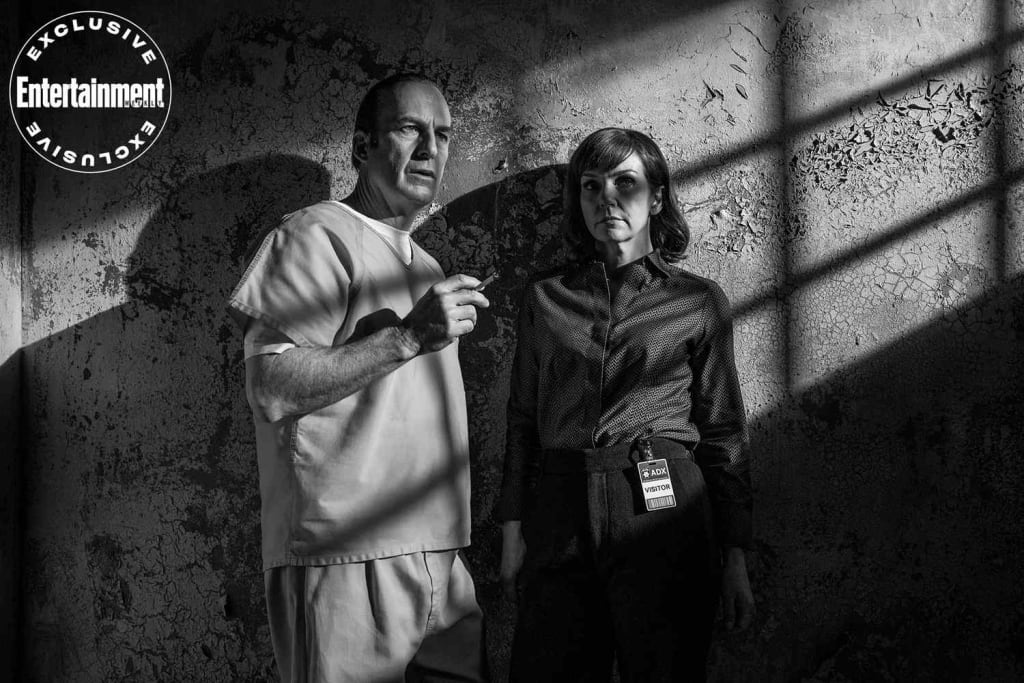
(Mild spoilers!)
Yes, I did indeed decide to write my own submission for my unofficial challenge. Because why not?
I just finished Better Call Saul this week, and upon finishing, I felt like I could run a mile. I could have cried until my eyes hurt. I could have jumped and touched the stars. I could have started a corrupt career in law—just kidding. Probably.
I think it’s safe to say most people have heard of the hit TV show Breaking Bad, or at least vaguely know its premise: high school chemistry teacher Walter White, struck with a bout of terminal cancer, starts collaborating with an ex-student to make meth for money so that his untimely death won’t bankrupt his family. It’s an amazing show, which I don’t have to tell you. It’s one of the most revered TV shows of all time, and in my opinion, it absolutely deserves those accolades.
Better Call Saul is genuinely even better.
Better Call Saul qualifies as a prequel to Breaking Bad. It also qualifies as a sequel, and as an entirely stand-alone work as well. But from the standpoints of plot and of tone, it isn’t very similar to its predecessor at all—that’s what makes it so interesting.
Breaking Bad has this huge danger factor at almost all times that’s great for setting up these big, phenomenal moments, whereas Better Call Saul feels smaller, more casual, more down to earth. Breaking Bad has this action-packed, jaw-dropping plot while Better Call Saul takes its time immersing you into its world, into the law, and into the nuance of its characters. Instead of dealing with a man’s descent into darkness as Albuquerque’s biggest drug lord, we’re dealing with a man’s descent into himself, and what that means for both him as a character and for the audience.
Better Call Saul is much more subtle, and for some, it may seem a little slow at first, but this is by design. Because as you find yourself drawn into the world of Jimmy McGill, you find that it’s the jarringly emotional moments, the periods of silence, the discoveries and actions and reactions from the characters, that can feel just as big and as crushing as any fast-paced plot in its sequel. Its character building and its cleverly constructed tension and brilliant visual storytelling make its emotionally driven moments hit twice as hard.
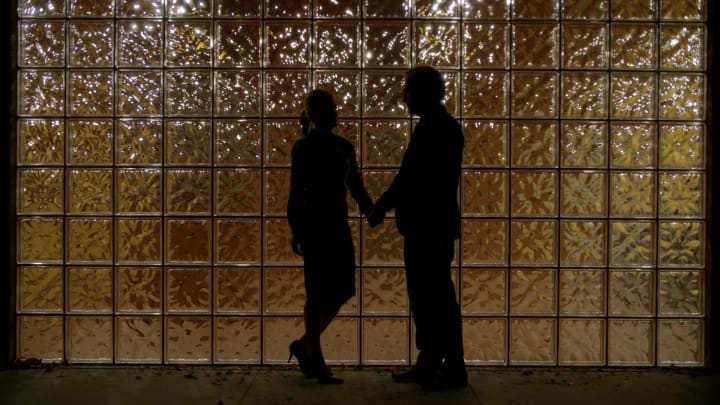
All of the characters in Better Call Saul are impeccably written. Jimmy McGill, before and after he becomes the notorious Saul Goodman, is a fascinating character. Seeing him struggle between his natural talents for conning and manipulation and his genuine desires to make others proud through hard work and good deeds is striking and thought-provoking. Jimmy is a charmer, which we always knew was the case, but the genuine goodness he inherently has within him is beautiful and almost tragic to watch, especially as it begins to erode away later down the line.
Kim Wexler, too, is phenomenal. She is so much more than Jimmy’s love interest, which was great to see. She is very much her own person, serving as the show’s main deuteragonist, with her own goals and traits and talents and personal moral code. She’s a fascinating character in how much she evolves and changes as an individual due to her own changing worldview, not just due to Jimmy’s influence. Seeing Kim’s own personal journey throughout the show was one of my very favorite parts of it.
We get to see a lot of familiar faces, which is always cool. We learn much more about Mike, Gus’s right hand man in Breaking Bad, and how he becomes the way he is. His story arc surrounding guilt, blame, and self-resentment is utterly devastating.
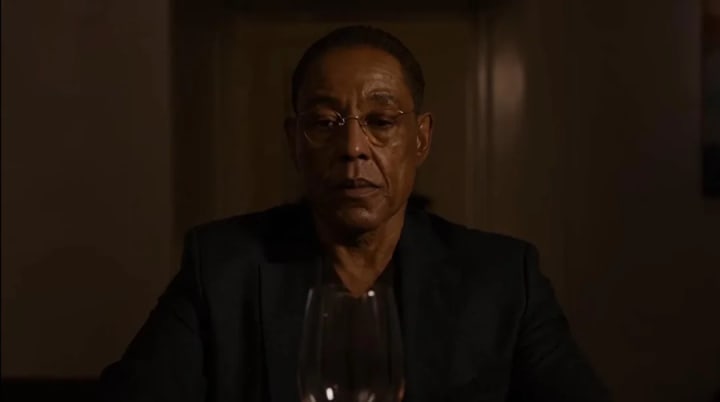
Gus, too, is remarkable in the show as well, and the show does an amazing job delving into the complexity of his cold exterior and his internally obsessive psyche.
All of the new characters are great, too. Chuck, Jimmy’s older brother, serves as an incredibly complex and troublesome figure in his life—and let me talk about Chuck for a moment here, because he is a brilliant goddamn character. I’ve never experienced a character quite like this.
We learn that Chuck has what he deems a severe “allergy to electricity” that causes him pain, which is really a mental ailment instead of a physical one. Though I and many other viewers certainly suspect it, the show doesn’t explicitly tell us this from the start; even still, even knowing this deep down but still believing his brother, Jimmy cares for him. He buys him groceries. He keeps him company. He helps him live his electricity-free lifestyle. He looks up to Chuck, who he thinks is a brilliant lawyer. Chuck is one of the partners of HHM, the law firm Jimmy works in the mailroom at, and Jimmy deeply admires his intelligence and talents as well as loves him as a brother.
But the end of season one sees a shocking moment where a revelation dawns on both Jimmy and the audience about his brother’s true feelings towards him. For all of the first season, we are told that Howard, the other law partner of HHM who Jimmy resents, continually refuses to hire Jimmy as a lawyer, much to his anger and deep disappointment. But plot unravels and it’s revealed it wasn’t Howard who hasn’t wanted to hire him for all these years. It was Chuck.
It was Chuck was the one who wanted to keep Jimmy away from the law. It was Chuck who didn’t want him, who didn’t think him worthy. It was Chuck who thought that Jimmy’s past mistakes in petty crime defined him as a person, and that they would certainly define him as a lawyer. And what hurts the most is that in the end, Chuck ended up being right about Jimmy, who did in fact use the law to be manipulative and corrupt and self-serving. But would it have happened without his betrayal? Who knows?
Their broken relationship is one of the most fascinating aspects of this show, and it ends in such unspeakable tragedy. My god, it is perfection.
The side characters are all great as well. Nacho, the Jesse equivalent in the show, has a heart-wrenching story arc that ends with one of the show’s very best moments. And Lalo, a psychopathic member of the cartel, is revered as one of television’s greatest antagonists for a reason.
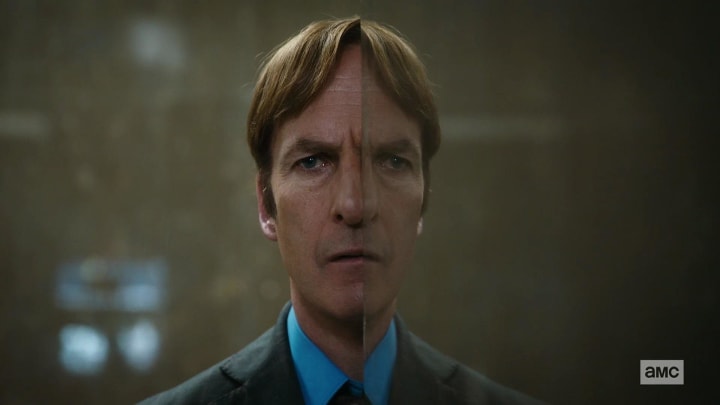
Additionally, the cinematography in Better Call Saul is some of the best I’ve ever seen in television. The shots, the lighting, and the intentionality of every single scene was so beyond impressive, even for someone like me who knows next to nothing about cinematography. The camera work ties explicitly into the show’s vibe and, at times, its symbolism.
I was gobsmacked to learn it wasn’t ever nominated for a cinematography Emmy. The rookery is real.
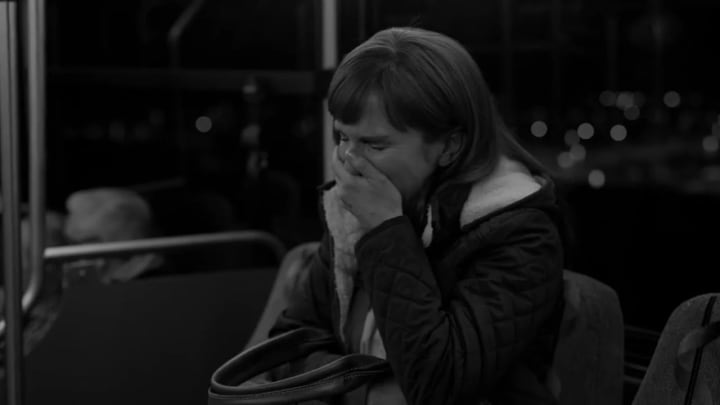
What Better Call Saul sometimes lacks in Breaking Bad levels of intensity, it makes up for with its layered symbolic moments and its attention to detail. It trusts its audience enough to read between the lines, to not have to spell things out, and I am so very grateful for that.
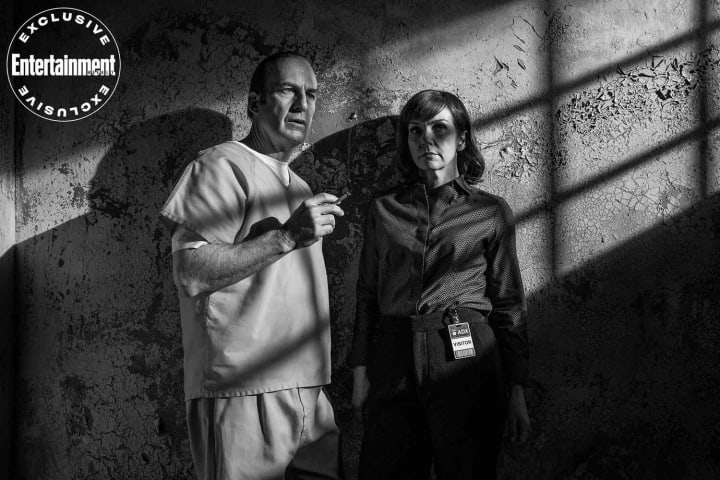
My favorite episode of this show is the final episode, entitled “Saul Gone”. It may be the closest I’ve ever come to witnessing perfection.
Kim, after many guilt-wracked years of being separated from him, shows up at Saul’s sentencing. Upon seeing her, Saul gives up his plea deal, which he had went through lengths concocting, to follow her lead in confessing. He confesses to all of his crimes and then some. He even confesses, for the very first time, for his (indirect) hand in Chuck’s death. (Yes, Chuck dies. No, I won’t say how. Please watch this amazing show.)
After a long, absolutely amazing entire fourth season of diverting any and all guilt or sadness for his brother’s passing, suppressing it, shutting it down and lashing out at others instead, he finally accepts it. He accepts that he had a hand in Chuck’s death, and he says quite simply, and absolutely brokenly and more honestly than we’ve ever heard him before, “And I’ll live with that.”
And don’t we all? Don’t we all live with our most regretted deeds lying heavy on our backs? And yet, we go on. We must, and so we do.
Everything culminates together beautifully in this finale, all with a perfect mix of hurt and pain and punishment and hope, as Jimmy subjects himself to 86 years in prison for his crimes, purposefully putting himself away for good. He knows it’s the only way he can be stopped, to put an end to the cycle of manipulation, and so he does—for love, and also for himself.
There’s a significant scene late in the last season where Walter White and Jimmy are waiting to be sent off to different lives with different identifies, effectively escaping the police by illegal and impressive means. Jimmy asks Walt the same question he once asked Mike: if he had a time machine, what would he go back and change?
Walter gives an unsurprising, honest answer: he wouldn’t leave his old company, which went on to excel without him. It highlights his selfish and envious nature, as well as his greed and his regrets of not becoming great in a way that was maintainable. Walt asks Jimmy the same thint: what would he want? Jimmy, who seems vaguely surprised Walt asked, gives a half-hearted answer about hurting his knee during a scam. And Walt just observes Jimmy and comments, rather bluntly, “So you were always like this.”
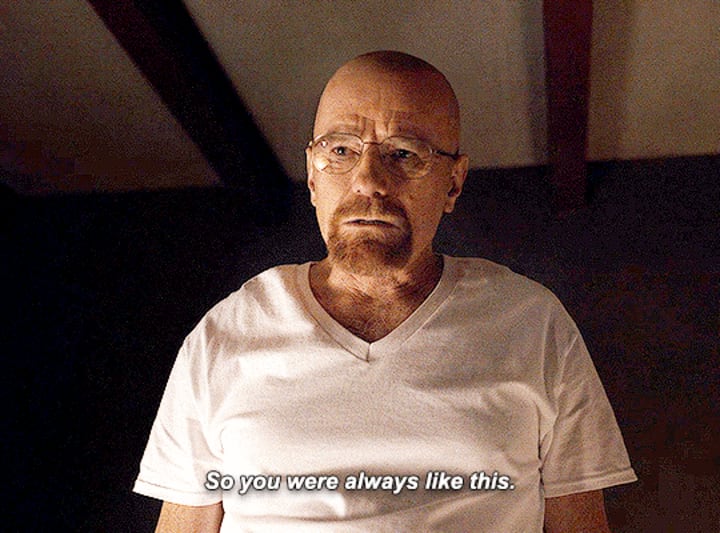
It’s an absolute gut punch of a line, and Jimmy’s reaction says it all.
Because yes, in a way, it’s true. In a way, Jimmy was always like this, always scamming, always manipulative, to his core. In a way, Chuck was right about him. But he always had another path, and Walt making it sound like he never in a million years could have chosen that path in such a blunt and simple way, when we’ve gone on this entire journey with Jimmy and know very well how not simple it all was, is a brilliant taste of brutal, depressing irony.
The show ends with Jimmy confronting and accepting the two parts of himself: Jimmy McGill and Saul Goodman, the conman and the bright-eyed, brilliant lawyer. They are both a part of him, and he must deal with the pain and the consequences he faces from being them both—and so he does.
Better Call Saul is a love letter to television and to media itself. It embraces these devastating and harrowing emotional moments with such authenticity and brilliance. It’s such a genius show, guys. Please, check it out.
—
Thank you so much for reading! Results for the challenge should be out in a few days!! ♥️♥️
About the Creator
angela hepworth
Hello! I’m Angela and I enjoy writing fiction, poetry, reviews, and more. I delve into the dark, the sad, the silly, the sexy, and the stupid. Come check me out!
Keep reading
More stories from angela hepworth and writers in Geeks and other communities.
Not Just For Clean Up: A History Of The MCU's Department of Damage Control
Initially an organisation that seemed to exist to help the heroes of the Marvel Cinematic Universe, from Phase Four onwards, the Department of Damage Control has shifted into a more antagonistic role. Most recently seen in the Wonder Man series, the current incarnation of Damage Control seems to target superpowered individuals, regardless of whether that person poses an active or intentional threat.
By Kristy Anderson3 days ago in Geeks
Groundhog Day Highlights: Punxsutawney Phil Predicts Six More Weeks of Winter
Every year on February 2, a small town in western Pennsylvania becomes the center of national attention. Punxsutawney, home to fewer than 6,000 residents, hosts one of the most enduring folk traditions in the United States: Groundhog Day. Before sunrise, crowds gather at Gobbler’s Knob, cameras roll, and all eyes turn to Punxsutawney Phil. This year, as has happened many times before, Phil emerged from his burrow, spotted his shadow, and signaled six more weeks of winter.
By Saboor Brohi about 11 hours ago in Geeks



Comments (2)
I've never watched Breaking Bad and only today I got to know that Better Call Saul is its spinoff, lol. Idk, they don't really seem like my cup of tea but as always, I enjoyed your review. I also never knew of the term deuteragonist. Fascinating!
Well now I’m ready to watch this! Breaking Bad never appealed to me because of the violence. But good character development and cinematography? Count me in! Have you watched Fleabag? The last episode might be the best 30 mins of television I’ve experienced in my whole life