

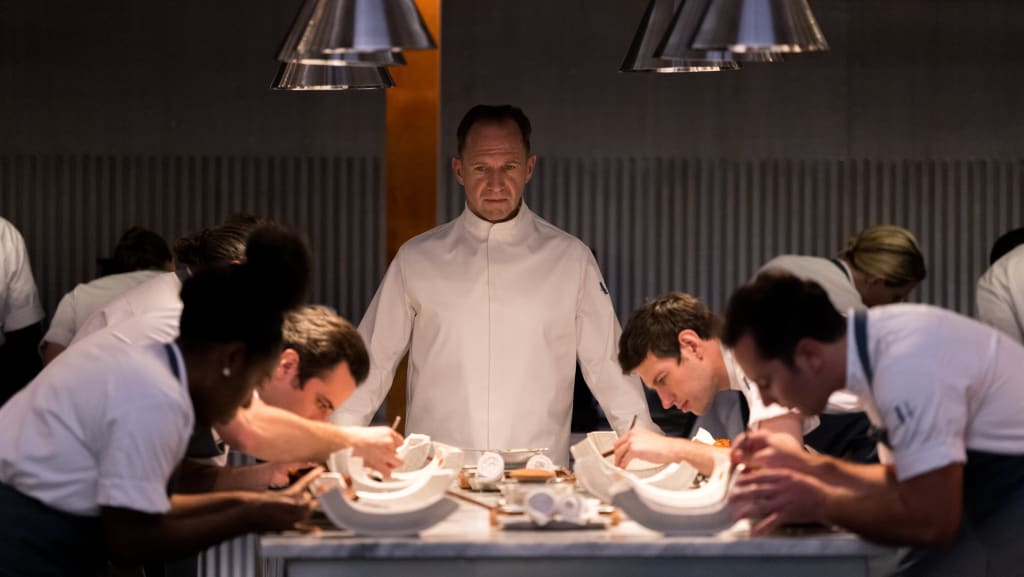
The Menu was truly one of my most anticipated films of 2022, and then we didn’t get to go see it in theaters. So though I was disappointed that I had to watch it on HBO Max I am glad that I finally got to see it. The trailer depicted what seemed to be a satire with the message of “eat the rich” a theme that made it a must watch for us. After watching the film, it was definitely a satire, just not truly the “eat the rich” kind, more like eat the overly intellectual. Which is part of the reason watching people on the internet analyze it to death is hilarious. There really wasn't that much to analyze and that's what I appreciated most about it, it was very straight forward.
Now one of the major criticisms I’ve seen from this film is that the satire is too obvious and on the nose. The reality is that the people that need to see satire need it to be obvious and on the nose or they simply won’t understand it. Add in the fact that satire’s are by definition over the top. The film did exactly what it needed to do, nothing more and nothing less. The theme was incredibly clear and there wasn’t much room for interpretation. One of my least favorite tropes in the history of screenwriting is when the theme is spelled out in dialogue. The Menu never quite got to that point, it got tantalizingly close several times but not so close that I would call it a critique.
Another incredible element to this film is the cinematography. The way it was shot was beautiful, kind of like the normal psychological thriller. The images were stunning and each one aided in the story instead of taking away from it. As they were first walking into the restaurant and the big swinging door closed behind them, the way the camera followed Margot down the hallway, and the first clap and call to attention for the rest of the kitchen staff were my favorite shots. But really this film was filled with great cinematic moments and that alone makes it worth the watch.
The acting was of course impeccable, now I don’t think anyone was oscar worthy, neither was the source material. The rest of the cast was pretty ancillary to the story but they all played their characters well. But Anya Taylor-Joy did a magnificent job and was the stand out part of the film. I am hoping that this does set up an opportunity for some Oscar worthy material for her.
Overall the movie was a great watch-at-home movie. Now movies that you have to see in the theaters are mostly reserved for films with overtly stunning visuals, even if they rely on those visuals and have no actual substance (yes I’m talking about Avatar), genre movies like Marvel or Lord of the Rings, or any film you just want to show financial support for. That said, The Menu was a watch at home choice, I wouldn’t necessarily pay $12 for a ticket to see it but I am also glad I saw it. There is a difference between a lower end theater film and a streaming service film and I think The Menu kind of walks that border. I would give the film a 6-7/10, it was excellent commentary and it sparked some hilarious internet discussions but the rewatch factor is pretty low and like I said if we didn’t have a-list it wouldn’t have been on our radar.
About the Creator
Alexandrea Callaghan
Certified nerd, super geek and very proud fangirl.
Keep reading
More stories from Alexandrea Callaghan and writers in Geeks and other communities.
Scarlet Witch
Now that the MCU has finally discovered (and wasted) the power of Scarlet Witch the comic book world has caught back up. Her newest solo series is releasing and the world will hopefully get to see the power of the Scarlet Witch again. As far as we know this is going to be an ongoing series, the first granted to miss Wanda Maximoff. Up until now she has only received a limited solo run and a joint solo series with The Vision. We could certainly talk about why it took so long for Wanda to finally get her own ongoing series but I feel like we all know the answer already.
By Alexandrea Callaghan3 years ago in Geeks
Not Just For Clean Up: A History Of The MCU's Department of Damage Control
Initially an organisation that seemed to exist to help the heroes of the Marvel Cinematic Universe, from Phase Four onwards, the Department of Damage Control has shifted into a more antagonistic role. Most recently seen in the Wonder Man series, the current incarnation of Damage Control seems to target superpowered individuals, regardless of whether that person poses an active or intentional threat.
By Kristy Anderson4 days ago in Geeks
Dracula Review: A Gothic Tale Reimagined for Modern Audiences
When Bram Stoker first penned Dracula in 1897, he created more than just a horror novel; he forged the template for vampire mythology that continues to captivate audiences over a century later. From films to television series, Dracula has been reimagined countless times, but the latest adaptation seeks to balance the original gothic charm with a modern sensibility. The result? A bold and intriguing rethinking of one of literature’s most iconic figures, but also a reminder of why the classic still holds its own. Plot Overview The latest iteration of Dracula comes from the creative minds behind Sherlock, Steven Moffat and Mark Gatiss. This version of the legendary vampire is structured around a three-part miniseries, each episode running an hour and a half. Set in 1897, the story follows the infamous Count Dracula (played by Claes Bang) as he plots to leave Transylvania and invade England. However, this time, the focus is not just on Dracula’s evil machinations but also on the female characters, particularly Sister Agatha (Dolly Wells), a resourceful nun who sets herself up as Dracula’s nemesis. The show begins with the well-known origin story of Dracula’s rise, with an intriguing twist. Dracula, a master of manipulation and seduction, is depicted as more than just a bloodsucker. He is a figure of intellect and strategic genius, using his supernatural powers not only for killing but also for self-preservation. Unlike many previous iterations, Moffat and Gatiss present him as both a force of pure evil and an embodiment of society’s fears and desires. Performance and Casting Claes Bang’s portrayal of Count Dracula is, without a doubt, one of the most compelling parts of this adaptation. He exudes charisma and menace with equal precision, imbuing Dracula with a complexity that pushes the character beyond the typical portrayal of a mere villain. His performance conveys a layered personality—a being both ancient and alluring, calculating and dangerously charming. However, the true standout in this series is Dolly Wells as Sister Agatha. What could have easily been a traditional ‘final girl’ role is instead given a much-needed update, with Agatha being both a formidable antagonist and a surprisingly complex character. The dynamic between her and Dracula provides some of the most interesting moments of the show, as the tension between good and evil is explored with nuance. Her wit, strength, and resolve make her an excellent foil to Dracula's unyielding malevolence. The rest of the supporting cast, including a range of characters in Dracula's path of destruction, holds their own but often fall short when compared to the central performances. Nonetheless, they serve to further the plot, providing Dracula with the means and obstacles he needs for his wicked schemes. Cinematic Visuals and Atmosphere One of the greatest strengths of Dracula lies in its visual aesthetic. The show embraces the gothic nature of the story, using intricate, atmospheric settings that heighten the tension and eeriness of the tale. From the dark, towering walls of Dracula’s Transylvanian castle to the Victorian mansions of London, every set is meticulously designed to evoke the mood of the original novel while enhancing the story’s modern twist. The show’s cinematography is rich with deep shadows and hauntingly beautiful shots that emphasize the themes of isolation, corruption, and the supernatural. A standout scene occurs in the first episode, where Dracula’s entrance into a new world is marked by a stormy, foreboding atmosphere, complete with creeping fog and the faint sound of organ music. These visuals help to immerse the viewer into the world of Dracula, reinforcing the timeless nature of his terrifying presence. Themes and Modern Twists While Moffat and Gatiss retain much of the original plot from Stoker’s novel, they infuse it with modern sensibilities, exploring themes like gender, power, and societal expectations. One of the most interesting aspects of the series is its approach to the character of Dracula, who is depicted not merely as a bloodthirsty monster but as a reflection of humanity’s darker impulses. The show cleverly examines how Dracula uses his powers not only to manipulate people but to expose the darker aspects of human nature. Furthermore, the role of women in the story is redefined. In previous adaptations, female characters often served as helpless victims, but here, they are imbued with agency and complexity. Agatha’s character is one of empowerment, and her resistance against Dracula is portrayed not as a mere battle of good versus evil, but as a confrontation of intellect, resilience, and willpower. The narrative also plays with the passage of time, reflecting on Dracula’s ability to adapt and survive throughout history. While the show sticks to its Victorian roots for much of the series, it takes some bold steps in reimagining the traditional narrative structure, keeping the audience on edge with unexpected developments and time-jumps that lead to both thrills and intrigue. Pacing and Structure While Dracula starts strong with an exciting and fast-paced first episode, the pacing slows down significantly in the second and third episodes. The middle episode tends to meander, losing some of the immediate tension established at the outset. The final episode also takes a rather ambitious narrative leap, which will leave some viewers either satisfied or perplexed by the unexpected twists. This structure may frustrate those expecting a more traditional, linear storytelling approach. Despite its somewhat uneven pacing, the miniseries remains an engaging and bold reinterpretation of the classic gothic tale. Moffat and Gatiss take risks, and though not all of them fully succeed, their vision is clear, fresh, and audacious in its attempt to modernize a centuries-old story. Final Thoughts Ultimately, the Dracula miniseries is a captivating reimagining that both honors and challenges the source material. With strong performances, particularly from Claes Bang and Dolly Wells, a gorgeous visual style, and thought-provoking themes, it offers a fresh perspective on an age-old story. While the pacing may falter at times, the show’s ambition and atmosphere make it an exhilarating ride for fans of both classic horror and modern reboots. This adaptation of Dracula is a thrilling exploration of power, fear, and human nature, cementing its place as a worthy entry in the long line of Dracula adaptations. For those willing to embrace a new take on an iconic character, this version is certainly worth the watch.
By Fiaz Ahmed about 15 hours ago in Geeks


Comments
There are no comments for this story
Be the first to respond and start the conversation.