

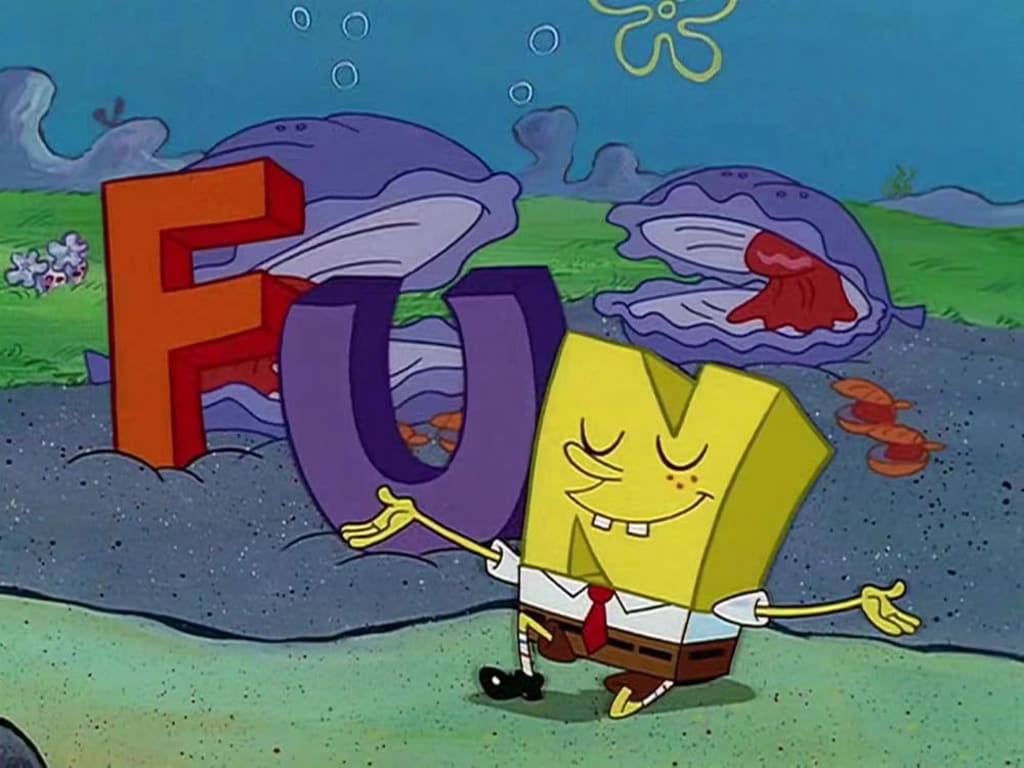
The episode "F.U.N." unfolds as a masterclass in character-driven comedy and narrative irony, centering on Plankton’s most hilariously transparent scheme to date. From the opening moments, the Chum Bucket’s oppressive gloom is a stark, almost visceral contrast to the sun-drenched, vibrant chaos of the Krusty Krab, a visual metaphor for the fundamental conflict between cynical ambition and joyful innocence. Plankton, tiny and vibrating with a fury that seems to distort the very air around him, constructs his "Friendship, U & Me, and Anywhere and Anytime" acronym not as a genuine olive branch but as a convoluted trap, his every syllable dripping with insincerity. The scene is a tightly wound spring of tension, as we, the audience, are complicit in the joke, watching SpongeBob—radiating pure, unadulterated optimism—plunge headfirst into the obvious snare with a trusting eagerness that is both exasperating and profoundly endearing.
SpongeBob’s reaction to the F.U.N. proposal is the emotional core of the episode, a brilliant portrait of naive enthusiasm executed with physical comedy that defies logic. His entire being transforms; his rectangular body quivers with excited energy, his voice climbs an octave, and his wide, starry eyes reflect a world suddenly filled with limitless possibility. The infamous song sequence, while undeniably catchy, is also a poignant document of SpongeBob’s desperate desire for connection, his lyrics a heartfelt, if grammatically nonsensical, testament to the power of companionship. He sings with a sincerity that momentarily makes the audience forget the sheer absurdity of the situation, his dance moves a joyous, uncoordinated explosion of bliss that inadvertently mocks Plankton’s stark, colorless existence. This juxtaposition—the complex, rehearsed villainy against unscripted, authentic joy—is where the episode’s genius truly lies.
As the narrative unfolds, the episode masterfully juxtaposes SpongeBob’s boundless optimism with Plankton’s scheming intellect, using vibrant color palettes and fluid animation to illustrate their opposing worldviews. The visual storytelling is meticulous: each time Plankton attempts to subvert SpongeBob’s earnest attempts at sharing joy, the background subtly shifts—bright, lively hues turn into muted, angular tones, underscoring the tension between genuine amusement and ulterior motives. The script’s wordplay, especially the recurring chorus “F‑U‑N, it’s fun to…,” becomes a rhythmic mantra that weaves through the episode like a surf wave, its cadence punctuated by the characters’ exaggerated facial expressions and exaggerated, almost theatrical, body language. The comedic timing is razor‑sharp, with moments of slapstick physicality—SpongeBob’s flailing arms, the sudden burst of bubbles, the exaggerated “boing” of Plankton’s gadgets—blending seamlessly with witty dialogue that simultaneously lampoons and celebrates the classic “buddy‑versus‑villain” trope. By weaving these visual and verbal cues together, the episode creates a rich tapestry that feels both accessible to children and subtly sophisticated for adult viewers who appreciate the layered satire.
The episode’s heart, however, lies in its thematic resonance: the notion that true fun is not a weapon to be wielded for personal gain, but a shared experience that can bridge even the most unlikely of divides. The climax—where SpongeBob’s relentless optimism finally cracks Plankton’s cynical façade—unfolds in a meticulously choreographed sequence that combines bright, swirling colors with a crescendo of musical notes, allowing the viewer to feel the palpable shift in emotional temperature. The animation here is particularly striking: Plankton’s usual angular, scheming silhouette softens, his eyes widen, and for a fleeting moment the audience witnesses a vulnerability that is rarely afforded to a character traditionally cast as the antagonist. This visual transformation is accompanied by a subtle change in the soundtrack, moving from a low‑key, scheming motif to a warm, buoyant melody that mirrors the growth of an unexpected camaraderie. In this way, the episode transcends its surface‑level humor, offering a poignant reminder that even the most entrenched rivals can discover common ground through the simple, universal language of joy.
About the Creator
Forest Green
Hi. I am a writer with some years of experiences, although I am still working out the progress in my work. I make different types of stories that I hope many will enjoy. I also appreciate tips, and would like my stories should be noticed.
Keep reading
More stories from Forest Green and writers in Geeks and other communities.
SpongeBob Review
The neon-drenched stage of the Krusty Krab talent show becomes an arena of brutal, unvarnished Bikini Bottom culture in “Culture Shock,” a masterclass in satirical storytelling that uses SpongeBob’s boundless optimism as a sacrificial lamb. From the moment the curtain rises, the episode meticulously constructs a world where genuine artistic expression is irrelevant, replaced by a cynical ratings machine run by a smarmy, suit-clad producer and an audience whose applause is a fickle currency. SpongeBob’s earnest, if bizarre, jellyfishing routine—complete with a literal net and interpretive dance—is not merely bad; it is an ontological crime against the very concept of entertainment as understood by this crowd, who are immediately shown to be more interested in nachos than narrative. The scene is painted with excruciating detail: the sweat gleams on his porous forehead under the spotlight, his smile never wavering as the boos begin like a low tide and rise into a roaring wave of contempt, a visual symphony of his heart breaking in real-time as the camera zooms in on his crushed, wide-eyed innocence.
By Forest Greenabout 12 hours ago in Geeks
The Machine That Learned to Lie: What Libratus and Pluribus Taught Us About Strategy 🃏🤖
Man vs. machine duels are truly fascinating topics. They show us how dynamically Artificial Intelligence is evolving and how it can outmaneuver humans in ways we never expected 🦾. I’ve previously written about Kasparov and chess, IBM's watson on Jeopardy, Project Debater, and the historic battles in Go. Today, we have something completely different on the table – the game of poker. 🃏
By Piotr Nowaka day ago in Geeks
Boundless
A geographical map could take you there. To the places I've been, to the sights I've seen, to the landscapes I've climbed. But no compass could point you in the direction of my memories. To the experiences I've lived, to the happiness I've felt, to the wonder I've held so close to my heart.
By Alyssa Musso3 days ago in Writers


Comments
There are no comments for this story
Be the first to respond and start the conversation.