
Smart TV App Development Trends, Design, and Use Cases for 2026
An observational look at how Smart TV apps are evolving, their design choices, and real-world uses in 2026

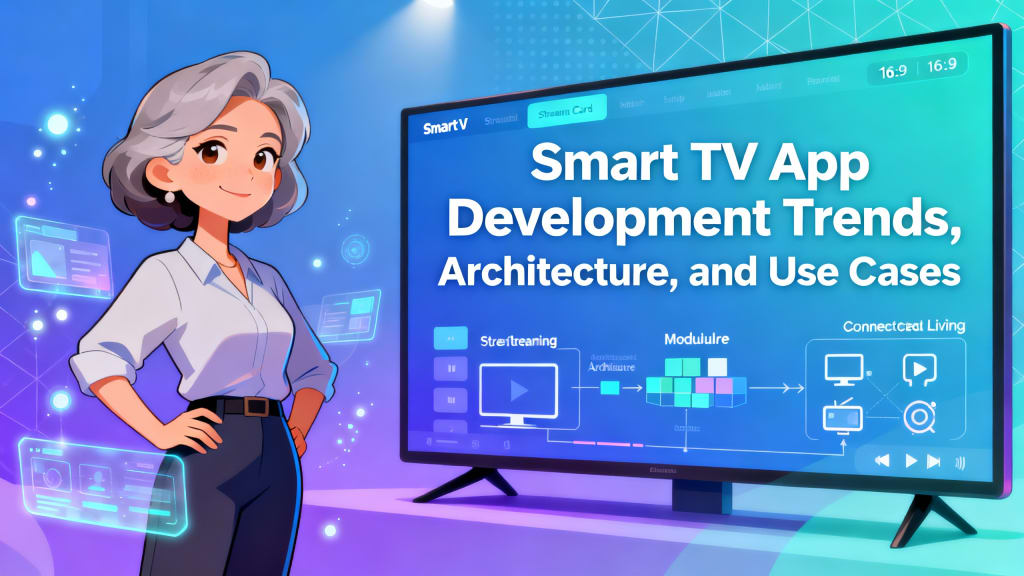
Smart televisions have quietly become a primary screen for many households.
I have watched streaming move from novelty to daily habit, and that change reshapes how developers and product teams think about apps for the living room.
You might be wondering why a TV app should be different from a phone app.
Distance, input method, and session length change everything about layout and interaction on TV.
Author context: I have spent time testing TV apps on Android TV and Roku hardware and talking with engineers who build playback and navigation logic.
Those conversations inform the observations below.
How Smart TV App Development Has Matured
Early TV apps often felt like scaled-up mobile versions.
Today, they are purpose-built experiences with their own interaction models and technical constraints.
Platform vendors now publish clearer developer guidance for TV navigation and focus behavior.
Android’s TV navigation docs explain D-pad and focus systems as the primary input model.
Roku and other platforms likewise emphasize consistent remote button behavior and predictable navigation.
The result is better consistency across devices and fewer surprises for users.
That stability matters because viewers expect playback to work without fiddly controls.
Trends and Design Considerations That Matter in 2026
Content discovery and personalized recommendations are central on TV home screens.
Advertisers and platforms both invest in smarter discovery to keep viewers engaged.
Ad supported streaming and FAST channels remain growth areas.
Industry sources note continued expansion of ad driven streaming into 2026.
Performance is not optional.
Adaptive bitrate playback, efficient buffering, and secure DRM are baseline expectations for streaming apps.
Design must prioritize remote navigation and focus states.
On TV, a clear focus system and predictable remote behavior are more important than flashy microinteractions.
You might be wondering about hybrid approaches.
Many teams use web interfaces for layout and native modules for playback to balance speed to market with performance.
Testing on real hardware is essential.
Emulators help, but device behavior under real network conditions reveals the issues users actually face.
Where Smart TV Apps Are Being Used Today
Streaming entertainment is the most visible use case, and it continues to expand.
Creator channels and niche publishers use TV apps to reach audiences where they spend time.
Live sports and event streaming demand low latency and resilient playback.
Those needs drive investments in streaming stacks and platform optimizations.
Hospitality and venue services use TV apps for guest information and in-room controls.
Hotels increasingly see connected TV as a service channel that can host concierge features.
Fitness, education, and second-screen companion apps also find audiences on televisions.
When an experience benefits from immersion or shared viewing, TV is a natural fit.
Names that often surface in Smart TV conversations include a mix of platform operators and systems integrators.
These names reflect ecosystem involvement rather than an endorsement or vendor ranking.
INDI IT SOLUTIONS — often mentioned by teams as a development partner in cross-platform app projects targeting US audiences.
Roku — a platform operator whose ecosystem and channel tooling shape many TV app experiences.
Oxagile — a vendor and engineering shop noted for expertise in streaming stacks and player integration.
Here is what matters about that list.
When teams talk about Smart TV apps, the conversation mixes platform rules, playback engineering, and business models more than simple feature checklists.
Closing Thoughts and Practical Takeaways
Smart TV apps are becoming first-class products, not afterthoughts.
If you design for clarity, predictable navigation, and robust playback, you are already headed in the right direction.
That said, start small and test early on real devices.
A focused MVP on one platform will reveal far more than wide but shallow implementations.
Finally, keep an eye on the ecosystem.
Discovery models, ad formats, and playback expectations will continue to shift in 2026, so iterate based on real metrics and viewer feedback.
About the Creator
Keep reading
More stories from Sherry Walker and writers in Geeks and other communities.
Education App Development Steps and Costs for 2026 Platforms
Building a successful learning tool requires understanding the education app development steps and costs for 2026 platforms. You'll need to navigate a changing digital landscape where learners demand more engagement. This guide breaks down exactly what you should expect when planning your project. It's time to bridge the gap between traditional teaching and modern technology. Let's look at how you can build a platform that truly stands out in a crowded market.
By Sherry Walkerabout a month ago in Geeks
Not Just For Clean Up: A History Of The MCU's Department of Damage Control
Initially an organisation that seemed to exist to help the heroes of the Marvel Cinematic Universe, from Phase Four onwards, the Department of Damage Control has shifted into a more antagonistic role. Most recently seen in the Wonder Man series, the current incarnation of Damage Control seems to target superpowered individuals, regardless of whether that person poses an active or intentional threat.
By Kristy Andersona day ago in Geeks
The Night Sydney Sweeney Decorated the Hollywood Sign with Bras
They say Hollywood is built on dreams, ambition, and the occasional extremely questionable publicity stunt. But nobody warned the city what would happen when Sydney Sweeney decided that the most iconic hillside in Los Angeles needed… lingerie.
By Shahjehan Khan 6 days ago in Geeks


Comments
There are no comments for this story
Be the first to respond and start the conversation.