
How Demand Forecasters Integrate ERP & Planning Tools (2026)
Discover how demand forecasters seamlessly integrate ERP and planning tools to optimize supply chains. Learn expert strategies for accuracy & efficiency in 2026. Explore our guide!

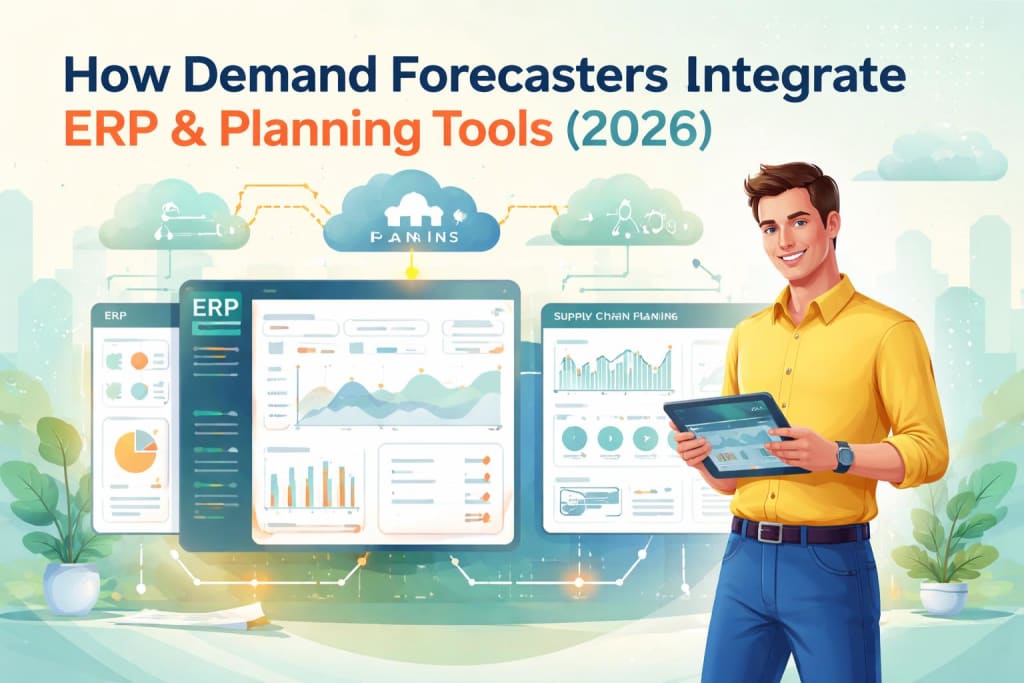
The Messy Reality of Spreadsheet Hell
Reckon we have all been there. You are staring at a massive Excel sheet that’s fixin’ to crash your laptop while trying to guess how many units you will sell next Tuesday. It is a nightmare, plain and simple.
Back in the day, demand forecasters were basically just glorified guessers. You’d pull some dusty data from an old ERP, shove it into a spreadsheet, and pray the macro didn’t break. It was proper dodgy, mate.
But here we are in 2026, and the game has changed. We aren’t just looking at what happened last year and adding five percent. That’s all hat and no cattle. We are talking about deep, real-time integration.
Thing is, if your ERP and your planning tools aren't talking to each other like old friends at a pub, you’re already behind. The silos are finally crumbling, and honestly, it’s about time. Let me explain how this actually works now.
Why Your 2024 Spreadsheet is Basically a Relic
If you are still clinging to manual data entry, you’re essentially bringing a knife to a gunfight. Static data is dead data. By the time you’ve formatted your cells, the market has already moved on without you.
In 2026, forecasters are dealing with "causal factors" that change by the hour. Weather patterns, TikTok trends, and port strikes in Newcastle all hit the bottom line instantly. You can't capture that in a VLOOKUP, no cap.
The Data Silo Struggle is Real
Real talk, the biggest headache has always been the "wall" between the IT folks and the planners. The ERP holds the "truth" of inventory, but the planning tool holds the "logic" of the future.
Getting them to sync used to require a massive IT project that lasted eighteen months and cost a fortune. Most of the time, the results were still rubbish. We were knackered just trying to get a clean data export.
How Modern Demand Forecasters Are Actually Doing It (The 2026 Way)
So, how are the pros doing it today? They are using what we call "headless integration." The ERP acts as the engine, but the planning tool is the brain. They are tethered by high-speed APIs that never sleep.
This isn't just about moving numbers. It is about moving context. When a sales rep in Sydney closes a deal, the planning engine knows the production impact in real-time. It is fair dinkum magic when it works.
A good example of this is seen in specialized tech sectors. Teams working in this space, like those at mobile app development ohio, are building the custom middleware that allows these massive systems to shake hands without the lag.
But wait, it gets better. We aren't just syncing data once a night anymore. We are talking about event-driven architecture. Something happens in the warehouse, and the forecast adjusts automatically. No human intervention is required for the small stuff.
Real-Time Syncing or Bust
If your data is older than five minutes, it’s basically ancient history. The top-tier planning tools now pull live telemetry from the ERP. We’re talking about sub-second latency for inventory updates and purchase orders.
According to a Gartner 2025 Report, nearly 75% of supply chain leaders have moved toward "Decision Intelligence" platforms that bridge the gap between transactional ERPs and tactical planning tools.
API-First Architectures Are the New Black
Forget those clunky batch uploads. The modern forecaster demands APIs. This allows for a "best-of-breed" approach where you can swap out your planning logic without nuking your entire database. It’s hella more flexible.
I reckon this is why we’re seeing a surge in specialized apps. Companies want tools that do one thing perfectly rather than an ERP module that does ten things poorly. It’s about being sorted, not just busy.
Moving Beyond Basic Historical Data
In 2026, "historical averages" are for amateurs. We are using "Digital Twins" of the supply chain. We simulate a thousand different scenarios—like a sudden surge in demand for organic oats—before they even happen.
"The silos between transactional ERP data and planning logic are finally dissolving thanks to unified data models that allow AI agents to act on live signals." — Jeremy Bowman, Supply Chain Lead at SupplyChainBrain
The Rise of AI Agents in Planning
We are seeing AI "agents" that live inside the ERP. They don't just report data; they interpret it. If the agent sees a delay in a raw material shipment, it automatically nudges the forecaster to lower the sales expectations.
It’s like having a personal stylist for your data. It cleans up the messy bits and makes sure the forecast looks sharp. It's properly brilliant when you don't have to spend your Sunday night fixing broken data links.
The Tech Stack: ERP Meets Planning Intelligence
Look, your ERP (be it SAP, Oracle, or NetSuite) is great for keeping the books. But it’s usually rubbish at predicting the future. That is why the "Integration Layer" is now the most important part of the stack.
This layer acts as a translator. It takes the "computer-speak" of the ERP and turns it into "human-logic" for the forecaster. Without it, you are just drowning in a sea of unorganized rows and columns.
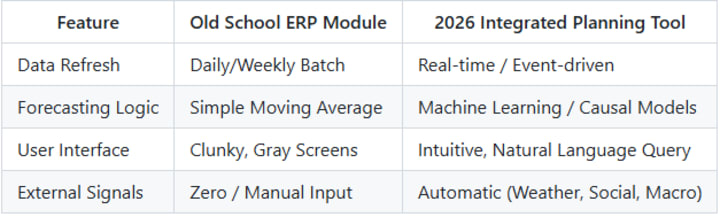
Connecting the Dots with Cloud Native Tools
Everything is in the cloud now, no cap. If your ERP is still on a server in a basement, you’re hosed. Cloud-native integration means you can scale your compute power when you’re running heavy simulations for Black Friday.
It also means you can collaborate. I can be in Austin, you can be in London, and we’re both looking at the exact same live forecast. No more "Final_Version_v4_REAL_FINAL.xlsx" clogging up the email inbox.
Handling the Bullwhip Effect with Live Data
The bullwhip effect is the bane of my existence. A tiny change in consumer demand turns into a massive overstock at the warehouse. Live ERP integration kills this by providing "end-to-end visibility."
When the ERP and planning tools are synced, you see the ripple effect immediately. You can tap the brakes before you end up with a warehouse full of fidget spinners that nobody wants anymore. It’s about not being a muppet.
💡 Lora Cecere (@scmguru): "In 2026, the 'forecast' is no longer a number. It's a range of probabilities fueled by real-time ERP execution data." — Supply Chain Insights
AI Agents as the Glue Between Systems
These agents are getting smarter. They are fixin' to take over the mundane stuff. They match the "Actuals" from the ERP against the "Plan" and highlight the gaps before your boss even notices.
They also handle "Data Cleansing." We all know ERP data can be a bit dodgy sometimes. The AI identifies outliers—like a one-time massive order from a fluke customer—and makes sure it doesn't skew the future forecast.
Common Pitfalls and Why Integration Still Sucks Sometimes
I’m not gonna lie to you. It isn't all sunshine and rainbows. Even with the best tools, things go wrong. Integration is hard because humans are involved, and humans are notoriously messy with their data entry.
Sometimes the "automated" system gets a bit too confident. It sees a spike in demand, assumes it’s a trend, and orders a million units of something that was just a one-day viral prank. You still need a human in the loop.
Dirty Data In, Hot Garbage Out
This is the golden rule. If your warehouse team isn't scanning pallets correctly into the ERP, your fancy planning tool is going to give you a forecast that is pure fantasy. It’s a classic case of garbage in, garbage out.
You have to fix the culture before you fix the code. Everyone from the dock worker to the CEO needs to respect the data. If they don't, even the most expensive AI in the world won't save you from a stockout.
Over-complicating the Workflow
I've seen companies try to track 500 different variables for a single SKU. That’s just being a glutton for punishment. Sometimes, you just need to know if it’s going to rain and if the price of shipping is going up.
Simplicity is often the best strategy. The best integrated systems focus on the "Big Rocks" first. Once you have the major signals sorted, then you can start worrying about the tiny details. Don't be a "stuck-in-the-mud" perfectionist.
💡 Supply Chain Tech Daily: "The biggest barrier to ERP-Planning integration in 2026 isn't the API technology; it's the lack of clean, standardized master data across global entities." — ZDNet Tech Insights
The Cost of Keeping It Real
Maintaining these integrations isn't cheap. You need "Data Engineers" who understand both the supply chain and the code. They are a rare breed, and they cost a pretty penny. But the alternative—losing millions in lost sales—is much worse.
"We found that companies using automated data synchronization between ERP and SCP systems reduced their inventory carry costs by 12% on average in 2025." — Dr. Maria Sanchez, Lead Researcher, MIT Center for Transportation & Logistics
The 2027 Outlook: What’s Coming Next?
Looking ahead to 2027, the trend is moving toward "Autonomous Planning." We are talking about systems that don't just suggest a forecast but actually execute the purchase orders within the ERP themselves. The role of the forecaster is shifting from "data cruncher" to "exception manager." We will be spending our days dealing with the weird stuff that the AI can't figure out, while the machines handle the "steady state" business. Expect to see a massive adoption of "composable" supply chain platforms that allow for even tighter integration with external partner ERPs, creating a truly global, "live" supply web.
Integrated demand forecasting isn't just a buzzword anymore. It’s survival. If you are still manually moving data between your ERP and your planning tools, you’re basically a dinosaur watching the meteor head straight for you. Get your systems talking, get your data clean, and for heaven's sake, stop relying on that 2024 spreadsheet. It’s time to get sorted for 2026 and beyond. No more excuses, y'all.
How demand forecasters integrate ERP and planning tools is ultimately about trust. Trusting the data, trusting the automation, and trusting that the person on the other end of the API knows what they're doing. It’s a gnarly challenge, but the rewards—a smooth supply chain and a happy boss—are totally worth the effort.
About the Creator
Keep reading
More stories from Samantha Blake and writers in Geeks and other communities.
Cost to Develop an MVP in 2026: Real Pricing, Timelines, and Hidden Expenses
Building a product in 2026 is hella different than it was a few years ago. You’d think with all the AI automation, the cost to develop mvp would have dropped to pennies. It hasn't. Not even close.
By Samantha Blake5 days ago in Geeks
No Other Choice (2025)
It is only February, so other films may well surpass “No Other Choice”, but I think this is the best film I’ve seen so far this year. And that surprises me, because, it is a subtitled film and while I am pretentious enough to choose to watch foreign-language films, I was also very tired and that was an extra commitment from me. But more importantly, let me warn you, this film is gruesome and violent. There were times I had to turn away from the screen to avoid the worst of it (including some self-inflicted dentistry).
By Rachel Robbins4 days ago in Geeks
Steve Burton has exited General Hospital and returned more than any other cast member
Steve Burton has departed GH again Steve Burton is beloved as Jason Morgan on General Hospital, but fans have been caught off guard by a series of exits and returns. Genie Francis, who portrays Laura Collins, debuted on the ABC soap in 1977 and has left and returned four times in four decades.
By Cheryl E Preston6 days ago in Geeks
The Tango Connection
I suppose I've become a writer so I wouldn't bore everyone to death telling them my stories. Reading them is reading. Not the same. There's rhythm. And timing and, most importantly, drama and suspense. Unless you have tremendous magnetism and an undeniable stage presence, there's no way you can engage an audience the way you can by writing your story. That's my opinion.
By Rene Volpi 3 days ago in Beat




Comments
There are no comments for this story
Be the first to respond and start the conversation.