
From Fire to the Internet: Key Inventions That Changed the World 🔥💻
Architects of Tomorrow: The Inventions That Redefined Humanity

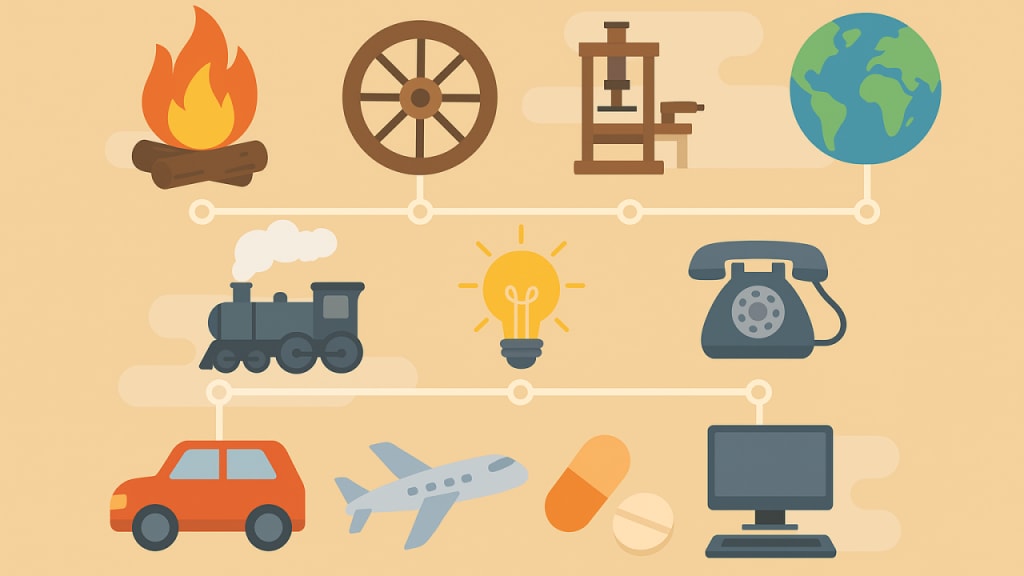
The history of technology is not merely a timeline of gadgets; it is the story of human survival, ambition, and the relentless desire to transcend our biological limits. Long before Homo sapiens dominated the globe, our ancestors possessed a latent potential to reshape the environment. This drive is what separates us from every other species on Earth. We do not just adapt to nature; we bend it to our will. As we stand on the brink of new frontiers like AI and space colonization, it is vital to look back at the fundamental pillars that supported our ascent.
The Spark of Civilization: Fire and the Wheel
The journey began with Fire. Controlled fire was the first "biotechnology." It did more than provide warmth; it effectively "pre-digested" food, allowing our ancestors to spend less energy on digestion and more on brain development. Fire was the original social hub, the campfire where language and culture were forged in the flickering shadows.
Millennia later, around 3500 BCE, came the Wheel. Often cited as the ultimate simple machine, the wheel’s true genius lay in the "axle-and-wheel" system. This invention didn't just move carts; it became the mechanical soul of pulleys, waterwheels, and gears. It was the moment humanity moved from being a nomadic, burden-carrying species to a logistical powerhouse, capable of building monuments and trading across vast distances.
The Renaissance of Knowledge: The Printing Press
For centuries, knowledge was a luxury held by the elite. In the 15th century, Johannes Gutenberg changed that forever with the Printing Press. By automating the reproduction of text, Gutenberg triggered a "knowledge explosion." It was the medieval equivalent of the internet; ideas could no longer be silenced by destroying a single manuscript. This invention fueled the Reformation, the Renaissance, and the Scientific Revolution, creating the first truly educated middle class and laying the groundwork for modern democracy.
The Age of Iron and Steam
The 18th century witnessed a transition from muscle and horse-power to the raw strength of the Steam Engine. Perfected by James Watt, the steam engine was the heart of the Industrial Revolution. It decoupled human productivity from the limitations of nature—factories no longer had to be located next to rushing rivers. It gave birth to the locomotive and the steamship, effectively "shrinking" the planet for the first time.
The Electric Pulse and Global Connectivity
In the late 19th century, the world literally lit up. Through the foundational science of Michael Faraday and the commercial genius of Thomas Edison, Electricity and the Light Bulb turned night into day. This wasn't just a convenience; it extended the productive hours of humanity and powered the second industrial revolution.
Simultaneously, the Telephone, patented by Alexander Graham Bell, began to dissolve the barriers of distance. For the first time in history, a human voice could be heard hundreds of miles away instantly. This was followed by the Car (Karl Benz) and the Airplane (The Wright Brothers), which transformed the world into a global neighborhood where migration and trade could happen at speeds previously unimaginable.
Biology and Bits: Penicillin and the Computer
As we entered the 20th century, the focus shifted toward the internal and the invisible. Alexander Fleming’s accidental discovery of Penicillin in 1928 marked the beginning of the antibiotic era. Before this, a simple scratch or a minor infection could be a death sentence. Penicillin doubled the average human lifespan, allowing our species to focus on intellectual growth rather than mere survival.
That intellectual growth manifested in the Computer. While the vision started with Charles Babbage, it was the mid-20th-century pioneers who turned vacuum tubes and silicon into thinking machines. Computers revolutionized our ability to process complex data, leading us from the calculation of ballistic trajectories to the exploration of the stars and the mapping of the human genome.
The Global Brain: The Internet
Finally, we reached the ultimate milestone: the Internet. Developed by visionaries like Vint Cerf, Bob Kahn, and Tim Berners-Lee, the World Wide Web created a "global brain." Today, nearly the entire sum of human knowledge is available in the palm of our hands. The Internet didn't just change how we buy things or talk to friends; it reshaped the very fabric of our digital society, enabling a level of global collaboration that would have seemed like magic to Gutenberg or Watt.
Conclusion: The Continuous Chain
Looking back at these inventions, a clear pattern emerges: each breakthrough is a stepping stone. Fire led to metallurgy; metallurgy led to the steam engine; the steam engine led to the modern factory; and the factory led to the computer. We are part of a continuous chain of bold ideas and risky experiments.
What we consider "ordinary" today—the smartphone in your pocket, the medicine in your cabinet—was once an impossible dream. As we look toward the future, we must wonder: what is the next link in the chain?
💬 What do you think? Which of these inventions has had the biggest impact on your daily life? Is it the connectivity of the Internet, or perhaps the life-saving power of modern medicine? Let’s discuss how these milestones continue to shape our world!
About the Creator
Piotr Nowak
Pole in Italy ✈️ | AI | Crypto | Online Earning | Book writer | Every read supports my work on Vocal
Keep reading
More stories from Piotr Nowak and writers in Geeks and other communities.
IBM — A Company That Shaped Modern Technology
When looking at today’s technological landscape, dominated by agile startups and social media giants, it is easy to overlook the titan that laid the foundations of this world long before the Internet existed. IBM—International Business Machines—is more than just a company; it is an institution that has spent over a century redefining how humanity processes data. Its journey from the 1911 Computing-Tabulating-Recording Company to a modern AI and cloud powerhouse is, in many ways, the history of the modern world itself.
By Piotr Nowakabout 21 hours ago in Geeks
Not Just For Clean Up: A History Of The MCU's Department of Damage Control
Initially an organisation that seemed to exist to help the heroes of the Marvel Cinematic Universe, from Phase Four onwards, the Department of Damage Control has shifted into a more antagonistic role. Most recently seen in the Wonder Man series, the current incarnation of Damage Control seems to target superpowered individuals, regardless of whether that person poses an active or intentional threat.
By Kristy Anderson6 days ago in Geeks
Dracula Review: A Gothic Tale Reimagined for Modern Audiences
When Bram Stoker first penned Dracula in 1897, he created more than just a horror novel; he forged the template for vampire mythology that continues to captivate audiences over a century later. From films to television series, Dracula has been reimagined countless times, but the latest adaptation seeks to balance the original gothic charm with a modern sensibility. The result? A bold and intriguing rethinking of one of literature’s most iconic figures, but also a reminder of why the classic still holds its own. Plot Overview The latest iteration of Dracula comes from the creative minds behind Sherlock, Steven Moffat and Mark Gatiss. This version of the legendary vampire is structured around a three-part miniseries, each episode running an hour and a half. Set in 1897, the story follows the infamous Count Dracula (played by Claes Bang) as he plots to leave Transylvania and invade England. However, this time, the focus is not just on Dracula’s evil machinations but also on the female characters, particularly Sister Agatha (Dolly Wells), a resourceful nun who sets herself up as Dracula’s nemesis. The show begins with the well-known origin story of Dracula’s rise, with an intriguing twist. Dracula, a master of manipulation and seduction, is depicted as more than just a bloodsucker. He is a figure of intellect and strategic genius, using his supernatural powers not only for killing but also for self-preservation. Unlike many previous iterations, Moffat and Gatiss present him as both a force of pure evil and an embodiment of society’s fears and desires. Performance and Casting Claes Bang’s portrayal of Count Dracula is, without a doubt, one of the most compelling parts of this adaptation. He exudes charisma and menace with equal precision, imbuing Dracula with a complexity that pushes the character beyond the typical portrayal of a mere villain. His performance conveys a layered personality—a being both ancient and alluring, calculating and dangerously charming. However, the true standout in this series is Dolly Wells as Sister Agatha. What could have easily been a traditional ‘final girl’ role is instead given a much-needed update, with Agatha being both a formidable antagonist and a surprisingly complex character. The dynamic between her and Dracula provides some of the most interesting moments of the show, as the tension between good and evil is explored with nuance. Her wit, strength, and resolve make her an excellent foil to Dracula's unyielding malevolence. The rest of the supporting cast, including a range of characters in Dracula's path of destruction, holds their own but often fall short when compared to the central performances. Nonetheless, they serve to further the plot, providing Dracula with the means and obstacles he needs for his wicked schemes. Cinematic Visuals and Atmosphere One of the greatest strengths of Dracula lies in its visual aesthetic. The show embraces the gothic nature of the story, using intricate, atmospheric settings that heighten the tension and eeriness of the tale. From the dark, towering walls of Dracula’s Transylvanian castle to the Victorian mansions of London, every set is meticulously designed to evoke the mood of the original novel while enhancing the story’s modern twist. The show’s cinematography is rich with deep shadows and hauntingly beautiful shots that emphasize the themes of isolation, corruption, and the supernatural. A standout scene occurs in the first episode, where Dracula’s entrance into a new world is marked by a stormy, foreboding atmosphere, complete with creeping fog and the faint sound of organ music. These visuals help to immerse the viewer into the world of Dracula, reinforcing the timeless nature of his terrifying presence. Themes and Modern Twists While Moffat and Gatiss retain much of the original plot from Stoker’s novel, they infuse it with modern sensibilities, exploring themes like gender, power, and societal expectations. One of the most interesting aspects of the series is its approach to the character of Dracula, who is depicted not merely as a bloodthirsty monster but as a reflection of humanity’s darker impulses. The show cleverly examines how Dracula uses his powers not only to manipulate people but to expose the darker aspects of human nature. Furthermore, the role of women in the story is redefined. In previous adaptations, female characters often served as helpless victims, but here, they are imbued with agency and complexity. Agatha’s character is one of empowerment, and her resistance against Dracula is portrayed not as a mere battle of good versus evil, but as a confrontation of intellect, resilience, and willpower. The narrative also plays with the passage of time, reflecting on Dracula’s ability to adapt and survive throughout history. While the show sticks to its Victorian roots for much of the series, it takes some bold steps in reimagining the traditional narrative structure, keeping the audience on edge with unexpected developments and time-jumps that lead to both thrills and intrigue. Pacing and Structure While Dracula starts strong with an exciting and fast-paced first episode, the pacing slows down significantly in the second and third episodes. The middle episode tends to meander, losing some of the immediate tension established at the outset. The final episode also takes a rather ambitious narrative leap, which will leave some viewers either satisfied or perplexed by the unexpected twists. This structure may frustrate those expecting a more traditional, linear storytelling approach. Despite its somewhat uneven pacing, the miniseries remains an engaging and bold reinterpretation of the classic gothic tale. Moffat and Gatiss take risks, and though not all of them fully succeed, their vision is clear, fresh, and audacious in its attempt to modernize a centuries-old story. Final Thoughts Ultimately, the Dracula miniseries is a captivating reimagining that both honors and challenges the source material. With strong performances, particularly from Claes Bang and Dolly Wells, a gorgeous visual style, and thought-provoking themes, it offers a fresh perspective on an age-old story. While the pacing may falter at times, the show’s ambition and atmosphere make it an exhilarating ride for fans of both classic horror and modern reboots. This adaptation of Dracula is a thrilling exploration of power, fear, and human nature, cementing its place as a worthy entry in the long line of Dracula adaptations. For those willing to embrace a new take on an iconic character, this version is certainly worth the watch.
By Fiaz Ahmed 2 days ago in Geeks
Our Song
Evening has given way to night. Gently, I settle next to you on the comfortable, old love seat and reach for your hand. You snatch it away, again. It cuts me to the quick, but I hide the pain, understanding that the reaction is but part of your demented state. Since the accident, your presence here in our cozy home has been clouded by a haze I can't see. Nevertheless, I feel the frigidity of your expressions and it serves as an excruciating reminder of the immeasurable distance between us.
By Dana Crandell3 days ago in Fiction



Comments (1)
Nice